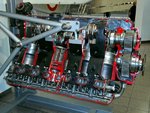
On a spitfire For example the location of the propellor is approximately in line with the cylinder heads so there is a housing/gearbox to take the drive from the bottom of the engine to the top. With the engine inverted the end of the crankshaft is approximately in line with the propellor. Im not saying that is a reason for using it inverted but its an effect.
On the Spitfire the Propeller is
not in line with the cylinder heads. The propeller shaft is in almost the same place as regards the crankshaft of either the DB series of engines or the Merlins.
Prop shaft placement was a result of the reduction gear type and design, it has nothing to do with the engine design. P-40Ds and later used Allisons with a different reduction design than the the P-40s up through the "C" model. it changed the prop shaft location by 6 inches. P-39s put the reduction gears 10 ft from the engine.
Radial engines used epicyclic reduction gears to keep the propshaft in line with the crankshaft as did some older V-12 engines. Some inverted aircooled V-12s even off set the propshaft to above the crankcase to allow for a gun to fire through the prop. THis did nothing for the frontal area of the engine though.

It was claimed the inverted engine gave a better view. the cylinders form a triangle with 60 degree angles. With an upright V-12 the widest part of the triangle is closest to the pilots eyes while with the inverted engine the widest part is further away. the view over the nose directly ahead isn't much different but the view downwards along the sides of the engine should be better on the inverted engine.
However, since cowlings don't follow the exact contours of the engine (oil tanks, coolant header tanks, cooling air for sparkplugs, engine mounts, starters, superchargers, etc) some of this theoretical advantage disappeared.