1941: the best airframe for a single engined fighter

Ad: This forum contains affiliate links to products on Amazon and eBay. More information in Terms and rules

All in - the 51 was faster on the deck at a higher gross weight, had a lower total drag, had lower induced drag and had lower parasite drag - i did the above calcs in a hurry but you are free to challenge and present your own from the two reports cited.

And this basically demonstrates what I meant by "aerodynamic efficiency". My definition is simply the comparison of horsepower generated to speed achieved. This measures the efficiency of the entire aircraft as system, including L/D, cooling efficiency, etc. and negates any fuel types or compressor operations. Since most aircraft has a SL hp and SL airspeed this is a common point. Just comparing the post '44 P-51B with other similar aircraft, the Spit MkXIV, Fw-190D-9 and the Bf-109K-4 we get the following:

P-51B hp/mph at SL 4.6, top speed 388 mph, hp 1788 (note: pre-May, '44 P-51B was 4.5, difference was probably just a variable in the aircrafts.)
Bf-109K-4 4.7, 376, 1800
Spit mk XIV 5.4, 389, 2130
Fw190D-9 5.44, 386, 2100

Note that the Bf-109K and the P-51B were very similar to each other but the P-51B is a much physically larger aircraft.

It is important to compare aircraft of similar speed since drag is a geometric progression and this distorts comparison between aircraft with significant difference of top speed.
 
@drgondog,


Exactly and this is why assessments done on the hp basis alone is misleading.
Now, the P51A's engine characteristic, from Shortround6's chart, looks more like Merlin 45 than V-1710-81 a standard engine for P51A and this combination certainly doesn't belong to '41 and comparison against 109F4.
Then, there's the matter of supercharger tuning and propeller, which differs for those two engines and particularly for 109, so again claiming superior drag performance based on different engine/propeller setup is also misleading.
This is why I said 109G-1 would be better comparison to P51A (with Merlin 45) from the chart.

...

If I may.
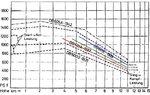
Since a picture says thousand words, I've clapped a 'chart' that covers the HP achieved by both P-51's Allisons, plus the Merlin 45. The lines for the Allisons are provided above the FTH, and for Merlin 45 for the comparable altitudes. All lines are without the ram effect, and I did not bothered to convert from BHP to PS, it would make no difference for the lines I've drawn. We can easily see that whatever the performance at altitude the V-1710-81 had over the -39, Merlin 45 was one step ahead. Of interest is that P-51A was faster than P-51 at 20-25000 ft for some 25-35 mph (add 12 mph if the P-51A is not equipped with wing racks), and it's was luck for the LW that it was not equipped with a single stage Merlin from day one.

The Merlin 45 was not the best Merlin available in 1941, being only the 3rd best available Merlin after mid 1942. Compared with those, contemporary V-1710s* were 3rd, or 4th tier, and if we count in the DB-601/605s, V-1710s* were really looking bad. And then we have the plane that, on 'bad' engine, makes some of the competition (boasting the 1st/2nd tier engines) eating it's dust. Perhaps that airplane had great airframe, waiting for the really good engine to become a great performer?

*talking about single-stage versions, found in the P-39/40/51

Bill, thanks for the D-9 reply.
 

Attachments

  • chart MER ALL 800.JPG
    chart MER ALL 800.JPG
    74.8 KB · Views: 149
Last edited:
@drgondog,
109G-1 - 700km/h - 7km/23k ft - ~1150 hp/AtA1.42
P51B - 679km/h - 7km/23k ft - ~1270 hp (high and low blower)
Now, what?

@tomo,
forget about Merlin.
My mistake since I didn't figure, that 51A flew with some hybrid Allison...normal -81 was rated at 1200hp/SL, according to manufacturer's table.
Funny detail; plane was specially washed prior to flight. Hardly a wartime maintenance standard.
and it's was luck for the LW that it was not equipped with a single stage Merlin from day one.
Ain't so.
Luftwaffe had top racers when they needed them.
They didn't bother to go over 700km/h until '43, since they didn't need it and they could hang heavy weapons, at expense of performance.
Most data you got for 109Fs and 109Gs are flown with AtA1.30 and it was '42/'43 (depending on model), when Allied 700+km/h fighters started to arrive in tactically significant numbers, when Luftwaffe lifted AtA1.42, limit.
 
Last edited:
amazing stuff guys, keep it up, Im sure some consensus will eventually emerge....or is this another sorenism
 
Now, what?

Ain't so.
Luftwaffe had top racers when they needed them.
They didn't bother to go over 700km/h until '43, since they didn't need it and they could hang heavy weapons, at expense of performance.
Most data you got for 109Fs and 109Gs are flown with AtA1.30 and it was '42/'43 (depending on model), when Allied 700+km/h fighters started to arrive in tactically significant numbers, when Luftwaffe lifted AtA1.42, limit.

Seems to be a bit of a disconnect here. See:

Kurfürst - Mtt. AG. Datenblatt, Me 109 G - 1. Ausführung

Speed at 7km is 660kph using 1230PS. not 700kph using 1150hp.

Which one is correct??

and no you don't get 1150hp at 7km using 1.42 AtA and also get 1230PS using only 1.3 AtA at 7km
 
@drgondog,
109G-1 - 700km/h - 7km/23k ft - ~1150 hp/AtA1.42
P51B - 679km/h - 7km/23k ft - ~1270 hp (high and low blower)
Now, what?

Maybe we should start over at Kurfurst's site where the entire report on the G-1 dated May 1942 is presentedKurfürst - Mtt. AG. Datenblatt, Me 109 G - 1. Ausführung

Then note that the Maximum speed is 660km/hr=410mph at 1230 hp and 22,435 feet -not the 700km/hr number you used then go back and look at the same P-51B report and note that the 51 is still cruising at 403mph/815hp at 38,000 feet

Here is a test performed in July 1942 on the F-4 in which the Test team noticed that the prior november 1941 tests were overstated due to not factoring in compressibility - not a big deal ~3km/hr

Kurfürst - Mtt. AG. Datenblatt, Me 109 G - 1. Ausführung


Now what?

QUOTE]

Bottom line is that the G-1 in the report dated May 1942 States 535Km/hr at SL w/1270Hp at 2700 rpm and 1.3 ata and 660km/hr at 7000 m... not the 700km/hr you pulled up. It closely agrees the F4 tested with 100 less hp at SL

I am not sure what you are about.

The speed number and altititude you picked from the chat for the P-51B- was the Critical altitude for low blower at 23,200 feet - and at the same Hp at critical high blower altitude of 29,600 (6,000 feet higher) the speed was 441mph.. and the G-1 speed value 0f 700km/hr at 23,600 is bogus. What were you trying to accomplish?

Find 109G SL data from Kurfurst site for say the 605A and then run your own numbers, present them and draw your own conclusions.

You write a decent game but so far you are letting everybody else do the work.

if you want to get to pretty good Drag calcs, stick to SL speed data with verified Hp. When you goose around at >20K for the fast WWII fighters you are well into compressibility - which as the May 1942 LW notes observe. What say you start manuevering into delivering facts and then extrapolating from there?
 
Last edited:
Ok but then, how do you explain, Mustang Mk.I being 30mph slower with similar power rating like P51A on the deck?
While at that, can you explain what does "the most aerodynamically efficient airframe of any major propeller fighter of WW2", exactly mean?

I do not understand where you got your information. I looked at every P-51 test that had the P-51 using 1150 hp on the Williams site and this is what I got
1. North American (NA) test Apr 24, 1940, SL Speed 316 mph. This was an estimate prior to the development of the P-51 with no engine or power base. The Allison engine on the P-40 at that time was generating 1050 hp, most likely the number used in this estimate and not a valid comparison.
2. NA estimate of the A-36 May '42, SL speed 345 mph at 1324 hp. Estmate speed at 1150 325 mph. Since bombs were estimated aircraft would be estimated with racks. If so 335 mph would be an estimate clean. A-36 is much slower than an equivalently powered P-51 and should not be included in estimate.
3. P-51 #41-37320 with -39 engine. Test June, '42 Speed at 5k ft, 363 mph, calculated at SL 340 mph.
4. P-51 test Dec. '42. Average of three test aircraft, 343 mph at 5k ft. Calculated at SL, 328 mph.
5. P-51A #43-6007 test Apr '43. 5k ft. alt. speed at 1150 hp, 358 mph. Calculated at SL, 343 mph
6. P-51 #41-37320 test Jul '43. 4.3k ft. alt. speed at 352 mph. Calculated at 352 at SL. Deleted as high value.
7. P-51 #41-37320 Sep '43. 13k ft. alt. airspeed at 395 mph. Calculated at SL, 345.
8. Mustang I, Apr '42. 9k alt. airspeed at 350 mph. Calculated at SL, 320. However, boost is low at 42" verses approved 44", so will not include in comparison.
9. Mustang I, Feb.43. 1k ft. alt. airspeed at 328. Calculated at 325 mph.

So, deleting 1. for estimate prior to build and probably wrong engine, 2. because A-36 has a different configuration to P-51, 6. because of highest value, and 8. for lowest values, which should have been eliminated anyway in that it did not generate require hp due to lower boost, I get the average of 336 mph. I doubt this is acceptable to you, but it is a rational way to exam data (flight control use a similar algorithm).
 
Good work Mr Cola, good work.
So if i understood
drgondog s calculations are using wrong speed (363mph) ,and even this is achieved by a sanded machine with 4 o.50 HMGs, not cannons. What he is trying to accomplish? Also that 51B was 403mph at 38000 ft has to do with the 2 stage supercharger ,not the airframe
Mr davparir can not give tne SL speed but calculates it.But his results look more realistic
All 109s values are on 1,3 Ata. Correct? And had semi retractable tail wheel and no full covered main wheels. And if german factories could achieve good quality construction( similar to the american s) up to 12 km/h could be added according to german documents,at Kurfust site
It seems afterall that Sl speed advantage of early 51s is not that great.
'Airframes that fly good straight, usually suck in turn and the other way around'.( by Cola)
Excellent statement , not confronted yet . Applyies well to P51.

PS Someone should protect Mr Soren from insults. He is not allowed to defend himself.
 
109G-1 - 700km/h - 7km/23k ft - ~1150 hp/AtA1.42
P51B - 679km/h - 7km/23k ft - ~1270 hp (high and low blower)
Now, what?

Maybe we should start over at Kurfurst's site where the entire report on the G-1 dated May 1942 is presentedKurfürst - Mtt. AG. Datenblatt, Me 109 G - 1. Ausführung
The speed number and altititude you picked from the chat for the P-51B- was the Critical altitude for low blower at 23,200 feet - and at the same Hp at critical high blower altitude of 29,600 (6,000 feet higher) the speed was 441mph.. and the G-1 speed value 0f 700km/hr at 23,600 is bogus. What were you trying to accomplish?

Hi drgondog,
I don't know if Cola just wanted to illustrate a point, that if you pick the lower and upper ends of test reports depending on your case you can come up with pretty skewed results. The 700 km/h figure is from the original source though and it stands out from other test reports of that type. One can speculate as to why. From what I read from the chart it is maybe with 1.42 ata (Hoechstleistung is a rather broad term), maybe not corrected for compressibility, but that would be pure speculation and I wouldn't resort to that. It is certainly not the speed flown by a typical G-1 in field conditions, I think everyone will agree on that.

It is an interesting discussion here, I hope that everyone is not just cherry-picking his data to prove his pet is the furriest, though.:rolleyes:
 
Last edited:
I think the 109 figures are starting to head for coulda/shoulda/woulda land. IF the Germasn had A, and done, B and Done C and........the 109 would equal the P51 in drag.

Are we arguing what could have been or what was?

And the P-51 was carrying a heavier payload of fuel, weapons and ammo so even if you get the drag of the 109 to equal the P-51 it still doesn't equal the efficiency of the airplane as a whole. Efficiency in this case being defined as power required to move a certain payload at a given speed. Or rephrased, hp needed to move 100pounds of payload at 325mph at sea level.
 
Last edited:
Davparl
i've some trouble with your 6. calculation
checking original the 4.3 speed is 369.5 mph
 
Last edited:
Good work Mr Cola, good work.
So if i understood

http://www.wwiiaircraftperformance.org/mustang/p-51-37320-test.pdf

Jim - read the report Jim. I took off the wrong altitude but I will correct and re-calculate drag at 5000 feet to get the correct CDo.

drgondog s calculations are using wrong speed (363mph) ,and even this is achieved by a sanded machine with 4 o.50 HMGs, not cannons. What he is trying to accomplish?

If you read the report Jim you will deduce that the the aircraft in the June 1942 flight test is tested in both 2 20mm and 4 20mm configuration, one at 8114# GW and one at 8824# GW. This was one of the very first P-51 Production machines accepted by USAAF. Brand new paint - no polish, no removal of guns, no covering of gunports, etc. Yet you and Cola imply that I took data from the polished P-51A-1 tested. Ask yourself what I was trying to accomplish once more? What would you be trying to accomplish?

Also that 51B was 403mph at 38000 ft has to do with the 2 stage supercharger ,not the airframe

I was making a point that Cola picked the very point when low blower peaked out and high blower, to compare against the 109G-1 at peak performance of the DB605A, and illustrated the point to show that the 51B was still significantly faster as the high blower kicked in and stabilized

Mr davparir can not give tne SL speed but calculates it.But his results look more realistic
All 109s values are on 1,3 Ata. Correct? And had semi retractable tail wheel and no full covered main wheels. And if german factories could achieve good quality construction( similar to the american s) up to 12 km/h could be added according to german documents,at Kurfust site
It seems afterall that Sl speed advantage of early 51s is not that great.

Jim, you seem to have missed the point. I will reiterate what my point was. It was to examine Drag - not speed. Increased speed by greater margin is available to the airframe with the least drag total drag.
The 109 overcame its higher drag by increasing the Hp dramatically. Nobody has claimed that the 109 was slow or even much slower than the P51 eqipped with the superior (to Allison) Merlin.

Construction and configuration are very important factors for Parasite drag. Comparing a 109 in part retraction or completely extended (like G-2 and above) is like comparing the P-51 with bomb/fuel tank racks or a 109G with underwing stores. Yes? The standard (removable) racks on a Mustang contributed so much drag that they reduced the airframe top speed by 20km/12 mph.. so? That was a design feature both powers chose for the Mission.


'Airframes that fly good straight, usually suck in turn and the other way around'.( by Cola)
Excellent statement , not confronted yet . Applyies well to P51.

Jim - would you say that the turning ability of a Mustang sucks when engaging a 109 at high speed and high altitude? It wasn't. Further, there are quite a few a/c that contradict your (and Cola's) agreement. The F8F is the only piston engine on the planet that compete's (successfully) with the Mustang in the most unlimited of test arena's - the Reno races - in the context of pure aerodynamics at the limit of power to drive them. Would you say (or the clever Mr Cola) that the turning ability of the F8F 'sucks', or a P-38 with boosted ailerons, or a Spitfire IX/XIV or a Tempest, or an F4U?

Turning ability is a function of WL, CL max, Energy retention to offset vortex drag losses, roll rate to get into and change turn rate, power available at CLmax. The CLmax of the 109 was superior with slats fully deployed and when the pilot was skillful enough to maintain the maximum turn capability. Absent those conditions the Mustang was a very dangerous adversary despite a lower CLmax because it was able to compensate in those other areas. The Mustang was slightly inferior to the 109 in turn at medium to low speeds - that hardly constitutes 'sucks'.

The more important point is that the Mustang could more or less engage or disengage at will depending on the tactical situation.


PS Someone should protect Mr Soren from insults. He is not allowed to defend himself.

Protect yourself, I can handle myself from your insults.

Regards,

Bill
 
@drgondog,
you're probably right, but...
I say probably, because I calculated with overall pressure (dynamic + static) for 700km/h @7km as ~0.52 kg/cm^2, which is negligible, according to this chart.
Also Rechlin flight test, lists DB605A's power as 1355 hp, at 5.7km, which corresponds with my calculations.
However, it's still unclear where is that pressure measured and which pressure line corresponds with what speed and calculated values from Datasheets you linked, may be correct indeed.

A few more points, though...
First, I've noticed you substitute wing area in drag formula and you can't do that if you wanna calculate absolute drag or comparable drag coefficients, for different aircraft.
The reason is that wing area value disregards fuselage component of drag and you can have differently aspected wings within same area, both of which produce misleading results.
Second, there are two main propeller parameters, exit velocity and the air mass.
Since, propeller's thrust equals air mass times exit velocity, you end up with two types - fast (smaller mass over faster speed) and slow (larger mass over slower speed).
So, you can have equal nominal thrust, but different net thrust lapse over the speed curve and "fast" type can yield more net thrust on the right hand part of the envelope, producing faster plane.
I didn't have time to examine all propellers involved, but I hope I will, if I get the time.

Now as for the top speeds, they're not bogus, but flown at E-stelle in Rechlin.
Here's the AtA1.3 (which we know for sure), flight record for 109G-1 and I already linked AtA1.42, one.
Derived graph
109G-2, a model without pressurized cockpit, flew 666km/h at AtA1.30, so it's a fair guess it surpassed 700km/h at AtA1.42 and not marginally.

To conclude.
Calculated power for Kurfurst's datasheets, still remains open though and I'd appreciate any input toward solving that question, although I suspect them being correct.
(would be helpful if someone could translate this chart's text only, but in the context)

Cheers
 
Hi drgondog,
I don't know if Cola just wanted to illustrate a point, that if you pick the lower and upper ends of test reports depending on your case you can come up with pretty skewed results. The 700 km/h figure is from the original source though and it stands out from other test reports of that type. One can speculate as to why. From what I read from the chart it is maybe with 1.42 ata (Hoechstleistung is a rather broad term), maybe not corrected for compressibility, but that would be pure speculation and I wouldn't resort to that. It is certainly not the speed flown by a typical G-1 in field conditions, I think everyone will agree on that.

Hi Riacrato - The reason I pick SL for the calcs when I can find them is to strip multi stage supercharging questions out of the calculations, same with 5-6000 feet as all of these engine hp tables are from SL bench tests - thus lower 'probable' error in the Hp extracted for speed runs.

Second reason - virtually ALL test reports, with some exceptions, fail to correct for compressibility and the compressibility characteristics are Not the same for all Airfoil or even wing/body differences between the airframe.

Third reason - there are more samples usually to compare at SL for the different airframes - and no two aircraft of same engine/same airframe perform exactly the same - so some scattering has to be expected.


It is an interesting discussion here, I hope that everyone is not just cherry-picking his data to prove his pet is the furriest, though.:rolleyes:


Last but not least. None of the discussions regarding speed at any altitude are especially meaningful UNLESS the following data is clearly presented in the report;

1. Calibrated airspeed, corrected for Mach No compressibility effects.. not terribly significant on the deck but extremely important as airspeed at altitudes are presented.
2. Gross weight of the tests - mandatory to calculate Induced Drag which is mandatory to calculate parasite drag from the free body equation at equilibrium Thrust = Total Drag = Parasite + Vortex (incl compressibility) + Induced + Wave Drags
3. Horsepower - the most questionable of the Test assumptions, but necessary for Thrust assumptions
4. Special conditions (like 400 grit sandpaper on P-51A tests which I did not use) or 20mm cannon barrels versus 50 caliber recessed in wing). The P-51 four cannon configuration is a Significant drag feature over four recessed 50 cal, ditto underwing gondolas, ditto external bomb racks - all contributing significant increases over base airframe.
5. Notes in the report about balky carburation or engine performance.


I missed the 5K vs SL data point but have recalculated and will put up the revised P-51 w/-39 Allison. Two points: the difference did increase flat plate drag (which I should have picked up immediately) from 3.5 to 4.06 sq ft. And two, the Parasite and induced drag of the 51 is Still (both) lower than the Me 109F4 as Uncorrected data presents AND the 51 in that report is excessively draggy over 4 gun 50 config but I did use the two 20mm cannon config at the lower gross weight of 8100..
 
Something on the German Charts is that there may (or may not, I don't read German) be a difference between the power chart supplied by the engine maker and the power as installed and used in the Airplane. British and American engine makers supplied power charts without ram effect being figured in and let the airframe manufactures or government figure out the actual power at height using ram.

The difference is evident in many of the Charts on the Spitfire performance site where the "full throttle" height of an airplane does not correspond with the full throttle height given in any charts/specification by the engine makes and that full throttle height in level flight is 2-4000ft higher than the full throttle height in a climb.

A Spitfire I will be able to have a higher full throttle altitude in level flight than a MK I Hurricane because the extra speed allows the RAM effect to maintain the needed inlet pressure that much higher.

At sea level ram is not particularly important because the superchargers can supply more air than the engine can use and the engine are throttled back. at 6-8000 meters ram in level flight can allow either a full throttle height 2-4000ft higher or, in effect shift that sloping line upwards (or to the right) by 50-150hp (or by the altitude difference).

Please note on teh German charts that the points noted as 1.42 or 1.30 at 5-6000meters are the highest points at which that pressure is maintained and as the plane/engine climbs higher and that power line declines the engine is no longer running at 1.42 or 1.30 AtA. Using Ram would account for the 109 having more power at 7000 meters than the engine chart says.
 
@drgondog,
you're probably right, but...
I say probably, because I calculated with overall pressure (dynamic + static) for 700km/h @7km as ~0.52 kg/cm^2, which is negligible, according to this chart.
Also Rechlin flight test, lists DB605A's power as 1355 hp, at 5.7km, which corresponds with my calculations.

The discussion necessarily is focused on Drag. The reason I don't fool around with high speed/high altitude data as much as SL is that I KNOW there is a significant delta due to compressibility - which results in a higher parasite drag total for that particular aircraft (109K, P-51B/D/H, FW 190D9, P-47D/N, etc) than indicated for incompressible flow. In addition Power available for the max speed run is always questionable as only manufacturer tables for a mid range performing new engine is available.

When I did the calcs on a 700K/hr with the Hp you presnted in the zuegeister report - the parasite drag was way off for the derived thrust - for any version of a 109 for any report I have ever seen - and no explanation regarding reducing flight data for compressibility - hence my strong remarks about dragging a red herring into the discussion. having said that I boneheaded the Max V pickoff for the P-51 for -39 Allison at 5K instead of the SL I quoted.

The revised Cdtotal @5K = .01727, the CL =.0143, the Cdi=.00094 and calculated Cdparasite= .01633 which is very close to published P-51 Parasite drag for incompressible flow. The Mach number at 363 for 5 K at STP = 363/33.42*Sqrt(500.2) + ~.48M so it is just short of entering compressible flow..


However, it's still unclear where is that pressure measured and which pressure line corresponds with what speed and calculated values from Datasheets you linked, may be correct indeed.

A few more points, though...
First, I've noticed you substitute wing area in drag formula and you can't do that if you wanna calculate absolute drag or comparable drag coefficients, for different aircraft.


Of course I can 'do that' just as I set aside a wetted drag result to provide context. As to context, every flat plate drag calculation is expressed as a function of wing area as a first cut - simply because drag on a wing is such a high percentage of parasite drag - independent on induced drag or high AoA Vortex drag. Ditto for succeeding calcs on friction, gaps, protrusions, exhaust stacks, cannon barrels becaue that aero wanted to get all the duckies in one frame of reference - and wing area is THE common frame of reference. For what it is worth I gave the 109F-4 the benefit of the doubt and used Hoerner's figures for his text book example on a 109 - even though I penalized the 51 by using .85 for e and applied it to the AR for the CDi calc. Hoerner reduced his AR by only 5% instead of 15% like my 51 calc (and e=.85 is the standard for Preliminary design until the designer intruduces something funky like winlets)

The reason is that wing area value disregards fuselage component of drag and you can have differently aspected wings within same area, both of which produce misleading results.

I agree subject to the above. For these two birds the wing efficiency, per se is reasonably close as the induced drag increment due to rounded tip versus the 51 tip/chord ratio sets up a reasonaly close spanwise lift distribution, the aspect ratios are close. The 51 has a slight delta due to washout, the 109 has some issues due to wheel wells - not to mention the drag buckets otherwise called radiators.., slats and aileron gaps that the 51 does not have

Second, there are two main propeller parameters, exit velocity and the air mass.
Since, propeller's thrust equals air mass times exit velocity, you end up with two types - fast (smaller mass over faster speed) and slow (larger mass over slower speed).
So, you can have equal nominal thrust, but different net thrust lapse over the speed curve and "fast" type can yield more net thrust on the right hand part of the envelope, producing faster plane.
I didn't have time to examine all propellers involved, but I hope I will, if I get the time.

Have at it. You can play with variables to arrive at eta for Thrust calcs all day long, playing with RPM, tip Dia, airspeed (particularly at >.5M for tip transonic potential effects) if you want to build a sophisticated model - then find your model doesnts agree with enough flight test results. If you dare to slip into Low speed/High Power/High CL calcs for Prop efficiency you are deep into a world of non linear foolishness because you will need a very sophisticated Navier Stokes model with varying meshes to remotely Attempt to extract vortex drag, asymmetrical influences and deep into combined laminar/turbulent flow regions (that alter) so you may want to flip in a little chaos theory for Boundary layer assumptions.

Or you could stick with the generally accepted preliminary design equations and calc. I'll stick with the latter with full understanding regarding where and why they fart and fall down


Now as for the top speeds, they're not bogus, but flown at E-stelle in Rechlin.
Here's the AtA1.3 (which we know for sure), flight record for 109G-1 and I already linked AtA1.42, one.
Derived graph
109G-2, a model without pressurized cockpit, flew 666km/h at AtA1.30, so it's a fair guess it surpassed 700km/h at AtA1.42 and not marginally.

Once again - anything at .5-55M during WWII introduces noticable instrumentation errors and there is no mention of algorithms or even attempts to make TAS corrections, nor is there any reason to suspect wht the actual Power delivered happened to be, nor any prop efficiency or actual exhaust thrust measurements available to separate fact from opinion assumed from assumed facts or opinions extracted from places the sun doesn't shine. I don't care about boost - that isn't an aero variable, it isn't a prop efficiency variable, it is marginally an exhaust thrus variable if consistently tested and validated - only the 'real Hp' delivered is interesting because that is the basis for free body diagram to solve for gross Drag. Yes?

To conclude.
Calculated power for Kurfurst's datasheets, still remains open though and I'd appreciate any input toward solving that question, although I suspect them being correct.
(would be helpful if someone could translate this chart's text only, but in the context)

Cheers

I'm about done. Pick what you wish and leave the rest.
 
As an engineer I used to say: Tell me the result you want and I'll find the right calculation to present the proof....
cimmex
 

Users who are viewing this thread

Back