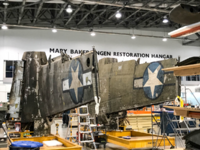
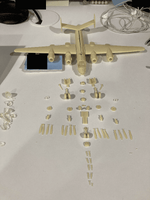
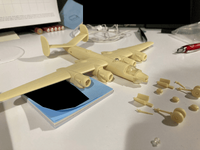
Hi everyone,
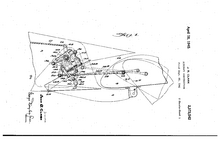
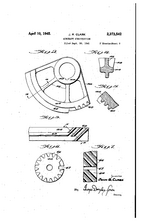
I've been working on this bird again for the last few days, after finding a set of higher resolution (mostly legible!) blueprints for the second to last version of this plane.
The Bad
There is a lot to fix, most noticeably the fact that the outer engines are around 4" inboard of where they're supposed to be and that the landing gear attachment points are in the wrong location. There are also countless smaller errors, some worth fixing, some not. I've been putting together a data sheet, much like with the B-26, documenting all the dimensions I can find (and read) and will post that sometime soon and update it when able.
The cause of a lot of the small errors is the fact that the commonly reported aircraft length of 79' 10" is
wrong. Or rather, it's correct for 3 versions of the plane, but not the final one. The final version of the plane measures
79' 8.875", having a shortened tail and a lengthened nose.
Because I started work on this model when I was 16 or 17 and barely understood aircraft design, I eyeballed most of the model based on the overall dimensions, sometimes rounding dimensions up or down to what I found a logical. I'm not entirely sure what steps I will take to fix the fuselage yet, but it will be tricky. It's a good thing I didn't start on the interior for the most part.
The Neutral
The aircraft's tires are the wrong diameter in my model, being slightly too large. This is most likely a result of the aforementioned wrongly scaled blueprints and subsequent rounding (as well as not being able to read the blueprints). This isn't a big issue as I was planning on remodeling the wheels entirely anyway, given that the tires look far too round and the wheel hubs look very wrong.
I'm not sure about my design for the landing gear doors, and am considering purchasing photographs of the prototype under construction from the Smithsonian, if they have any, and double-checking. It's my understanding that those can be sent digitally, which is very convenient for me as I'm still stuck outside the US for the time being (Though as far as I'm aware the archives are still closed). Given that I'm going to be rebuilding most of the engine nacelles, fixing the landing gear is now possible without affecting other components.
Thanks to the legible set of blueprints, I now know the airfoil for the main wing, or rather some details of it: NACA 65 series with 22% thickness at the root, 14% thickness at the theoretical tip. This enabled me to make a much more accurate airfoil, and combined with the other dimensions, a much more accurate wing. I won't be posting pictures of it yet because I have yet to cut the wingtips, flaps and ailerons. I'm still unsure as to how I'll accomplish the smooth blending of the wing into the engine nacelles, but am not in a rush to figure it out at the moment. I do not plan on significantly remodeling the stabilizers, not do I have the data to do so. They look very accurate, so at most I might squish and stretch them to match the proper dimensions.
The Good
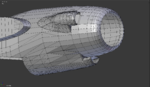
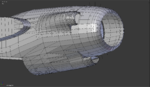
I've finally finished streamlining the forward nacelle and cowling, and I've cut out cowl flaps! I had no reference for these, so I based them off of the B-26's cowl flaps. They're not entirely accurate to the B-26, but I think they look good enough. The general arrangement drawing shows 3 sets of 4 cowl flaps, but the area between the two top intakes is large enough to accommodate 5 flaps. I went with 5 for now, but might change this later. I copied the movement range from the B-26 as well, so the flaps can move between -5 and +40 degrees. They are shown below in the 0 and 40 positions. I have yet to model proper hinges.
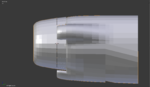
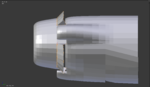
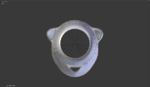
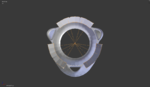
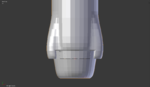
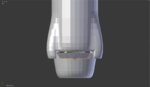
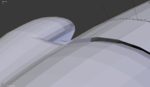
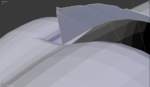
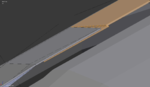

Using 5 flaps at the top results in greater interchangeability of parts (all 3 sets end up being identical save for an additional flap fitted in the middle of the top set), and in much cleaner and symmetrical streamlining of the top air intakes. However, both the blueprints and
the scale model used for wind tunnel testing seem to have 4 flaps in this section. Switching to 4 will require once again remodeling part of the air intakes, so I'm unsure if I will. I'm also not sure what internal equipment (if any) would prohibit the area near the intakes from being used for cowl flaps. Again, photographs might be useful in this area.
What's Next
I'm not sure yet, as there is a lot to do, and it's not clear what the next step should be. I might continue work on the nacelles, work on the landing gear, stabilizer or fuselage, or wait until I can get photographs.
Cheers,
-Matt