- light fighter discussion -
Light Fighters in general are a sort of dead-end. Even the best light fighter - the Zero - was entirely obsolete by 1942. Unfortunately, the great Colin Chapman's quote of "Simplify, then add lightness" very rarely applies to aircraft. The ideal weight range for a piston fighter seems to be in the 2,500 kg ~ 4,500 kg range, anything lower than 2,000 kg becomes a headache.
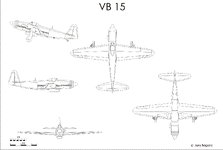
However the R.30 is an interesting case because it was based around the M.B.151's design (I believe the designer was a relative of the guy who designed the M.B.152). So although it's not a 1:1 comparison, we can glean some ideas on what the Bloch's could've been capable of in regards to multi-role and strike capabilities. I think a bomb layout of 3 x 250 kg bombs (one under each wing, one centrally) is reasonable for the 155 and 157. Maybe 2 x 500 kg bombs (one under each wing) for the 157 if I'm being generous.
One wonders were they got the ex circus midgets to act as ground crew in the Photo.
Something that's worth mentioning, and might have interesting repercussions regarding the size and weight of French designs, is that France is consistently on the
lower end of the average height chart from 1930 to 1940 regarding the major players in the war in this time period. 169 cm / 5'5" to 171 cm / 5'6", roughly equal with Italy and only slightly taller than Russia. You know who else had small aircraft designs in this time period? Italy and Russia.
Or it shows the genius of the French designer.
If I can be 100% honest for a moment, I do believe there's truth in this statement. Let me explain.
France has been a front-runner and pioneer in military equipment and theory for a long time, and to an extent they still are.
- The first smokeless powder cartridge made and adopted for military service was the 8 mm Lebel - a French round for a French weapon adopted by France.
- The French Canon de 75 modèle 1897 was one of the best artillery pieces from its introduction all the way until the early 30's, along with setting the template of what any and all future mobile artillery pieces would be. A version of it even ended up as the main gun for the M4 Sherman.
- A contender for the first assault rifle is the Ribeyrolles 1918, a very capable weapon that almost certainly would've been mass-produced had WW1 not ended.
- The Renault FT was the first mass-produced tank, was exported in various forms to over 30 countries world-wide, and also set the template for the configuration of almost all tanks including modern ones.
- A strong contender for best aircraft of WW1 is the SPAD S.XIII, a highly reliable and incredibly tough fighter whose only real competition is the better performing but less reliable Fokker D.VII.
- The French 7.5 mm MAS cartridge is an excellent round despite its small size, having ballistics comparable to modern 7.62 NATO. A marksman and competitive shooter acquaintance of mine called it the best round he's ever fired.
- The MAS-36 carbine was average in terms of accuracy (not a bad thing) but was immensely strong and reliable.
- The SOMUA S.35 was arguably the best tank in the world in 1940.
- France had one of the strongest navies in the world in 1940, only beneath US, Britain and Japan in that order, with the scuttling of the French Navy being a significant strategic blow to the Allies. Even in modern times, the French Navy is comfortably the second or third strongest navy in the world - behind US and tied with Britain.
- While the Maginot Line is often ridiculed for its perceived ineffectiveness, it's telling that Germany made the choice to trek through what many considered a militarily untraversable forest
just to avoid the defenses. Had they took the line head-on, it would've been a bloodbath.
There's many more examples I could give but we'd be here all day. France was -
and still is - a world leader in the military realm. The speed at which Germany took down France was a shock to the world, something absolutely nobody expected. They had the resources, industrial base, equipment, designers and engineers to compete with Germany, with a vast majority of military theorists world-wide at the time believing that WW2 would be extremely similar to the trench-based WW1. Germany just flipped the script, again in a way that nobody expected.
So while your skepticism and cynicism is entirely understandable, especially considering the bureaucratic mess that France was in from 1936~1940, I do think that you're not quite giving them the credit they deserve.