Hi again,
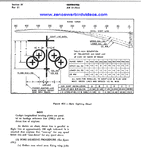
"If you look at the bore sighting chart for the type, you'll see that the machine guns were only half a meter apart and set to fire parallel, and that the guns were carfully harmonized to converge in the vertical plane to give the highest concentration of fire possible."
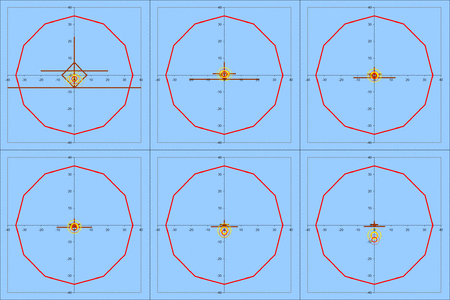
In order to illustrate this point, I used the above boresighting chart for the P-38 to create the attached animated GIF, showing the sight picture for a straight six, no deflection "boresight" attack (placing the centre of the crosshair right on the centre of the target) against a P-47-sized fighter.
Ranges start with 100 m and increase in 100 m steps to 1000 m maximum.
Thin-line circles are 100 % hit circle, fat-line circles are 75 % hit circle.
The 20 mm cannon is indicated in red, the 12.7 mm machine guns in yellow and orange.
Basically this is the same kind of diagram as I have posted above for the P-47 and the Me 109K, just in a more compact presentation.
It was still more complicated to assemble because instead of one pattern per (half) battery, the new diagram has one pattern per gun. Additionally, I found that the P-38 boresighting chart gives surprisingly flat trajectories for some unknown reason, perhaps because because it illustrates the situation at 30000 ft or something. For comparison purposes, I established sea-level trajectory data from speed-over-range diagrams for the 12.7 mm and 20 mm armour piercing ammunition, using 12.7 mm trajectory data provided by Tony Williams (from "Machine Guns" by Max Popenke and Tony Williams) to verify that my calculation is sound. (Tony's data: Flight time to 1200 m 2.04 s, my calculation: 2.00 s, Tony's data: mid-range trajectory +510 cm, my calculation: +491 cm).
Anyway, I think the resulting diagram illustrates the excellent qualities of the P-38 as a gunnery platform quite well!

Regards,
Henning (HoHun)