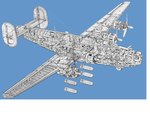
"Although overshadowed by the B-17 Flying Fortress, the Liberator had a number of virtues that made it a much more sought after bomber: It was fast (300 mph at 30,000 feet), capable of carrying 8000 LB of bombs, and had an operational range of approximately 2290 miles.
The prototype XB-24 flew in 12/39 and the first deliveries were made 1941 to the RAF. It's worth was soon realized when it served as a reconnaissance aircraft, submarine bomber, VIP transport, and ferried pilots and personnel across the North Atlantic. Heavily armed and possessing long range, the Mighty B-24 Liberator helped the Allies to take and maintain control of the vital sealanes.
Liberators dropped more than 635,000 tons of bombs on Europe, Africa. and the Pacific and shot down 4,189 enemy aircraft.
In combat the B-24 tended to burn more easily than the B-17, and when damaged, was inclined to break up during a wheels-up landing.
This was due to its very complex construction: In particular, the wing was relatively weak and in many cases, if hit in the crucial places, it gave away completely. Photographic records of WWII show B-24s plummeting from the sky with their two wings folded upwards like those of a butterfly."
MORE..
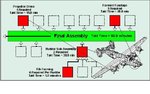
"First, break the plane's design into essential units and make a separate production layout for each unit. Next, build as many units as are required, then deliver each unit in its proper sequence to the assembly line to make one whole unit~ finished plane.
To house all this and provide for efficient operation there should be a new plant specially designed to accommodate the progressive layout. I saw no impossibility in such an idea even though mass production of anything approaching the size and complexity of a B-24 never had been attempted before.
But who would accept such a wild notion? And instead of one bomber a day by the prevailing method I saw the possibility of one B-24 an hour by mass production assembly lines. How could the aviation people take that estimate seriously?
As soon as I returned to my room at the Coronado Hotel, I began figuring how to adapt Ford assembly methods to airplane construction and turn out one four-engine bomber an hour."
NOTE THE FIRST PARAGRAPH!! "Next, build as many units as are required, then deliver each unit in its proper sequence to the assembly line to make one whole unit~ finished plane."
That meant all the sub assemblies were previously built somewhere else and it took TIME TO ASSEMBLE THEM - Sorrenson's breakthrough was sequencing them so final assembly could be done between 60 and 90 minutes - it still took several weeks to stage this!!!!!
And even then, because of the "Automotive Production Line" environment, there wasn't enough time to implement production changes so mod centers had to be set up to actually "finish" the bomber!
SO ASK YOURSELF - IS THE BOMBER REALLY COMPLETED IF IT HAS TO GO TO A MOD CENTER BECAUSE THE PRODUCTION LINE CAN'T SUPPORT ENGINEERING CHANGES!!!!!
"As might have been expected, the production pool system did cause lots of problems with standardization of components and equipment. Variants coming from the various members of the pool would often have significant detail differences from each other, leading to a spare parts and interchangeability nightmare. There were often significant differences between the various production blocks of the same model Liberator and sometimes differences even WITHIN a production block. Parts for Liberators built at different factories were often not interchangeable with each other, and all four factories involved in primary manufacturing produced Liberators of similar variants but of vastly different detail specification. Even the two Consolidated plants suffered from this problem.
With the introduction of the B-24J, all five members of the pool (both primary manufacturers and sub-assemblers) converted to the production of this version.
Since Liberator production rates were extremely high, it became difficult to introduce changes dictated by field experience onto the production line in a timely fashion. Consequently, newly-constructed Liberators were often already obsolescent as soon as they rolled off the line. For this reasons, a series of modification centers were established for the incorporation of these changes into new Liberators following their manufacture. There were seven known modification centers: Consolidated/Fort Worth, Oklahoma City Air Materiel Center, Tucson Modification Center, Birmingham Depot, Northwest Airlines Depot, Martin-Omaha, and Hawaiian Air Depot. "
To further this, here's a great shot of a B-24 wing - this wing was probably assembled in a jig, leading edge down with clamps and tooling holes keeping it in place. Long "planks" of skin was riveted to the ribs and with a corrugation sandwich between them - this is not an operation where a 50 foot structure that could take one day to complete - even if you throw 20 men on the assembly, they would just wind up getting in each others way....
Photo from Kalibab Journal
I could tell you that this methodology was the same for the P-3 wing something I am very familiar with. The only difference is instead of using corrugated aluminum, milled 7075 aluminum planks were riveted to the ribs - this was very time consuming and at best time it would take about 2 weeks to complete a set of P-3 wings which were about the same size of a B-24 wing (99 feet as opposed to 110).
I haven't even gotten into the other sub assemblies like the flight station, tailplane and fuel cell installation.....
You tell me if you think this aircraft could be built in a hour from first rivet to final assembly?!?!?
AND HERE'S MORE CONCERNING OTHER PROBLEMS IN SAN DIEGO....
"The nearer a B-24 came to its final assembly the fewer principles of mass production there were as we at Ford had developed and applied over the years. Here was a custom-made plane, put together as a tailor would cut and fit a suit of clothes.
The B-24's final assembly was made out of doors under the bright California sun and on a structural steel fixture.
The heat and temperature changes so distorted this fixture that it was impossible to turn out two planes alike without further adjustment. The Consolidated and the Air Force people talked about an order from Ford Motor Company for center and outer wing sections; but it was obvious that if the wing sections had uniform measurements, the way we made parts for automobiles, they would not fit properly under out-of-doors assembly conditions."