OK, so since everyone is going straight to the nitpicking I'll take that as a "no" on any really big changes in trade patterns.
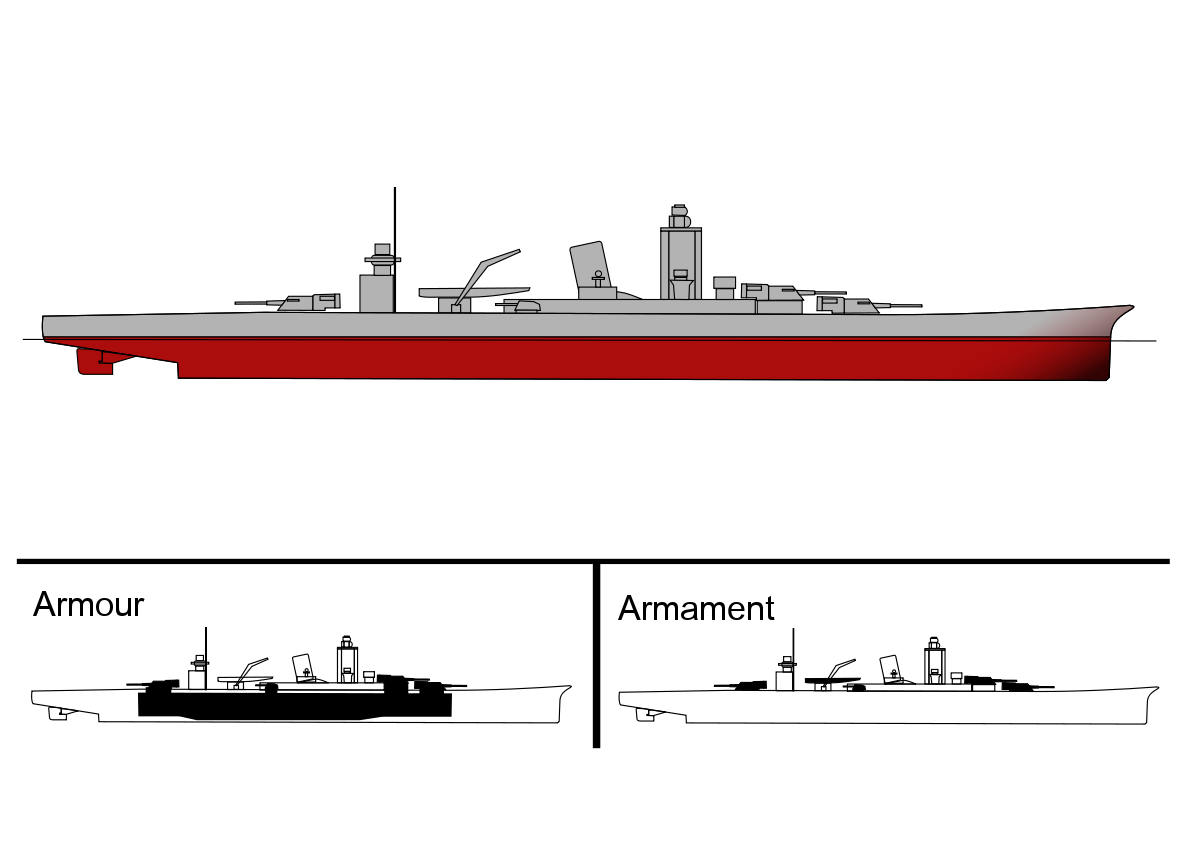
So how do you define "big gun ships"?
Battleships and cruisers as you have done.
How do you deal with the Tirpitz in a potential action without the KGVs, construction of which started in 1937?
Periodically bombing her and using older BBs for convoy escort - they just have to drive her away, not catch her. If the weather is too bad for aircraft carriers it is too bad for ranges >20k yards to matter so who cares about the elevation? And frankly looking at the relative size of merchant losses to U-boats, aircraft and merchant raiders vs BBs and cruisers, yeah I'm willing to take one or two more PQ17s (a few hundred thousand tons in loss out of the >11 million for the war). But of course the actual losses to PQ17 were to U-boats and aircraft, and having better tanks and say cleaning the Italians and Afrika Corps out of North Africa early means all those resources that went into protecting the Malta convoys could be moved to the Arctic (let alone my daydream of actually not losing in France 1940).
More generally if you think the historical build of "big gun ships" was the best use of resources at the time, I don't think either of us is going to convince the other.
Lets define "light bombers" shall we.
I want more Spitfires and Hurricanes and fewer Battles and anything else that gets in their way (Merlin-engined Whitleys?). I don't accept that with four years' warning you can't tweak the production lines to have a bit more of one Merlin subtype and (smaller) aircraft and less of another. (I also want a Mercury-engined Whirlwind-style fighter-bomber instead of the Blenheim, and to start making the Bristol 133 as well as the Gladiator, but that is more a Williams '34 POD than '36.)
Yes I know you want more Battles for training and various auxiliary roles, fill them with something that doesn't use your best engines and stressed-skin constuction.
I really, really, really wish that everybody would just give up on the 13-pdr 6cwt horse artillery gun as a stepping stone to anything after WW I. They only built 416 of them before/during the war and only 114 were still in service at the end of WW I. It was not a very close match to the French 75. The 13pdr fired a 12.5 projectile, the French 75 fired a 16lb Shrapnel projectile just a little bit slower. When they started loading in better HE shells post war that around 14.6lbs the lighter weight helped with the increase in velocity along with the better powder and higher pressure.
I was going off the Wiki figures for the 12.5 lb HE shell. But OK say it's a little weaker than the 75. I still think it is a more useful all round tank gun than the 2-pdr even loaded to WW1 levels let alone uploaded. If there aren't enough left to actually use a significant number of parts or ammo it's still a good starting point to indulge the British predilection for reusing old cartridge cases, use 3" machinery the British have lots of, and illustrate the minimum dual (triple?) purpose gun size to fit in the smallest possible tank and turret ring. I have nothing against the 75 but if we're starting early we don't have all that free American ammo. Or the necked down 18-pdr (13-pdr 9 cwt) but it's maybe a big bigger than absolutely essential in 1940 and I want to fit this thing in a 3-man turret (within the British loading gauge?) and as much ammo as possible in the hull. (Might be good as a Zis-3 type gun instead of the 6-pdr though?)
Fix all the stuff that was wrong with the 2pdr before installing fancy/short 6pdr guns or short 75mm guns.
Why? It's 1936, you're not locked into the 2pdr as a tank gun yet (except on the A9/A10), and installing a bigger gun will actually help force to fix some of the issues (shoulder elevation, no HE, small turret rings) and not make the others any harder (crappy sights & shells).
you don't get 1 15 ton tank for 2 6 ton tanks and you need many (not all) of the light tanks for scouting, over seas use, and training.
Every body keeps blaming the light tanks when the true culprit of the shortage to British cruiser tanks in 1940-41 was the Covenanter, 2000 20 ton tanks that could not be used overseas.
Not sure about that, the Sherman appears to be twice or more the mass of the Stuart and typically cost less than twice as much (just from Wiki). But if so that makes my point even stronger - we need more resources into tank production and less of something else. (I'm tempted to say heavy AA as well.)
By all means ditch the Covenanter (and both Matildas) for I guess some Valentines and Cruiser III/IVs with slightly bigger turret rings (based on the great data above I'm looking to increase the turret ring about 4" from Valentine to Churchill size), less side armour for the Valentines to at least maintain speed, and less speed and more armour for the cruisers - I guess I am aiming for something close to the Centaur/Cavalier but with 340 instead of 410 hp and maybe Horstmann instead of Christie, better sloped armour of course). But the 1000 light tanks is referring to the outbreak of war so won't pay off until a bit later.
I would also upgrade the Vickers Lights a bit to say a French 25mm or 2-pdr pom-pom (manually loaded) - there were some export models to Belgium and Latvia that did the latter. (I don't mean you could swap them on existing tanks but less change to the production lines than tooling up for an entirely new model).
Requires a lot faith to start tooling up in 1939

Compared to tooling up for the Hercules (or the Sabre, or the Vulture)? At least the R-2600 has crossed the Pacific and Atlantic by that time
We can tell that Tony is far more of a
gun guy than an
aircraft guy when reading that book

His aircraft timelines are a little optimistic, sure.
Doubling down with that fashion - opting from 47mm to 40 mm - was a thing for the gallows.
I don't know. The 40mm was a much better hole puncher and I'm unconvinced even 3-pdr manually loaded HE is that much better than a coax against an AT gun or whatever.
OK, WHICH R-2600 do the British license/invest in tooling for?
I'm also happy with the 1600hp first version to prove the concept, then if that works produce the 1700hp later on in parallel (like was done with different types of Merlin). There were multiple
factories that eventually produced the Hercules so it's more/less not either/or.
Now the Question is if anybody in Britain except Bristol and RR can even make an R-2600?
Well all the shadow factories that made Hercules (and Merlins though I don't want to lose those). Presumably Wright can tell them what to do just as well. (Actually Wright had a lot of problems but IIRC the outsourced factories in the US actually worked better than the parent company.)
Of course this depends on the R-2600 actually having a significantly lower production cost than the Hercules. I'm relying on the various cost sheets someone put up a while ago (indirect comparison - Hercules vs Merlin in the UK and then Merlin vs R-2600 in US). But then in Calum Douglas' book the Germans estimated they took similar man hours and the BMW 801 a lot more. Maybe Bristol was just forcing the Air Ministry to amortise the horrendous development costs? Set up one factory to produce the 1600hp version first and see what happens.