loftonhenderson
Airman
- 18
- Sep 3, 2023
Bristol/Fedden brute forced their way into making the sleeve valve work, and succeeded, but lost a lot of time in the process. The general conceit of this timeline is "what if the man-hours and resources poured into making sleeve valves work instead was directed at S/C efficiency, fuel injection (successfully developed from the Draco), and twin-row radial cooling," and "imagine Hooker chooses to join a more successful Bristol instead of RR."
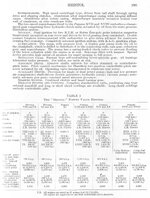
I'd like help creating a plausible development arc for a twin-row 14-cyl Mercury. Using the Mercury XV as a base (source attached):
Mercury XV / 1937
5.75 x 6.5 bore and stroke
24.9 L
51.5" diameter
1065 lb
1-stage 1-speed S/C
840 hp (WEP) @ 2750 rpm @ 14,000 ft / 87 oct
995 hp (WEP) @ 2750 rpm @ 9,250 ft / 100 oct (+18% hp increase)
Using historical benchmarks, adding fuel injection should add 7-12% max hp. That's -> 1095 hp (WEP) @ ~10,000 ft with FI / 100 oct (I'm not sure why the 100 oct rated alts are less than the 87 oct, if anyone knows please share)
Just using proportional math, a 14-cyl Mercury should be:
"Andromeda" V / 1940
5.75 x 6.5 bore and stroke
38.7 L
51.5" diameter
~1650 lb (1065 lb on Mercury / 9-cyl = 118 lb * 14 = 1656 lb)
1-stage 1-speed S/C
~1700 hp (WEP) @ 2750 rpm @ ~10,000 ft with FI / 100 oct (1095 hp on FI Mercury / 9-cyl = 121.7 * 14-cyl = 1703 hp)
That's ~120 hp/cyl vs ~113 for Herc XI (1941, 1590 hp / 100 oct)
1700 hp doesn't account for losses from the twin-row design, and is clearly over optimistic. And ~1650 lb doesn't account for the fuel injection system.
From what I've read elsewhere on a twin-row Merc:
For power estimates from others:
I'd like help creating a plausible development arc for a twin-row 14-cyl Mercury. Using the Mercury XV as a base (source attached):
Mercury XV / 1937
5.75 x 6.5 bore and stroke
24.9 L
51.5" diameter
1065 lb
1-stage 1-speed S/C
840 hp (WEP) @ 2750 rpm @ 14,000 ft / 87 oct
995 hp (WEP) @ 2750 rpm @ 9,250 ft / 100 oct (+18% hp increase)
Using historical benchmarks, adding fuel injection should add 7-12% max hp. That's -> 1095 hp (WEP) @ ~10,000 ft with FI / 100 oct (I'm not sure why the 100 oct rated alts are less than the 87 oct, if anyone knows please share)
Just using proportional math, a 14-cyl Mercury should be:
"Andromeda" V / 1940
5.75 x 6.5 bore and stroke
38.7 L
51.5" diameter
~1650 lb (1065 lb on Mercury / 9-cyl = 118 lb * 14 = 1656 lb)
1-stage 1-speed S/C
~1700 hp (WEP) @ 2750 rpm @ ~10,000 ft with FI / 100 oct (1095 hp on FI Mercury / 9-cyl = 121.7 * 14-cyl = 1703 hp)
That's ~120 hp/cyl vs ~113 for Herc XI (1941, 1590 hp / 100 oct)
1700 hp doesn't account for losses from the twin-row design, and is clearly over optimistic. And ~1650 lb doesn't account for the fuel injection system.
From what I've read elsewhere on a twin-row Merc:
- "14 cylinder twin row engine with a chunky three bearing crank and enclosed valve gear. Some improvements from the Pegasus line (e.g., induction system)"
- "Not sure how much the 4 valve head played part there, and how easy will be to engineer a 4 valve head in a 2-row radial. Probably the joint camshafts will be needed for pairs of cylinders."
- "Bristol's superchargers were big, 13 in impeller on Hercules, but were also suffering from lack of inducer vanes and 'messy' intakes. Same story was on the BMW 801A/C/D. It took both companies until late in 1944 to have better supercharging in service engines, although still no 2-stage S/C."
- "Apparently early Hercules engines had a very poorly designed supercharger inlet and/or outlet design which choked the airflow. When Hooker joined Bristol after the war he felt that the Bristol engine design team still didn't understand airflow properly."
- "Had Bristol made a good effort to improve and declutter the supercharges and intakes on the Pegasus and Mercury, they would've gained at least another 10% of power down low, and perhaps 15-20% above 15000 ft, for no weight increase. Same for the Hercules, without the wait until 1944 and the Hercules 100"
For power estimates from others:
- Early: "1250+ HP at ~15000 ft / 1350+ HP down low"
- Later: "1400-1600 HP (1500+ on early 100 oct)"
- plausible max hp with a 1-speed S/C? with 2-speed? with 2-stage + intercooler?
- with fuel injection?
- with overall improved S/C system efficiency? modern cylinder head design? ...etc.
- on 87 oct? on 100 oct?
- power on first run? power fully developed?
- reasonable weight estimates?
- and what should the rated altitude be at the various stages?