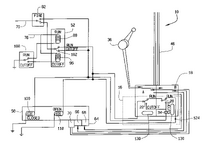
Here's a schematic of
Boeing's patent on the TCMA system. It's designed so that the hydromechanical units (HMU) which deliver fuel have multiple cutoffs. I believe a single active cutoff signal (out of several) will cut fuel. Although there are multiple inputs that modify that signal, such as the landing gear detection system. The TCMA system exists to prevent fuel from flowing to the engines during a fire (fire is not listed as the reason though) or if the engines are producing thrust after landing. For this reason, the main circuit is wired into the throttle. If the throttle is at idle, then fuel is automatically cut off.
But it appears that these are not simple on-off switches and that both FCUs are (16) wired into electronic control units, or electronic engine control (EEC) units.
Schiavo's argument is that erroneous sensor data led to the system activating while the plane was in the air. Going off the schematic, I believe it is possible to tell whether the FCU switches are electronically or physically moved, but it's dependent on how they've wired the firmware controller which governs the EEC system.
The reason the ANA flight in 2019 wasn't considered very severe is because the plane had already touched down and the system engaged when the thrust reversers were active. The investigators assumed that the engines were accidentally put into idle, which would have triggered the fuel cutoff. However, this report was never made public and we have no idea what was in it. The second-hand information that's available is not very reassuring or compelling.
But I am most likely incorrect on how the TCMA circuit is set up and some
actual engineers have analyzed the system. In particular, soarbum wrote that there needed to be two throttle yokes/sticks set to idle to trigger both engine cutouts. This would also be true for the ANA flight in 2019 and yet both engines had fuel cutouts on landing. That is extremely unlikely to have occurred for both engines and it's likely either pilot error or an electrical fault. soarbum also mentioned that a simple short could have caused both systems to trigger TCMA and that they are right next to each other, so just one metal wire could have done it. He has a very complex analysis and the conversation in that discussion thread is illuminating.



www.cbc.ca