German Battleships and convoy hunting.

Ad: This forum contains affiliate links to products on Amazon and eBay. More information in Terms and rules

Super heated steam turbine = high pressure steam turbine (HPT)
Agreed, by its arrival this tech was revolutionary compared to the old low pressure trubine.
But Diesel by far isn´t a step back. Esspeccially for US purposes:
As we know, the US soon went to the all or nothing raft body armor sheme after ww1. Diesel engines really fit more to this specification than would HPT.
The only real disadvantage is that they were heavy.
I will calculate an example with roughly some estimations based on the original 1939 North Carolina BB design(sorry for using metrics):
The NC´s were the first true US BB to be builded after ww1 (Lexington BC turned into CVA and South Dakota fell victim to the Washington treaty), let´s compare the design with a proposed Diesel design:

displacement: 42.000 t. (actually 46.770 deeply loaden)
length(waterline): 214,6m
beam: 33 m
length/beam relation: 6.5
speed (trial):28,5 kts @ 125.000 hp (enforced) and 43.500 t.
armor weight: 13.976 t.
main armor length: 111,3m
propulsion: HPT, 4 shafts, 8 Babcock boilers, 121.000 hp (at 100%)
propulsion length (biolers + turbines): 59, 5m
engine weight: 1.881 t. (+ 845 t. auxilary and systems)
fuel complement: 6.592 t.
range: ? according to the datas from Iowa, which had a comparable hull shape, but beeing larger and having more powerful and efficient engines (as well as more fuel complement) I estimate around 10.000 miles /12 kts. It should be noted that the ship benefits a lot by the low weight HPT engine, which spared some weight.
Now I replace the HPT with a german Diesel engine (Graf Spee), and since Graf Spee had 8 engines and 2 srews and NC has four I (just for gaming) calculate with the exact doubling (which would result in 108.000 hp), by arranging the 16 engines in the same way (4 on each shaft):
What would change?
engine weight: 3.302 tons (+ 650 auxilary and systems)
propulsion length (gears and Diesels:) 54 m
fuel complement: 2.814t.
range: approx. 18.000 nm at 12 kts.
= if we calculate engine weight with fuel complement together, the Diesel driven NC propulsion weights 6.772 t (compare, the executed design is 9.318 t., that are 2.5 Ktons safed in the end for a nearly doubled range, not bad is you ask me). Now what happens with the speed?
at 41.500 tons (reduced trial) 108.000 hp could still drive the ship to 28,3 kts, no significant speed drop. (Variant A)
But it even goes further: Lets assume the 5 m shorter engine dep. would led to a shorter ship design, which probably would happen. Then another 2 (at least) Ktons could be safed due to the shorter vital armor box as well! Less deck armor zone, less main armor belt in spacial dimensions (important for the AON sheme), but all has the same thickness. In the end such a modified NC would only weight around 43.000 tons (deeply loaded), be a bit shorter, having a reduced beam-length relation (~6.3 instead of 6.5) and therefor a reduced speed (27.7 kts deeply loaden). In their appearenc ethis ship would look like a modified South Dakota(Variant B)
Another possibility is to keep the weight and take a reduced speed (26.8 kts) for 3.000 tons of additional armor. Less probable. (Variant C)
A last one (my favourite) could use the space for additional Diesels, one on each screw and a larger internally protected fuel bunker. This variant (D) would have little larger spacial dimensions like the original one due to 4 m increased length and therefor beeing 2 Ktons heavier (larger armor dimensions):
Displacement: ~48.000 t. deeply loaden
length:~ 218 m (waterline)
beam: 33m
length-beam relation: 6.6
engine weight: 4.127 tons (+~ 850 t. auxiliarys)
fuel complement: 4.221 tons
range: approx. 26.000 nm/12 kts
Engine power: 135.000 SHP
estimated peed: 29,02 kts at 135.000SHP and 45.600 tons
Compared to the original design this variant would more than double the range and a slightly increased speed as well as slightly less engine weight (9.200 t. instead of 9.318 t.)
Concluded some positives:
A shorter construction time due to reduced displacement (except Varian D)
A better TDS because of more void cells instead of oil filled cells
A much longer range
A reduced crew complement
Better Seakeeping because of higher freeboard
Some tactical advantages (smoke free)
And a reduced vulnarability because of impossibility of boiler hits.
The disadvantages would be as following:
uncomfortable vibrations, high degree of produced sound
higher engine height (neglectable, since the US BB design already placed the main armor deck one level higher, so the engines fit into the spacial subdivision)
Keep in mind that we calculated with old 1927/28 designed Diesel systems! Now explain me why it would be kind of step back?
 
No comment?
Well, I agree that this was gaming, only. The Diesel tech of this sizeclass simply weren´t avaiable in the North Carolina design stage in the US. And I also have to underline that the HPT-tech advanced even further (take the South Dakotas and it simply doesn´t work anymore with Graf Spees Diesel, agreed).
Now I am close to finishing my critics on combinedfleet.com, jumping to tactical factors. I still have not all Datas for the Iowas but I can show mistakes for the South Dakotas and Bismarcks regarding the range figures:
The authow gives South Dakota and Iowa a 10 compared to the 8 for Bismarck. The superior range of Iowa/SD never was matter of discussion but I have reasons to question this. The author´s numbers would imply a 20% range advantage of South Dakota compared to the Bismarck class (at 12 kts). That´s partly wrong.
Why?
At first the fuel complement of Bismarck and Tirpitz differs:
Bismarck: 7.775 tons
Tirpitz: 8.641 tons
So in particular comparison with Bismarck it is both, true (ragarding the lower fuel complemet of Bismarck) and false (the bunker volume of Bismarck and Tirpitz are nearly identical, Bismarck simply wasn´t that deeply loaded, but it could have...), regarding Tirpitz it truly is false.
But lets discuss South Dakota first:
Fuel complement: 6.950 t. (also Massachusetts, but Indiana and Alabama: 7.340 t.)
At 12 kts the range of SD indeed is 16% superior to that of Bismarck (not Tirpitz!), but is 12 kts really a serious cruise speed? In a ship vs ship comparison (which is the intended purpose of the website) not necessarely. If Bismarck comes into play it would rarely cruise under 25 kts, this would force SD to this speed as well: range at 25 kts: 6.650 nm; Bismarck: 5.850 nm ( Tirpitz: 6.720 nm). Normal cruise speed for Bismarck in it´s historical first part (prior to damagings) of "Rheinübung" was 28 kts (range: 4.528 nm), while those of SD would be extrapolated to 4.400 nm (at 138.000 SHP enforced). Result:
With increased cruise speed the range gap between SD and Bismarck closes, while Tirpitz HAS MORE OPERATIONAL RANGE than South Dakota or Alabama. Keep in mind that the author prefers the most favourable cruise speed for his comparison.
I am not intending to reduce the excellent range performance of SD/Alabama nor the high economy efficiancy of their powerplants, just outlining one more point where statistics are bended in favour to the US ships. I would like to see some statistics for Iowa also but I suspect that the 7.073 t. fuel complement of Iowa (resp. 7.251 t. of BB62-BB65) serve them as well.
 
Its quite interesting how many tools they will recover from GS. Wether or not all ship remains will be lifted remains unclear, I suspect they have not enough financial background to do so. Inteesting on Graf Spee in particular is that the ship was the first to be equipped with radar for limited fire controll (alike Washington in Guadacanal with their MK 3 FC radar) und also the first to use fc radar during surface engagements.
 
I would like to see the ship in Montevideo as a museum.
Now to secondary armement (combined fleet):
The author splits it in two points:
1.) against ships
2.) against airplanes
This is a very reasonable splitting.
He takes the following points into consideration:
Rate of fire, number of guns, shell weight, throw weight
(as you can see, only weight effective and output effective parameters.)
What he don´t take into consiederation:
1.) range (important against ships)
2.) elevation (important as AA)
3.) muzzle velocity/ballistics (important as AA)
4.) ceiling (important as AA)
5.) ordenance (important against ships)
And since we know shell weight is worth nothing without AP and/or ordenance (look how tiny the ordenance of the AA 5" round with funny fuze is!), I take AP and ordenance as well (based on Naval tech. Board and Okun´s Gun AP comparison)
Now lets compare SD with Bismarck resp. Tirpitz (1943)....
----against ships:----
factor --------------Bismarck------------Iowa/South Dakota

guns----------------12*5.9"/55+--------20*5"/38
---------------------16* 4.1"/65

ROF-----------------10*, 15**-----------12-15 (1943)

Range--------------25.150 yrds,--------17.400 yrds
---------------------19.370 yrds

AA ceiling----------41.010 ft(4.1")------37.200 ft

AP weight----------99,87lbs,------------54 lbs
---------------------34,8 lbs

AP(HE)-------------1,95 (8,6) lbs-------2 (7,2)lbs
ordenance---------0,6 (6,2) lbs

muzzle velocity:---2.871fps (5.9")-----2.500-2.600 fps
---------------------2.962 fps (4.1")

[email protected]"-------------------5.1" (vert. against british cementated, EEF, deck against US"B", EEF)
@vert(@deck)----5.4"
[email protected]"---------------------2.9"
--------------------2.6"
[email protected]"+(0.52")----------2.1"+(0.6")
--------------------1.8"
[email protected]"+(1.15")----------1.5"+(1.4")
--------------------1.2"(+0.7")
[email protected]"+(1.8")-----------n (out of range)
--------------------0.8"+(1.4")
[email protected]"+(2.6")----------n (out of range)
--------------------n (out of range)
APpoints total:---29.15------------------13.6
--------------------13.9
battery output:---120 5.9"rounds+----240-300 5" rounds
(theoretical)------240 4.1"rounds
The upper Bismarck AP figure is for her 5.9"/55, the lower for 4.1"/65.
With these figures there is absolutely no justification to give Iowa or South Dakota a 10 against ships. Really: The AP capability of the US 5"/38 is only slightly better than the german 4.1"/65 and much inferior to the german 5.9"ers. The range of the US gun is 6.500 yrds less than the 5.9" and even 1.900 yrds less than the smaller 4.1"! Even if we take the battery output into consideration also, the US 5" don´t come close to the german output (120-150 rounds broadside in minute vs 180 rounds broadside in a minute) but it has worser ballistics, worser range, worser AP capabilities and ordenance as well...
However the US 5" gun was improved several times and in 1945 it reached a very high ROF (around 20), which may raise the overall performance against ships to about equal compared to Bismarck
Result: Bismarck 10, Iowa/South Dakota 8.5 against ships (1943) and
both 10 at 1945 (Bismarck class did not participated in improvements, except for Tirpitz all 4.1"/65 C 33 gunmounts, H class and Gneisenau refit with C37 gunmounts)

* ROF 6-8 for single mounts (pocket battleships, Scharnhorst, Gneisenau),
10 for semi automatic twin mounts (Scharnhorst, Bismarck, according to S. Beyer).
** ROF 14-15 in gunmount C 31, ROF 16-17 for gunmount C 33
 
Why wuold you like to see it in Montevideo? I understand that is where she was scuttled, but just what are your reasons.
 
If she was to be displayed anywhere it should be in Germany, however I don't see it happening because a) it will cost a lot of money to salvage her and b) it would be even more expensive to transport her back to Germany. So if she was to be raised she would probably end up being displayed in Montevideo for cost reasons. I still believe that she should be in Germany but don't see it as a feasible option if she is raised because of the costs involved.
 
I like the Montevideo harbour. A lot of tourists would be attracted there as well. But just my very personal view. Costs are also a heavy concern to bring GS to Germany.

The second part can be made shorter: Usage against airplanes.
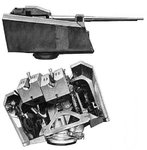
The primary AA gun for US ships was its DP 5"/38. The primary AA gun for Bismarck was their 4.1"/65 with C31 and C33 gunmounts (four C31 forwardly, four C 33 gunmounts rearly), Tirpitz got all C33 mounts.
It should be noted that the 5.9"/55 of Bismarck also was used against airplanes but with little success (Gneisenau got one plane shot down during channel dash with her 5.9"ers), due to the low rate of train and elevation. (Unlike the author we know that Shell weight alone is worth nothing so I leave the 5.9"ers out here)
What is important for AA use?
At first the elevation (the higher they can be elevated, the better it is)
Than the effectivity of AA firecontroll,
the HE ordenance (the larger the scrapnels fly the better)
Next will be the battery output (the more shells you fire, the better it is),
Then comes the max. ceiling of the rounds (one third total ceiling for effective AA)
And of course the range (one third total range for effective AA)
Next should be the stability of the gunplatform
And last but not least the fuze:
factor-------------Bismarck---------Iowa/South Dakota
guns--------------16 * 4.1"/65-----20* 5"/38
elevation:-------+80/-10---------+85/-15 degrees
rate elev/train---12/20------------15/25 desgrees / sec.
muzzle velocity--2962fps----------2.500 fps(average), 2.600fps (new gun)
ceiling:-----------41.010 ft---------37.200 ft
effective ceiling:-13.670ft---------12.333 ft
ROF:--------------15-18*-----------16*
effective range:--6.500 yrds------5.800 yrds
RPC:-------------limited FC(EZ38)--full FC (MK 38)
HE ordenance:---6.2 lbs-----------3.1 lbs (with proximity fuze)
fuze type:--------time fuze--------proximity fuze=VT
stability:--------fully tachimetric--dependend on ship
battery output:--240-288---------320

*firing AA rounds, the C33 mounted gun was designed for 20 rpm but the figure given reflect the numbers normally achieved by trained crews
**design figure firing AA rounds, 1945 and later in integral base ring mounts improved to 15-22, otherwise 12-15

Now lets estimate the worth of the proximity fuze introduced in late 42/43. Against Kamikaze it is highly effective(from John Campbell oct.44-jan.45):
shell type----------------------------planes shot down----------shells/hit
Fired 5"/38 AA common:-----------19---------------------------1162
fired 5"/38 AA proximity fuze:-----24.5-------------------------310
So late in the war it was a benefitial factor of around 3.74 in favour of the proximity fuze (not 5 as stated by the author) against Kamikaze. Keep in mind that the range settings were decreasing quickly, this is the best working environment of the proximity fuze (time fuzes sufferes most)
Now look for the Non Kamikaze actions(same source):
fired 5"/38 AA common:-----------33.5-------------------------960
fired 5"/38 AA proximity fuze:----20---------------------------624
With non Kamikazes (flight path not that extrapolatable) the advantage for proximty fuzes is only 1.48:1! Not 3, 5, or 6. 1 and but 1/1/2 to 1.
I expect that the author used Baldwins book as basic but it grossly overestimats the effectiveness of fuzes. Baldwin states 1 to 6 but he assumed that 70% of the VT fuzes work (Navy lower acceptance limit was 50%), while that truly is false. 1 to 4 is more reasonable but it doesn´t include the other AA common rounds. If we factor them properly, the average comes down to 1 to 3 in favour of the proximity fuze, not one to five as the author states (the historically achieved figures are lower, except for Kamikazes, see above), Keep also in mind that mechanical fuzes work for 95%-98% instead of the 50% for VT (variable timed=proximity..)fuzes.
So what are the advantages of 4.1"?
1.) higher effective range and ceiling
2.) slightly higher ROF (but worser battery output)
3.) more high explosive ordenance
4.) higher fuze reliability (twice compared to VT)
5.) fully three dimensionally stabilized tachimetric mounting, ship roll rate or list therfore can be neglected
6.) Firecontroll also three dimensionally stabilized, excellent optics
7.) high velocity ballistics (good flightpath)
8.) Only for Tirpitz: Radar for AA search and firecontroll
What are the advantages of the US system?
1.) MK 38 firecontroll as a system exceptionally good
2.) VT fuzes makes the heavy AA deadly effective (tripled compared to time fuzed but doubling the duds as well)
3.) Radar RPC
So what to conclude? I do personally would prefer the more modern 4.1"/65 AA gun (stabilized, good ballistics), but I admit that the VT-fuze of the US combined with their better battery output and excellent firecontroll overcomes the shortcomings of the 5"/38 poorer ballistics. It should be noted that at close distances the better train and elevation rates of the US MK28 mounts (used on Iowa and SD-class) benefits them while at longer distances the german system is clearly superior (more range and effective ceiling, more HE ordenance). In the end both are capable AA systems but the more the war progresses, the better the US system as a whole is: Iowa South Dakota 10, Bismarck 7-8?
 
I think the Iowa also could engage more aircraft targets under controlled fire than the Bismark.

Dont forget the 40mm AAA was also quite deadly for the planes that managed on occasion to penetrate the 5" fire
 
The question belongs to how many MK38 FC operators and Radar was avaiable. I doubt that the Iowa in 1943 could engage more aircrafts independently. Bismarck has 3 AA main directors but each gunmount also can switch to independent fire. I think it was Tirpitz with it´s Würzburg Riese radar which was the better AA platform (not Bismarck).
By 1945 the Iowas had more AA tools to controll and therefore could do as you suggest, agreed (in the end even their Bofors was RPC and radar controlled!).
I also agree that the 40 mm Bofors was an excellent AA weapon for the Iowas(better than Bismarcks 37mm, no doubt). Light AA goes to the US ships as well.
I compared the secondary armement and I found out that gun by gun, the US 5" gun isn´t that powerful against ships as well as against planes. It seems that the KM preferred more specialized guns for these tasks. The introduction of the VT fuze turns the comparison of heavy AA in favour for the Iowas/SD, but this shouldn´t be the reason to blame the Bismarcks designers or am I wrong?
 

Attachments

  • 4_1inchc65_c33_141.jpg
    4_1inchc65_c33_141.jpg
    26.2 KB · Views: 188
It should always be remembered that the Bismark was designed and built before the Iowa and of course had been sunk. Had the Bismark been afloat in 1945 their is little doubt that the LAA guns would have been strengthened. The 40mm was a better weapon (in fact the best in its class) than the 37 but that doesn't mean that the 37 was a bad weapon. The Iowa would have been better bt I am sure the Bismark would have handled itself well.

That said to compare the Iowa with the Bismark is like comparing apples and pears. The Bismark was a Pre war design and the Iowa was able to include all the lessons of the war.

What I find interesting is a comparison of the Bismark when built and the North Carolina as built. They were fairly close in timescale and a comaprison of this nature shows the importance and strength given to the AA defence by the Navies involved before they had experienced war conditions. Its not perfect but probably the best comparison you are going to get as they were both very late Pre War designs

North Carolina 20 x 5/38 16 x 30mm (4 x 4) 12 x HMG
Bismark 16 x 4.1 16 x 37 (8 x 2) 36 x 20 (4 x 4, 6 x 2, 8 x 1)

From this you can see that the USN who are normally credited with placing great emphasis on the LAA fire of their ships originally designed them to be almost defenceless. The Bismark wins this comparison by a country mile. Thee is no doubt that pre war, Germany took the threat from the air far more seriously than the USN
 
Observations from this point are interesting. To be fair it must be said that the Tirpitz later in the war got additional LAA:
10 20mm C 32 single barreled guns
72 20mm/ 65 in C38 (Flak 35) in quadrupel barelled mounts
16 37mm/ 83 in C30 in 8 twin gun mounts

That are 98 LAA guns. That´s for the standarts of 1944 mediocre at best (esspeccially compared to the US ships).
One of the real adavabtages beside of the proximity fuze was the fleet factor of the US guns. Even destroyers carried a wide array of LAA and AA.
A comparison of North Carolina vs Bismarck is a very one sided thing. I cannot even see one point (1941), maybe except for the superior AP deck penetration of NC main battery, where the US ship has the advantage (And even here it belongs to the shells: the super heavy 2.700 lbs AP wasn´t introduced in 1941). Protection, main and secondary artillery, firecontroll, speed, all Bismarck. I do not have range figures for NC, maybe anyone can help out?
 
True.
And I want to point out that no battleship has a chance to intercept incoming planes if it stands alone:
I will take Iowas highly reputated AA armement with the qualified sources of jan. 1945:

20 5"/38, RoF: 160 rounds per broadside and minute
80 40mm Bofors, RoF: 6.400 rounds per broadside and minute
49 20mm , RoF: 11.250 rounds per broadside and minute

Its all a numbers game?
Now lets attack it with a flight of 12 Fw-190 F from one side:
against easier targets (A6m5, Ki-61) Iowas and SD had following performance in 1945 with all modern tech there:
5"/38 (with proximity fuze): 624 rounds per kill
40 mm: 3.361 rounds per kill
20 mm: 7.125 rounds per kill

I will grant the Fw-190 some advantages (more robust and armored, smaller target, faster): against 5"/38: 5% (some scrapnels wouldn´t affect the plane, otherwise a 5" hit is really bad)
against 40 mm: 20% (rugged design)
against 20 mm: 40% (the lower the gunsize, the better the Fw190 is)

On a fast aproach, the Fw190 flight will travel 7000 yrds in a minute at low level (420 Km/h/261 mp/h fully loaden with on PC500 each). This means Iowa has around 50 sec. for their 5"ers, 35 sec. for the Bofors and 20 sec. for its 20mm rounds of effective firing range BEFORE the Fw-190 flight is over Iowa (reduce additional 3 sec. for Fw-190 bomb dropping range).
adjusted ROF:
5": 134 rounds for full broadside
Bofors: 3733 rounds full broadside
20 mm: 3750 rounds full broadside
In this numbers game, Iowa has a 20,4% chance to kill ONE FW190 with her 5"/38 (21,4% chance to kill 1 A6M);
It´s Bofors have a 92,6% chance to kill ONE Fw190 (111% to kill a A6M)
and its 20 mm have a 37,6% chance to kill ONE Fw190 (52,6% to kill a A6M).
All in all, Iowa gets one Fw190 down for sure (and another maybe) before at least 10, maybe 11 out of 12 will find their way to drop the bombs on Iowa! No protection, sorry.
This numbers game cannot been won by Iowa alone, regardless of their AA suite. Only task forces may deal with such attacks. This may explain the worse AA performance of Yamato and Bismarck as well, both ships had to handle the intruders on their own.
 
A single 40mm hit on any single engined plane is enough to bring it down.

20mm was really useless and the USN quickly replaced it after the war.

The 5" proximity fused shells would take out a lot more of the attacking planes though. That plus the massed 40mm guns would make it costly for the attacker. You wouldnt get all of them, but quite a few.
 
A 40mm hit MAY destroy a single engined fighter, agreed, but it doesnt ENSURE. 20% Fw-advantage is not that much. Believe me Syscom, I reread the combat records: It took quite a few hits to disable a Zeke in most cases.
Anyway, my simplified gaming underlines that the Bofors battery was far more effective than the 5"ers and 20mm together :rolleyes:
And I am pretty sure the VT-fuzed 5"ers wouldn´t take down more Focke Wulf. Why do You think they would do better against Focke Wulf than against Zekes and Dinahs historically achieved?
I am open to change my mind if You bring arguments forward to support Your claim.
Compare john Campbells book or Ed Jennings article at the technical Naval Board, he tooks the statistics from oct. 44-jan. 1945, this implys including power remote controlled, Radar directed 40 mm and 20 mm AA and a higher reliability of VT fuzes already! Advantages not avaiable in 1943.
It is a somehow disappointing result, however.
If the allies could bring up the reliability of the VT fuze to around 90% AND increase the sustainable ROF of their 5"ers to 22rpm then Iowa has a 55% chance to kill one Fw-190 instead of 20%. The probability to hit reduces greatly with a higher Beaufort number becuase of the non stabilised base ring mountings of both, AA guns and AA directors.
Your argument of multiple hits is valid. I can include it here:
5"/38: 0 kills: 80%; 1 kill: 20%; 2 kills: 4%; 3 kills: 0.06%
Bofors: 2 kills: 34%; 3 kills: 6.2%; 4 kills: 0.8%
20mm: 2 kills: 9%; 3 kills: 0.15%
I see that at least the Bofors has a reasonable chance for multiple hits but I cannot see how Iowa could down more than (at best) 2-3 Focke Wulf before they reach bomb dropping distance. There are 9-10 planes left...
 
A 5" gun is in effect, a 127mm gun. Thats heavy flak. It wouldnt matter if the aircraft that it detonated against (or near) was an FW190, a Zero or a Hellcat. Its going to do a lot of damage. The proximity fused projectile had a smaller charge, but made up for it in increasing the probability of damage or kill.

I suggest to you that the 5" will begin the attrition on the attackers at longer ranges, the 40mm will put up a wall of fire at the middle ranges with the 5" still managing to hit something with the proximity fuses, and then the 20mm managing to ruin the aim of those that get through the 5" and 40mm.

And one thing to remember about a plane thats coming into attack a ship..... its coming in head on. Any hit is going to be on the engine, windshield or the leading edges of the wing. A hit on any of those area's would cause major or catastophic damage.
 
I think its also worth remembering that a hit from a 40mm MAY bring a plane down, but unless its a suicide plane, it WILL cause the plane to turn away.
As the idea of a defensive gun is to stop the ship being hit that is sufficient
 

Users who are viewing this thread

Back