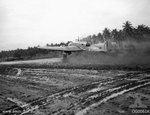
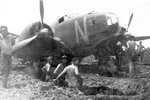
I can't vote for a single air force because almost all ground crews were ingenius in all their given situations.
I cannot believe that no one has mentioned the RAF ground crews. I suppose it is up to me to point out that in 1940 these lads kept heavily damaged fighters in air while being harassed and bombed by the Luftwaffe. Even throughout the war the RAF ground crews maintained their fighters and heavy bombers (with extensive damage) with the odd bombing from the Luftwaffe.
At Crete the poor lads were left behind to defend the island alongside the ground pounders after the final four Hurricanes left for Malta. And on Malta the ground crews kept all the defending fighters, fighting fit even with spares shortages and constant bombardment.
In North Africa, even with the constantly moving fronts between 1941 and 1943 the ground crews shifted in the party system to keep each squadron operating even while moving from base to base. This was under bombing and bombardment from German heavy guns (especially so in 1943 with Rommel's last offensive in Africa).
All this mention of the RAAF in the PTO - well here's a thumbs up to the RAF lads in India and Burma. With the second Chindit operation ground crews were operating an airfield behind enemy lines. They kept eight Spitfires operating and maintained any C-47s that landed. And there's just as little to do in the Burmese jungle as there is any Pacific Island.
Then in France and Germany the same movement system that was created in North Africa. Through rain, wind, snow and sleet these lads kept anything and everything flying.
And if we include Fleet Air Arm lads we've got the carrier operations to be dealing with.
Anything the US ground crews did, the RAF crews did too.
The U.S ground crews in North Africa get praise for "Mongrel" though.
"When we flew overseas we carried what was referred to as the 'Flight Kit' consisting of a collection of spare parts guesstimated by the Group CO and his staff. These parts were scattered throughout the airplanes of the flight. This small supply was our only source of replacement parts for a long time. Although the RAF had some Liberator parts at a Depot in Palestine, few if any were available to us. The Army Air Force answer was to fly combat planes with combat crews overseas to be cannibalized (the planes, not the crews, although we got hungry enough to eat some plump bombardiers). I believe the 98th received five of these 'cannibals' while in Palestine, all going to Group HQ at Ramat David. Soon these planes were skeletons standing around the airport. One Warrant Officer, named Cook, got permission from the Group CO to build airplane out of the remaining parts. With the help of various mechanics, W.O. Cook soon had an airplane with variously colored wings and empennage, some original design in controls, gas lines made of ordinary water pipe, and an insignia consisting of a bitch with some offcolor pups. When I took over the Group at Fayid, Egypt, the Mongrel was listed in flying condition but seldom flew and was on no HQ list of airplanes. When we moved into the Western Desert and set up our tents at Gambut, I first flew the Mongrel and was agreeably surprised at her performance. Later when we in for pretracted operations at Benina Main, east of Benghazi, we began to fly the Mongrel to and from Cairo, ferrying crews on leave, laundry, supplies, mail and what have you. She usually carried over 30 men and unweighed poudage of freight." - Col. "Killer" Kane.
From The 9th Air Force in World War II by Kenn C.Rust.