Soren said:
Erwin Leykauf, German fighter pilot, 33 victories:
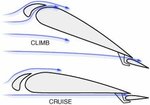
"The Bf 109s also had leading edge slats. When the 109 was flown, advertently or inadvertently, too slow, the slats shot forward out of the wing, sometimes with a loud bang which could be heard above the noise of the engine. Many times the slats coming out frightenened young pilots when they flew the Bf 109 for the first time in combat. One often flew near the stalling speed in combat, not only when flying straight and level but especially when turning and climbing. Sometimes the slats would suddenly fly out with a bang as if one had been hit, especially when one had throttled back to bank steeply. Indeed many fresh young pilots thought they were pulling very tight turns even when the slats were still closed against the wing. For us, the more experienced pilots, real manoeuvring only started when the slats were out. For this reason it is possible to find pilots from that period (1940) who will tell you that the Spitfire turned better than the Bf 109. That is not true. I myself had many dogfights with Spitfires and I could always out-turn them.
One had to enter the turn correctly, then open up the engine. It was a matter of feel. When one noticed the speed becoming critical - the aircraft vibrated - one had to ease up a bit, then pull back again, so that in plan the best turn would have looked like an egg or a horizontal ellipse rather than a circle. In this way one could out-turn the Spitfire - and I shot down six of them doing it."
Franz Stigler, German fighter ace. 28 victories:
"- Did pilots like the slats on the wings of the 109?
Yes, pilots did like them, since it allowed them better positions in dogfights along with using the flaps. These slats would also deploy slightly when the a/c was reaching stall at higher altitudes showing the pilot how close they were to stalling.....this was also useful when you were drunk "
You forgot the indicated statements !

And with them, your small indications mean NOTHING !
Walter Wolfrum, German fighter ace. 137 victories:
"Unexperienced pilots hesitated to turn tight, bacause the plane shook violently when the slats deployed. I realised, though, that because of the slats the plane's stalling characteristics were much better than in comparable Allied planes that I got to fly. Even though you may doubt it, I knew the Bf109 could manouver better in turnfight than LaGG, Yak or even Spitfire."
Do you even know what STALL means ! You can also stall a wing at high speed RG !
The AoA just has to be efficient !
Every example which is specific indicates they deployed at low speed, near the stall.
Nope not a single one of them !
The slats worked at ALL speeds, and contributed to increase lift in combat-turns by a considerable margin !.
The slats opened out at low speed or at high speed under high G loads, and restored airflow which would have been long separated otherwise due to turbulance= Greater lift in turns. (See the AoA chart a presented)
The auto-deployment of the slats was subject to extensive testing prior to WW2, and was found to be beneficial in ALL situations. The American F-86 Sabre was equipped with similar passive leading-edge slats.
Also usually whoever claims that slats caused problems ignore that slats were only "problematic" prior to the E models. However 'Dust' caused some problems for the 109's slats in Africa though, but pilots soon learned to cover them up when their airplane was on the ground.
These are FACTS RG !!



 (Lets see a source thats specifically says this ?