Japanese Versus American Victory Claims (2 Viewers)

Dunn's work contains a lot more citations and is a lot more in-depth. This is from keyword searching "ratio" in Southwest Pacific Air War.

View attachment 898970
What I was referring was the recurring trend for researchers to put an aim first that " Allied overclaim was vast and the overall exchange ratio shall be 1:1 even", and based on biased statistics from different sources that are often not able to cover all combat units & losses types, draw the conclusion "Allied victory claims are wildly exaggerated, while Japanese claims are merely inaccurate" from flawed & bias method.

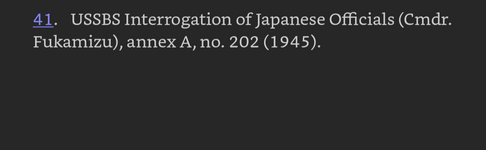
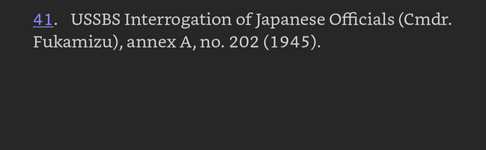
It is clear from this reference, Dunn directly used Japanese wartime propaganda number of 64 as the loss value and said "no reason for Japanese to downplay". Which is an extraordinary assumption, considering Japanese systematically doctor their losses & claim figures to the press after the battle of midway, and peaked at late 1944 which is known as the Daihon-ei Happyou. Using this number for the basis of research is unacceptable and definitely biased.

Further similar narrative done by Dunn can be seen as 193 American claims against 44 Japanese losses from 1–15 January 1944 alongside 170 F6F claims against 35 F6F losses from September–December 1943, then suggests the Hellcat was roughly breaking even with the Zero. He was comparing losses & claims from different times, based on captured Japanese telegram and assumed the overclaiming ratio was constant. One of the example would be the raid on Wake Island, where US claimed 30 A6M destroyed in the air, while actual loss for the Zeros were 18, with 6 Hellcat loss in exchange. Here the overclaim definetely exists, but not so exaggrated as been described in above mentioned works.

Those search narratives tended to draw conclusion first, and then find evidences. The result would be biased.

From the USSBS post-war interrogation and reconstruction, neither those 64 or 44 losses held valid for the Japanese. The true loss number to all causes was around 120 - 130 for Jan 1944, for IJNAF only.
1791789277634.png

Furthermore, as IJAAF systematically destroyed their loss records, most post-war figures were based on pure reconstruction by surviving docs and even pure memory, their accuracy as first-hand sources may be questionable.
1791789619958.png
 
Last edited:
From the book Operation KE, the authors Richard and Dennis Letourneau, point out something interesting.

Overclaiming of air to air kills is normal but during the period covered by the book, that of early 1943 when the Japanese were withdrawing from Guadalcanal, the Americans overall claimed two kills for every actual kill made.

In contrast, the Japanese, Army and Navy, claimed four kills for every actual kill made.

And when non-kill losses are taken into account, the actual number of kills claimed by US pilots is in reality an accurate estimate of enemy losses.

Consider the impact on morale of this situation. In the Battle of Britain the Luftwaffe was assured that the raids of the day before had finished off the RAF, only to have the numbers of Spitfires and Hurricanes seemingly undiminished every day. On one occasion the RAF was indeed tapped out, with all units committed, but a lone WW1 pilot, station commander, attacked a formation headed for his base and they all jettisoned their bombs and ran for home. Of course in that case the the German bombers had missed meeting up with their fighter escort (German fighters and bombers could not talk to each other over the radio but occasionally RAF and German fighters were on the same frequency) and just knew they were going to get their arses well and truly kicked. The appearance of that one Hurricane was seen as conformation of this fear, since there surely had to be a hundred fighters right behind it.

With their massive overclaiming it must have seemed to the Japanese that the Americans had an inexhaustible supply of planes and pilots, which indeed they did, only just not right there and then.

And of course we know that many US aircraft hit by Japanese fire made it safely back to base. In contrast a USMC F4F pilot at the Canal was desperately trying to get the Zeros off a Admiral's PBY and just sprayed .50 cal at them to scare them off. It was years after the war that he found he had shot three Zeros down that day; they were only slightly damaged but in each case probably no more than a single .50 cal round had damaged an engine, punched through an oil line, and caused a fuel leak that prevented the Zeros from making it home.

View attachment 895571View attachment 895573View attachment 895574View attachment 895575
It would help if you could provide dates for each of the combats you mention.


The seminal works to read about the Pacific naval airwar, are Lundstrom's First Team, two volume set and his Black Shoe Carrier Admiral volume.
 
What I was referring was the recurring trend for researchers to put an aim first that " Allied overclaim was vast and the overall exchange ratio shall be 1:1 even", and based on biased statistics from different sources that are often not able to cover all combat units & losses types, draw the conclusion "Allied victory claims are wildly exaggerated, while Japanese claims are merely inaccurate" from flawed & bias method.

It is clear from this reference, Dunn directly used Japanese wartime propaganda number of 64 as the loss value and said "no reason for Japanese to downplay". Which is an extraordinary assumption, considering Japanese systematically doctor their losses & claim figures to the press after the battle of midway, and peaked at late 1944 which is known as the Daihon-ei Happyou. Using this number for the basis of research is unacceptable and definitely biased.

Further similar narrative done by Dunn can be seen as 193 American claims against 44 Japanese losses from 1–15 January 1944 alongside 170 F6F claims against 35 F6F losses from September–December 1943, then suggests the Hellcat was roughly breaking even with the Zero. He was comparing losses & claims from different times, based on captured Japanese telegram and assumed the overclaiming ratio was constant. One of the example would be the raid on Wake Island, where US claimed 30 A6M destroyed in the air, while actual loss for the Zeros were 18, with 6 Hellcat loss in exchange. Here the overclaim definetely exists, but not so exaggrated as been described in above mentioned works.

Those search narratives tended to draw conclusion first, and then find evidences. The result would be biased.

From the USSBS post-war interrogation and reconstruction, neither those 64 or 44 losses held valid for the Japanese. The true loss number to all causes was around 120 - 130 for Jan 1944, for IJNAF only.
View attachment 898976
Furthermore, as IJAAF systematically destroyed their loss records, most post-war figures were based on pure reconstruction by surviving docs and even pure memory, their accuracy as first-hand sources may be questionable.
View attachment 898977


Are you just shoving your argument through ChatGPT or some other LLM? The random bolding of text and use of EM dash screams that this is just a generated response. If that is the case then I see no reason to continue.
 
Are you just shoving your argument through ChatGPT or some other LLM? The random bolding of text and use of EM dash screams that this is just a generated response. If that is the case then I see no reason to continue.
I use llm as search engine and type it myself. I don't know how you been so against llm agent as a tool of research. Which is a topic never related to South Pacific War, or anything should be discussed in this thread.
 
I use llm as search engine and type it myself. I don't know how you been so against llm agent as a tool of research. Which is a topic never related to South Pacific War, or anything should be discussed in this thread.

It definitely reads like you are using it to craft arguments for you and have not really bothered to reference Dunn's book at all and just instead rely on an AI summary of it.

For instance the chart that you linked as somehow a refutation of Dunn's narrative is apparently from the same section of the US Strategic Bombing Survey that he cites in his book? Or are you using a different section of the US SBS that reports Japanese losses purely based on US claims?

The tangent on Wake Island also doesn't have anything to do with my excerpts from Dunn's book either.


Those search narratives tended to draw conclusion first, and then find evidences. The result would be biased.

Like this whole idea seems to be a conclusion you have reached about both authors and both times you have provided "proof" seems to just be an odd unrelated tangent. First trying to link Claringbould and Dunn to the claims of some Japanese author and now to some other anecdote on Wake Island.

Allied victory claims are wildly exaggerated, while Japanese claims are merely inaccurate" from flawed & bias method.

This is not at all the narrative in Dunn's book. He points out multiple times when the Japanese wildly over-claimed their victories even in comparison to the Americans.
 
Last edited:
It definitely reads like you are using it to craft arguments for you and have not really bothered to reference Dunn's book at all and just instead rely on an AI summary of it.

For instance the chart that you linked as somehow a refutation of Dunn's narrative is apparently from the same section of the US Strategic Bombing Survey that he cites in his book? Or are you using a different section of the US SBS that reports Japanese losses purely based on US claims?

The tangent on Wake Island also doesn't have anything to do with my excerpts from Dunn's book either.


Like this whole idea seems to be a conclusion you have reached about both authors and both times you have provided "proof" seems to just be an odd unrelated tangent. First trying to link Claringbould and Dunn to the claims of some Japanese author and now to some other anecdote on Wake Island.


This is not at all the narrative in Dunn's book. He points out multiple times when the Japanese wildly over-claimed their victories even in comparison to the Americans.
The loss figure was reconstructed by the request of GHQ and was included as the supplementary material in No.446, the interrogation of Miyazaki Takashi in Jan. 1946 and was confirmed by IJN Admiral Kusaka.
 
The loss figure was reconstructed by the request of GHQ and was included as the supplementary material in No.446, the interrogation of Miyazaki Takashi in Jan. 1946 and was confirmed by IJN Admiral Kusaka.

So do we think that Dunn did not read the US SBS?
 

Attachments

  • Screenshot_20261012-000737.png
    Screenshot_20261012-000737.png
    33.8 KB · Views: 2
For instance the chart that you linked as somehow a refutation of Dunn's narrative is apparently from the same section of the US Strategic Bombing Survey that he cites in his book? Or are you using a different section of the US SBS that reports Japanese losses purely based on US claims?
If you've read Dunn's narratives you would immediately find his bias and trying to create the sense that Japanese fought evenly with Allied forces, both in combat results and in materials.


In this work that I previously used as an example, other than that specific paragraph using illy prepared figure based on Japanese telegram of a different time period, bias and questionable narratives can be concluded as follows:

1. The perfromance figure as accepted by the BuAer, which showed 392mph on the conference, less optimistic value of 380mph was also often been used, but Dunn used rated power performance in his article, provided by some secondary conclusion. I don't believe someone prefessional as Dunn never read any materials from the BuAer.
1791793960682.png
1791794677749.png


2. He claimed pilots to obtain far less performance figure as published, and put it in the same level of performance with A6M's figure, without considering pilot was using rated power for testing (5-min limit for Military Power as noted by Prelinminary Handbook of early F6F-3) and with 20-knot pitot positional error uncorrected for. As a professional historian I don't believe he didn't know it, he probably hide the fact intentionally. According to Dean 'Diz' Laird who flew early F6F-3 during that time they waxed the airplane and obtained higher top speed than published. If one would write the similar article with the opposite bias, I would then choose VF-13's test that F6F would do 425-438mph to show how great F6F was, and hide the same instrument error from the audience.
1791793916276.png

3. He claimed that F6F pilots out-turning A6M been purely pilot's skill issue, igoring that VF-9 war diary pointed out to use combat flaps and also many other records happened around this time.

1791794198844.png


4. He selective quotes Japanese POW interrogation quotes that downplayed the threat of the Hellcat. Ignoring those widely accepted opinions in Imperial Japan about the threat made by the Hellcat, which can be found in IJAAF fighting doctrine and IJNAF doctrine as well as many interviews in USSBS.
1791794363840.png

5. He repeated the similar narratives to P-38, P-39 and many other Allied fighting machines in that theatre. There was a friend of mine who really believed in Dunn's narrative and quoted his research and turned out to be very wrong.

These may not referring to the specific work you've mentioned, but clearly shows the intellectual sleight-of-hand done by these researchers to manipulate opinions surrounding South Pacific combat, as you've said previously. And generally speaking, you can see the biased method exists in those researches.
 
Last edited:
If you've read Dunn's narratives you would immediately find his bias and trying to create the sense that Japanese fought evenly with Allied forces, both in combat results and in materials.


In this work that I previously used as an example, other than that specific paragraph using illy prepared figure based on Japanese telegram of a different time period, bias and questionable narratives can be concluded as follows:

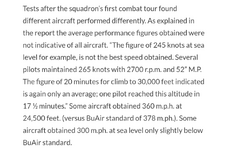
1. The perfromance figure as accepted by the BuAer, which showed 392mph on the conference, less optimistic value of 380mph was also often been used, but Dunn used rated power performance in his article, provided by some secondary conclusion. I don't believe someone prefessional as Dunn never read any materials from the BuAer.
View attachment 898990View attachment 898993

2. He claimed pilots to obtain far less performance figure as published, and put it in the same level of performance with A6M's figure, without considering pilot was using rated power for testing (5-min limit for Military Power as noted by Prelinminary Handbook of early F6F-3) and with 20-knot pitot positional error uncorrected for. As a professional historian I don't believe he didn't know it, he probably hide the fact intentionally. According to Dean 'Diz' Laird who flew early F6F-3 during that time they waxed the airplane and obtained higher top speed than published. If one would write the similar article with the opposite bias, I would then choose VF-13's test that F6F would do 425-438mph to show how great F6F was, and hide the same instrument error from the audience.
View attachment 898989
3. He claimed that F6F pilots out-turning A6M been purely pilot's skill issue, igoring that VF-9 war diary pointed out to use combat flaps and also many other records happened around this time.

View attachment 898991

4. He selective quotes Japanese POW interrogation quotes that downplayed the threat of the Hellcat. Ignoring those widely accepted opinions in Imperial Japan about the threat made by the Hellcat, which can be found in IJAAF fighting doctrine and IJNAF doctrine as well as many interviews in USSBS.
View attachment 898992
5. He repeated the similar narratives to P-38, P-39 and many other Allied fighting machines in that theatre. There was a friend of mine who really believed Dunn's narrative and quoted his research and turned out to be very wrong.

These may not referring to the specific work you've mentioned, but clearly shows the intellectual sleight-of-hand done by these researchers to manipulate opinions surrounding South Pacific combat, as you've said previously. And generally speaking, you can see the biased method exists in those researches.

So now we have moved the goalposts to finally make the thread about the flight performance of the F6F Hellcat?

This seems to be a common trend with your posting on the forum.

And once again we get to random bolding from LLM output to make a more compelling narrative? Odd.
 
So now we have moved the goalposts to finally make the thread about the flight performance of the F6F Hellcat?

This seems to be a common trend with your posting on the forum.

And once again we get to random bolding from LLM output to make a more compelling narrative? Odd.
Oh yes, quoting a single of your word should not bolded. You'd better tell forum not to give functions for bolding or italic.
 
Oh yes, quoting a single of your word should not bolded. You'd better tell forum not to give functions for bolding or italic.

Your entire posting style is consistent with what I have seen generated by LLM.

Your whole recent reply is some pedantry because Dunn didn't use the most favorable figures possible in a rivet counting contest with the F6F.

Didn't you do this exact same thing in the past when it came to talking about Bf.109s and Fw-190s???
 
Your entire posting style is consistent with what I have seen generated by LLM.

Your whole recent reply is some pedantry because Dunn didn't use the most favorable figures possible in a rivet counting contest with the F6F.

Didn't you do this exact same thing in the past when it came to talking about Bf.109s and Fw-190s???
No, it was that he clearly researched in-depth but choose to hide certain facts. Same thing questionable as I've pointed out he used Japanese propaganda values for losses.

And yet if you find everything is generated LLM I think you never use one of them.
 
No, it was that he clearly researched in-depth but choose to hide certain facts. Same thing questionable as I've pointed out he used Japanese propaganda values for losses.

One of the sources that he uses for losses is part of the same section of the US SBS that you cite claiming that it refutes him.


He claimed that F6F pilots out-turning A6M been purely pilot's skill issue, igoring that VF-9 war diary pointed out to use combat flaps and also many other records happened around this time.

Do you think simply using flaps will make up for the dramatic difference in wing loading that favors the Zero? It would narrow the gap at best but pilot skill would be the driving factor.

Dunn is not wrong here.

I don't believe someone prefessional as Dunn never read any materials from the BuAer.

This is addressed in the article that you linked. You can just actually read it instead of the AI summary. His claim is that there were aircraft that made it to the fleet that did not perform to the BuAer specification.

I don't know why you would find this unreasonable. Either there is a report he is citing exists or it doesn't.

If one would write the similar article with the opposite bias, I would then choose VF-13's test that F6F would do 425-438mph to show how great F6F was, and hide the same instrument error from the audience.

This test is for an F6F-5 with water injection. This is an aircraft that didn't go into service until the middle of 1944. If the F6F-3 had such an enormous advantage over everything Japanese then why did it even need water injection?


4. He selective quotes Japanese POW interrogation quotes that downplayed the threat of the Hellcat. Ignoring those widely accepted opinions in Imperial Japan about the threat made by the Hellcat, which can be found in IJAAF fighting doctrine and IJNAF doctrine as well as many interviews in USSBS.

The interviews that he quotes are once again from the US SBS. It seems that your issue is that he concludes that the Japanese did not treat the F6F as a "super fighter" and that opinions on its relationship to the Zero was that it was either better than it, or equal if the Zero was flown by a more experienced pilot.

This is overall a pretty sensible take and is broadly in line with experience in the European theater as well.
 

Attachments

  • Screenshot_20261012-012716.png
    Screenshot_20261012-012716.png
    51 KB · Views: 2
This test is for an F6F-5 with water injection. This is an aircraft that didn't go into service until the middle of 1944. If the F6F-3 had such an enormous advantage over everything Japanese then why did it even need water injection?
Great, then we are looking at nearly 80mph difference between early and late version of F6F, funny. I've said he omitted instrument error in his writing as well as the power setting in the test and related figure, whether intentionally or unintentionally. Which may mislead the audience and clearly some person like a researcher I knew, did got misled by him.

Dunn's action report quoted from pilot which at the time net yet receive any correction table for airspeed system, in this case you would add 10-15 knots at that speed range for the known airspeed error problem. If you add the correction, the speed figure lies within BuAer's record, around 320-330mph after correction based on table provided by the handbook of 1944. Of course, most pilots simply didn't correct airpseed for instructment & compressibility error. If he lies "BuAer" records besides the number, but not mentioning the instrument error, the misleading is likely to happen, and I would say it can be intentionally created.
One of the sources that he uses for losses is part of the same section of the US SBS that you cite claiming that it refutes him.
Then why not use numbers from no.446, instead of some weird captured telegram.

All in all I used topics where I have the most rich materials with, to tell you the bias contained in Dunn's writting. No doubt he did researched in-depth, but his narrative seems questionable if information was selectively provided.

BTW, what makes you got banned on WT forum. Is that the use of LLM?
1791798723059.png
 
Great, then we are looking at nearly 80mph difference between early and late version of F6F, funny. I've said he omitted instrument error in his writing as well as the power setting in the test and related figure, whether intentionally or unintentionally. Which may mislead the audience and clearly some person like a researcher I knew, did got misled by him.

Dunn's action report quoted from pilot which at the time net yet receive any correction table for airspeed system, in this case you would add 10-15 knots at that speed range for the known airspeed error problem. If you add the correction, the speed figure lies within BuAer's record, around 320-330mph after correction based on table provided by the handbook of 1944. Of course, most pilots simply didn't correct airpseed for instructment & compressibility error. If he lies "BuAer" records besides the number, but not mentioning the instrument error, the misleading is likely to happen, and I would say it can be intentionally created.

You are making the assumption here that Dunn is supposed to have categorical knowledge of every idiosyncrasy of the F6F and it's instrumentation error or that it was purposely omitted.

Your gripe here just seems to be that he didn't go out of his way to find the highest performance number possible for the F6F when writing his article and that he didn't use figures from 1944 to qualify the performance the plane in 1943...and instead used figures from 1943.

That's as dumb as me saying that the Fw-190 was faster than the P-51 because it would have received a 3,000hp Jump Poopenfarten special if the war had continued into 1946.

Then why not use numbers from no.446, instead of some weird captured telegram.

He is using numbers from No.202 which is "AIRCRAFT AVAILABILITY AND LOSS REPORTS" from the US SBS.

All in all I used topics where I have the most rich materials with, to tell you the bias contained in Dunn's writting. No doubt he did researched in-depth, but his narrative seems questionable if information was selectively provided.

There are hundreds of citations in Dunn's book.

Your citations of bias have been attempting to link him to some completely unrelated Japanese author, and then derailing the thread into attempting to rivet count on the F6F.

BTW, what makes you got banned on WT forum. Is that the use of LLM?

I thought I recognized you from somewhere. Thanks for confirming it because I was trying not to ask. But now everything makes sense.
 

Attachments

  • Screenshot_20261012-000737.png
    Screenshot_20261012-000737.png
    33.8 KB · Views: 1
You are making the assumption here that Dunn is supposed to have categorical knowledge of every idiosyncrasy of the F6F and it's instrumentation error or that it was purposely omitted.
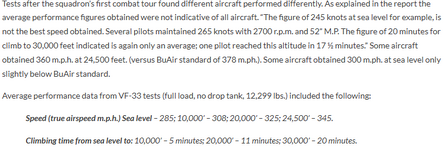
Yet in another article he was rivet counting A6M2, according to your standard. With a 368mph figure been placed, which is extraordinary, despite been citing from a POW quote, but his entire article was about the real speed for the A6M been under-estimated.
1791806272211.png


It is clear that R.L. Dunn possess the knowledge on research WW2 aircraft performance, and he's willing to dig into first-hand sources to find out other than standard performance figures.

While he was digging it to push A6M's top speed, he inversely put those laughable numbers on the F6F
1791805854967.png

285mph at SL and 345mph at 24,500, very done research on that.
1791812516204.png

His "official figures" also been suspecious as it came from William Green's secondary source rather than any BuAer file, or simply ACP file around that time, and this figure itself is exceptionally low.

I think Dunn as a researcher who have done decades of research on the Pacific War and wrote all these articles in-depth, he must've read many more records than I did. While I am going over the war diaries, I've only found records that were higher than BuAer standards :
1791806023088.jpg
1791808179347.png


I've not yet find the specific source Dunn was citing, those may be mentioned in the war diaries of VF-33 but so far I haven't find the number he was referring to in VF-33's record. I've reason to believe Dunn have saw numerous front line reports and decided to use the one that was made with early technical limitations and with large PCE error uncorrected.

It is clear that with much less research experience, I was able to locate many field testing reports on the F6F showing higher-than-standard performance. There is no reason for Dunn to have missed them during his research. Therefore, this is not a matter of the F6F-3 only being able to do 345 mph in 1943 and then drastically increasing to 425 mph in 1944; it is a selective narrative.


1791805775316.png
(This table came after mid-1944 version of the handbook, no correction table been provided in the 1943 prelinminary handbook).

Knowing that the position & compresibility error was a common source of instrument error during WW2 which was also a noted problem on the F6F, ignoring this can be unlikely for such a professional researcher. Especially he was trying to dig any technical problems that caused A6M for its performance "underclaimed".

1791806750440.png
Putting an uncorrected value alongside with a BuAer figure which had been corrected will provide a misleading sense that the U.S. was overclaiming their performance.

1791806272211.png
While the Japanese were underclaiming their aircraft performance.

Dunn had a tendency to lead his reader that Allied forces were not only over-claiming their combat results, but also fighter performance figures, all those examples show that his works lack neutrality and are biased.

I thought I recognized you from somewhere. Thanks for confirming it because I was trying not to ask. But now everything makes sense.

So you haven't yet to share your experience with the WT forum ban, which makes me worry about your 'LLM fear' :>
 

Attachments

  • 1791806153401.png
    1791806153401.png
    12.6 KB · Views: 2
  • 1791805705240.png
    1791805705240.png
    47.8 KB · Views: 2
  • 1791805612056.png
    1791805612056.png
    18.2 KB · Views: 2
Last edited:
I've said he omitted instrument error in his writing
Grumman said that the speed superiority of the F4U over the F6F was almost entirely due to the F4U instrumentation error.

On the other hand, Grumman used few flush rivets on the F6F on the basis that they were harder to install, weaker, and more costly than round head rivets.
 
Grumman said that the speed superiority of the F4U over the F6F was almost entirely due to the F4U instrumentation error.

On the other hand, Grumman used few flush rivets on the F6F on the basis that they were harder to install, weaker, and more costly than round head rivets.
That the F6F's speed been slower than F4U purely due to instrumentation error was given by Corky Meyer, which I personally believe only partially holds. It may be possible that the F4U tested by Grumman was not flown at its optimistic condition, just as the F6F flew by Vought was clocked to be somewhat slower than Grumman's best figure. The F4U was also experiencing instrumentation error in which the Corsair constantly indicating 10 knots below actual speed, while the Hellcat indicating 20 knots below it. Also, for performance figures to be published, all those instrument errors were to be corrected, so instruments error wasn't a problem for published figures, but it does affect pilots' sense of his speed and range calculation.

F4U's quality control was a problem and before been standardized to FG-1D by Goodyear, you can find F3A/FG-1/F4U to be ranging somewhere on par with F6F-3 to 30mph faster than F6F-3( for those tail-hook removed Corsair) .

The reason for F4U been faster is simple, it has 20 sqft smaller wing area and 20 sqft smaller horizontal tail surface, with a more compact fuselage give it way less wetted area, plus it has flush gun ports and faired gear bay (the Hellcat had protruding guns and landing gears partially unfaired), also the Hellcat's wing and tail were placed 1 and 3.5 deg higher than the Corsair's, relative to the thrust line. In many cases F4U's speed record was clocked at higher critical altitude which naturally yield better. However,the speed advantage at similar condition enjoyed by the Corsair wasn't that great, commonly to be 10-15mph faster than the Hellcat at the same altitude.

As for the rounded rivets at the rear fuselage of the Hellcat, it was visually linked with more friction but I do think F6F's general shape is cleaner than F4U and this also noted in NACA report 829, presumably caused by F4U's wing-duct.

F6F vs F4U is an interesting topics that've been lasting for at least 20 years on the internet since the HiTechcreation forum, and I think it is a topic worth digging out.
 
Last edited:
The loss figure was reconstructed by the request of GHQ and was included as the supplementary material in No.446, the interrogation of Miyazaki Takashi in Jan. 1946 and was confirmed by IJN Admiral Kusaka.

Yet in another article he was rivet counting A6M2, according to your standard. With a 368mph figure been placed, which is extraordinary, despite been citing from a POW quote, but his entire article was about the real speed for the A6M been under-estimated.
View attachment 899014

It is clear that R.L. Dunn possess the knowledge on research WW2 aircraft performance, and he's willing to dig into first-hand sources to find out other than standard performance figures.

While he was digging it to push A6M's top speed, he inversely put those laughable numbers on the F6F
View attachment 899011
285mph at SL and 345mph at 24,500, very done research on that.
View attachment 899025
His "official figures" also been suspecious as it came from William Green's secondary source rather than any BuAer file, or simply ACP file around that time, and this figure itself is exceptionally low.

I think Dunn as a researcher who have done decades of research on the Pacific War and wrote all these articles in-depth, he must've read many more records than I did. While I am going over the war diaries, I've only found records that were higher than BuAer standards :
View attachment 899012View attachment 899018


I've not yet find the specific source Dunn was citing, those may be mentioned in the war diaries of VF-33 but so far I haven't find the number he was referring to in VF-33's record. I've reason to believe Dunn have saw numerous front line reports and decided to use the one that was made with early technical limitations and with large PCE error uncorrected.

It is clear that with much less research experience, I was able to locate many field testing reports on the F6F showing higher-than-standard performance. There is no reason for Dunn to have missed them during his research. Therefore, this is not a matter of the F6F-3 only being able to do 345 mph in 1943 and then drastically increasing to 425 mph in 1944; it is a selective narrative.


View attachment 899010(This table came after mid-1944 version of the handbook, no correction table been provided in the 1943 prelinminary handbook).

Knowing that the position & compresibility error was a common source of instrument error during WW2 which was also a noted problem on the F6F, ignoring this can be unlikely for such a professional researcher. Especially he was trying to dig any technical problems that caused A6M for its performance "underclaimed".

View attachment 899017 Putting an uncorrected value alongside with a BuAer figure which had been corrected will provide a misleading sense that the U.S. was overclaiming their performance.

View attachment 899014 While the Japanese were underclaiming their aircraft performance.

Dunn had a tendency to lead his reader that Allied forces were not only over-claiming their combat results, but also fighter performance figures, all those examples show that his works lack neutrality and are biased.


So you haven't yet to share your experience with the WT forum ban, which makes me worry about your 'LLM fear' :>

This whole argument boils down to you claiming bias because he didn't pick the highest possible speed figure that he could find as being indicative of the performance of the F6F in a completely unrelated article, and then attacking his credibility based on your own opinion that the F6F was the greatest most fantastic fighter of all time.


1791826014951.png


The figures that you are making a whole fuss about are a whopping 5 m.p.h slower than the BuAir figures; this is in an article where the central point that he is making is that F6F (and certainly other aircraft) had a range of actual performances in the field vs testing. The article on the Zero also makes a similar point.

1791826479040.png


It really seems that you have a tendency to liberally interpret sources, or have an LLM interpret them for you, in order to arrive at your conclusions.

1791826630574.png


This second one isn't even about the F6F and you derailed the whole thread because you think the F6F has some super special aerodynamic properties in regards to CL values that no other fighter during the war had and insist that your interpretation is the only valid one, while arguing with a guy who actually has a degree in the subject and quite a bit of work experience in it.

I think at one point you also accused him of not being a professional and of being biased as well. But I am not going to look all that hard. It just seems like a common pattern for you.

So you haven't yet to share your experience with the WT forum ban, which makes me worry about your 'LLM fear' :>

What does a War-Thunder forum ban have to do with this conversation? It is not even tangentially related.

The ban was for posting a screenshot of another users conversation because he was crying that everyone arguing with him was being racist against Indians. It turned out that the guy himself was just projecting and ended up going on a whole tangent how his point of view was actually justified.
 

Users who are viewing this thread

Back