Irregualr23
Airman
- 75
- May 13, 2025
What I was referring was the recurring trend for researchers to put an aim first that " Allied overclaim was vast and the overall exchange ratio shall be 1:1 even", and based on biased statistics from different sources that are often not able to cover all combat units & losses types, draw the conclusion "Allied victory claims are wildly exaggerated, while Japanese claims are merely inaccurate" from flawed & bias method.Dunn's work contains a lot more citations and is a lot more in-depth. This is from keyword searching "ratio" in Southwest Pacific Air War.
View attachment 898970
It is clear from this reference, Dunn directly used Japanese wartime propaganda number of 64 as the loss value and said "no reason for Japanese to downplay". Which is an extraordinary assumption, considering Japanese systematically doctor their losses & claim figures to the press after the battle of midway, and peaked at late 1944 which is known as the Daihon-ei Happyou. Using this number for the basis of research is unacceptable and definitely biased.
Further similar narrative done by Dunn can be seen as 193 American claims against 44 Japanese losses from 1–15 January 1944 alongside 170 F6F claims against 35 F6F losses from September–December 1943, then suggests the Hellcat was roughly breaking even with the Zero. He was comparing losses & claims from different times, based on captured Japanese telegram and assumed the overclaiming ratio was constant. One of the example would be the raid on Wake Island, where US claimed 30 A6M destroyed in the air, while actual loss for the Zeros were 18, with 6 Hellcat loss in exchange. Here the overclaim definetely exists, but not so exaggrated as been described in above mentioned works.
Those search narratives tended to draw conclusion first, and then find evidences. The result would be biased.
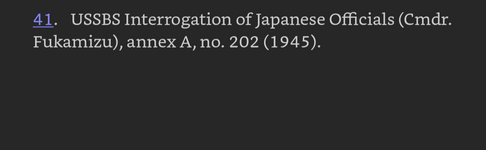
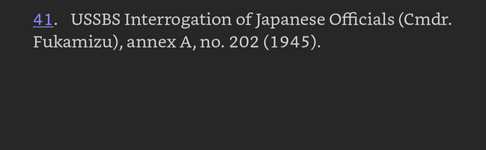
From the USSBS post-war interrogation and reconstruction, neither those 64 or 44 losses held valid for the Japanese. The true loss number to all causes was around 120 - 130 for Jan 1944, for IJNAF only.
Furthermore, as IJAAF systematically destroyed their loss records, most post-war figures were based on pure reconstruction by surviving docs and even pure memory, their accuracy as first-hand sources may be questionable.
Last edited: