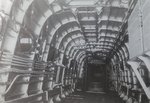
As a transport the Sterling was pretty good and thinking about it a good contender for the aircraft in a secondary role thread.
edit - additional information
On the 5th August three Sterling's from 620 Sqd joined the USAAF base at Harrington to assist with the dropping of people taking part in a Carpet Bagger operation. The original plan was to use six Liberators but changed when it was realised that three Sterling's could do the job.
They caused quite a stir as it was the first time they had seen a Sterling close up and the whole thing was filmed by one Captain John Ford. So somewhere there is an interesting film to be dug up
We should be aware that these aircraft were Mk IVs, a specific transport aircraft and extensively modified. It was not a case of the removable seating envisaged in the original 1936 specification being fitted. Following two factory conversions at Rochester in August 1943, EF503 and EF506 were sent off to the A+AEE for various trials and assessments followed by operational clearance.
The conversions from Mk III bombers were initially undertaken at 23 MU (Aldergrove) starting in October 1943. The switch to Mk IV production at the Belfast factory followed in December.
The Mk IV transport was different to the bomber version, not least in having nose and dorsal turrets removed, some had all removed, but it would not have been so successful had Shorts not included a troop carrying capability (not just an overseas reinforcement capability) in its original design.
A relatively unencumbered fuselage was needed and as can be seen on the Mk I that is exactly what the Stirling had. This one has a retracted FN25 ventral turret visible at the far end. This turret was deleted on later Mk Is and is not relevant to the Mk III conversions or aircraft originally built as Mk IVs.
The squadrons involved in these 'Special Operations' were largely manned by ex- Bomber Command men, 196 and 620 squadrons had left the Command in November 1943, and they were not at all happy to discover that they would be flying Stirlings.
John Payne of 620 Squadron remembered:
" About October 1943 a large bunch of slightly bewildered aircrew were posted to Leicester East, an awful quagmire on a hill above Oadby, a suburb of Leicester....
We were intrigued to discover that we were now to be engaged in 'Special Duties', something we had only previously associated with a mysterious group of ace pilots who did hairy things like landing Lysanders in fields in France under the noses of the Jerries.
But we had no aircraft, so the burning question during the subsequent weeks of inactivity was: "WHAT are we going to fly?" We had star studded dreams that at least we would get Lancasters, but more likely some extra special type so far yet unveiled.
Imagine the near mutiny which took place when something like 600 aircrew, representing an almost equal number of Commonwealth countries, were told we would be getting...shudder...Stirlings! The CO gained a slightly better hearing when he said: "Ah, but wait till you see THIS Mark, the IV."
Eventually a Mark IV arrived, prompting more questions.
"But where was the front turret, the dorsal, and what was that enormous, horse shoe shaped, lumo of steel wrapped around the belly just below and forward of the tail? "
After a few trial flights most were happier but
"the general pleasure was tempered, in the case of veterans, with the knowledge that they were to lose their gunners as 'surplus to establishment'.... Then the questions began. "What is the purpose of that horse shoe?" "It is a strop guard to prevent strops, which serve to pull open paratroopers' chutes, from lashing holes in the fuselage." "So we're carrying paratroops?" "That's right." "In daylight ops?" "That's right." (and remember, all those crews were ex-Bomber Command). This information was supplanted by news that we were also going to tow gliders - and again, all Hell erupted."
The cloak and dagger operations started in February 1944, often launched from an advanced base at Tarrant Rushton.
So secret were the various SOE, SAS and other operations that you will find them entered in pilots' log books simply as 'operations as ordered'.
By the time they gave the Americans a hand the squadrons were experienced in this sort of operation.
Cheers
Steve