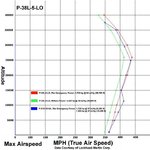
Anything greater than 442 mph for the P-38L would be in a dive.
Actually - they were very close to critical Mach at 25,000 feet at 425mph in level flight - I'll have to check for STP. I don't believe any P-38 was rated to exceed .68 Mach. Without dive brakes they immediately went into compressibility between 430 and 440 mph at 25,000 feet. With Dive brakes they immediately hit .68 but it was controllable.
What I've wondered about the P-38K's propeller is why they didn't make kits for retrofitting new cowling and paddle props to P-38Ls in the field, as this wouldn't have caused any cease in production (the War Production board not even allowing the 2-3 weeks needed for retooling.
Or why not use a 4-bladed propeller like late-model P-39Qs did, the spinner and prop-diameter would be the same so there would be no need for new cowling and there would be more clearance for the props. (the paddle-props having a larger diameter as well) A 4-bladed prop would also be easier to fit in the field as no new cowling would be needed.
None of these changes would have helped the dive speed limit... but might have helped climb rate
One big drawback that the P-38 never fully solved was high-speed dive capabillity, it could dive decently but even with the recovery flaps (allowed another 30-40 mph TAS to be aceived safely iirc) it was not much better than the P-51 in this category (depending on how much a pilot was willing to push the a/c), though at those speeds it would roll much better.
Actually the P-38 was never close to a 51 or a 47 or F4U in a dive because of near immediately slip into compressibility if it started at high speed and altitude .. i.e 400mph at 25,000 feet when he pushes it over., or push it over and deply dive brakes. In the first case he want a long way before he could even pull out in denser air. In the second case he mainatins dive speed around .68 mach because of the drag of the brake.
The 51 would do .75 in a dive w/o power or prop. It was tested several times this way, being towed by P-61, then cut loose. The purpose of theses tests was to compare flight test treadings with experimental and calculated results from wind tunnel and analytical methods.
The dive limt of the 51 (manual) was 505 true, and IIRC about 280 IAS at 25,000 feet - but don't hold me to that. It has been way too long and I'm on the road. The manual recommended .75 but that was exceeded often in combat conditions.
Although it could dive about as well as 190's and 109's as well, nothing could out dive a P-47 (even a Me-262 would have trouble out accelerating a fully loaded P-47D in a dive) a late P-47D could safely dive to Mach .80 (~.82 critical) and even more with recovery flaps. The P-38's critical mach was increased to ~.75 with the dive-flaps, though the safe limit would be closer to .70.
KK - What is your source that the 38 could do .75 with the dive brake? It looked like the dive limit for the 38L as presented by the Lockheed thread was .68 for both the J and the L? Is that wrong in your opinion?
I do NOT know that it couldn't but it doesn't make a lot of sense that an airplane that can't match a 51 in level flight with nearly twice the Hp, also has a similar dive speed. The manual limit was .75 for the 51, the aero/drag limit was .80-.82 MAX
In this respect the P-38 and P-47 were complete opposites, the P-47 easily escaping a P-38 in a dive (as long as it has decent altitude to work with) and the P-38 outclimbing the P-47 at almost any situation, except maby a P-47M or an N in clean configuration with empty wing tanks, though a P-38 with paddle props (or 4-blade) could beat this.
I think all versions of the P-47D could also out roll the P-38 - even the P38L with boosted ailerons.. it certainly could through 400mph and I suspect at 425+ which is near max speed of P38L. If you have a comparison test or data point me in the right direction?
The 440+ mph figure for the P-38 was achieved with 100/150 fuel and high manifold pressures (either 65" Hg or 70" I can't rember) where WEP was boosted to just under (or possibly exceeding) 1,800 hp. On the same note the P-47D's R-2800-63 (or -59, wich was nearly identical) was cleared for 2,600 hp with 70" Hg (although it was limited to 2,535 hp with 65" for climb) with which it could achieve 444 mph at ~23,500 ft. (the critical altitude for 70" Hg)
The P-51 had been cleared for up to 90" Hg with 100/150 AvGas which it could exced 450 mph without wing racks, with racks (~10 mph drop in speed) it too could do ~444 mph. However the P-51 could not hold this power for long w/out having to open the radiator to full which dropped speed significantly, the P-47 and P-38 could maintain this power longer without overheating iirc due to their cooling systems and since the boost pressure was ~20" less. The P-47 could probably run the longest like this due to it's tough engine. (the R-2800-57C of the XP-47J, and P-47M/N was tested to 3,600 hp at extremly high boost pressures without failure, though there was much wear on the engines; the WEP of these engine was 2,800 hp at 2,800 rpm)