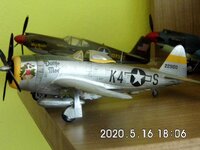
"The case for the P-47 Thunderbolt being the greatest fighter of the Second World War " (1 Viewer)

Ad: This forum contains affiliate links to products on Amazon and eBay. More information in Terms and rules

Thats an interesting assertion. I know its canon that its the case regarding the P47. But has anyone ever actually analysed which aircraft delivered 'the best odds on getting back'?

How can it be quantified, given it was also undertaking some of the most hazardous missions? Was its loss rate per sortie measurably superior to types undertaking the same missions, like say for ground attack, Hawker Typhoons? Or for bomber escort, P38s or P51s?
Your point and questions are valid. What appears to be true is that the P-47 loss per sortie is lower than P-51.

What is not baked into the data are three important silos of data.
1.) Number of escort sorties in which no enemy contact was made.
2.) Average radius of each sortie into enemy airspace. The reason this is important is that the distance to return to friendly territory with a damaged ship is important.
3.) Average threat environment for each sortie. For example, this factor IMO is higher for CAS than for escort on a sortie by sortie basis.
 
Last edited:
The Canadian Lancaster still flying is named after Pilot officer Andrew Mynarski, when their Lancaster was hit and in flames, he tried to free the trapped rear gunner, but couldnt. He eventually jumped but was too low and although he survived the landing he died later. The trapped rear gunner Pilot officer Pat Brophy survived the crash and his account of events allowed Mynarski to be awarded a V.C
That generation was beyond brave.
 
Ninth Air Force Operations 16 October 1943 to 8 May 1945, loss rates are MIA + CAT E per 1,000 credit sorties, that is sorties that came within range of the enemy. Note the hours are for all combat sorties, so the averages here are slightly higher than actual hours on credit sorties. The simplest survival measure is the ratio of MIA to category E, then the ratio of damaged to lost, but as already noted that has to be tempered by how far from base the aircraft was, hence the hours per sortie. Next are the threats, the claims give an idea of exposure to enemy aircraft, the bomb tonnage to flak. The notes make it clear there are plenty of uncertainties when it comes to cause of loss. Claims are the sum of destroyed+probable+damaged.

The Air Force lost 2347 tactical aircraft, and 742 were written off as the result of battle damage (Category E) in the full period of operations. Of every 1000 aircraft entering enemy territory 7.7 were lost or received damage resulting in salvage. Of every 100 aircraft losses or write offs for battle damage 47 were charged to flak, 13 to enemy aircraft and 40 to crash landings, accidents the result of enemy action, combinations of flak and enemy aircraft or losses with reason unknown. Bombers had a slightly lower, reconnaissance a considerably lower, and fighters a slightly higher loss rate than the air force average.

For every aircraft lost or salvaged for battle damage six received battle damage requiring major repairs or replacements. The ratio of flak loss to flak damage was one to 12.
(a) Category "A" describes aircraft repairable by the nearest convenient combat unit.
(b) Category "AC" describes aircraft repairable on site by an Air Service Command unit or equivalent.
(c) Category "B" describes aircraft to be collected by a salvage organisation and dispatched for repair to an Air Service Command or equivalent.
(d) Category "E" describes aircraft damaged beyond economical repair. Aircraft which crash in friendly territory are considered to be damaged Category "E", not lost.
P-38Credit SortieBomb tonsMIACAT ETotalRateClaimsHoursHours/sortie
Apr-44​
141​
0.000​
0​
0​
0​
0.0​
0​
1284​
9.11​
May-44​
2901​
148.500​
13​
11​
24​
8.3​
3​
6324​
2.18​
Jun-44​
4455​
1884.750​
44​
8​
52​
11.7​
45.5​
12442​
2.79​
Jul-44​
3565​
1253.250​
36​
11​
47​
13.2​
67​
9801​
2.75​
Aug-44​
3851​
1390.220​
64​
10​
74​
19.2​
128.5​
8944​
2.32​
Sep-44​
3022​
790.600​
20​
7​
27​
8.9​
37​
8621​
2.85​
Oct-44​
2271​
662.100​
25​
4​
29​
12.8​
66​
5703​
2.51​
Nov-44​
2224​
783.150​
22​
6​
28​
12.6​
15​
5408​
2.43​
Dec-44​
2740​
1284.500​
43​
5​
48​
17.5​
122​
6048​
2.21​
Jan-45​
1485​
588.600​
13​
2​
15​
10.1​
0​
3482​
2.34​
Feb-45​
1783​
1038.350​
16​
9​
25​
14.0​
13​
3492​
1.96​
Mar-45​
2974​
765.000​
13​
0​
13​
4.4​
15​
7826​
2.63​
Apr-45​
1402​
411.550​
8​
4​
12​
8.6​
9​
2883​
2.06​
May-45​
114​
0.000​
0​
0​
0​
0.0​
3​
323​
2.83​
1944​
25170​
8197.07​
267​
62​
329​
13.1​
484​
64575​
2.57​
1945​
7758​
2803.5​
50​
15​
65​
8.4​
40​
18006​
2.32​
Grand
32928​
11000.57​
317​
77​
394​
12​
524​
82581​
2.51​

P-47
Feb-44​
1098​
0.000​
5​
0​
5​
4.6​
7​
3538​
3.22​
Mar-44​
3694​
77.000​
6​
1​
7​
1.9​
13​
9399​
2.54​
Apr-44​
5465​
902.105​
14​
5​
19​
3.5​
33​
14150​
2.59​
May-44​
15079​
2974.545​
44​
8​
52​
3.4​
8​
44961​
2.98​
Jun-44​
21994​
5168.890​
186​
24​
210​
9.5​
170​
52119​
2.37​
Jul-44​
17594​
4579.410​
134​
20​
154​
8.8​
149​
36746​
2.09​
Aug-44​
18688​
3897.910​
149​
12​
161​
8.6​
158.5​
42711​
2.29​
Sep-44​
13771​
3163.340​
65​
25​
90​
6.5​
89​
39497​
2.87​
Oct-44​
12823​
4065.750​
69​
23​
92​
7.2​
157​
31181​
2.43​
Nov-44​
9431​
3062.487​
74​
18​
92​
9.8​
61​
19792​
2.10​
Dec-44​
12507​
5118.422​
128​
26​
154​
12.3​
409​
25753​
2.06​
Jan-45​
8633​
4284.156​
77​
13​
90​
10.4​
51​
17765​
2.06​
Feb-45​
13518​
6694.762​
68​
17​
85​
6.3​
82​
27730​
2.05​
Mar-45​
24969​
8942.556​
112​
38​
150​
6.0​
105​
53286​
2.13​
Apr-45​
16641​
3347.705​
73​
17​
90​
5.4​
197​
52043​
3.13​
May-45​
1286​
43.000​
4​
2​
6​
4.7​
13​
4381​
3.41​
1944​
132144​
33009.859​
874​
162​
1036​
7.8​
1254.5​
319847​
2.42​
1945​
65047​
23312.179​
334​
87​
421​
6.5​
448​
155205​
2.39​
Grand
197191​
56322.038​
1208​
249​
1457​
7.4​
1702.5​
475052​
2.41​

P-51
Dec-43​
361​
0.000​
7​
0​
7​
19.4​
24​
961​
2.66​
Jan-44​
325​
0.000​
4​
0​
4​
12.3​
98​
1333​
4.10​
Feb-44​
682​
0.000​
11​
0​
11​
16.1​
131.5​
2353​
3.45​
Mar-44​
933​
25.750​
30​
2​
32​
34.3​
64​
4317​
4.63​
Apr-44​
2052​
149.750​
39​
1​
40​
19.5​
135​
7121​
3.47​
May-44​
2194​
117.625​
21​
2​
23​
10.5​
113.5​
7119​
3.24​
Jun-44​
2733​
704.605​
31​
2​
33​
12.1​
78​
8802​
3.22​
Jul-44​
2973​
23.000​
16​
1​
17​
5.7​
81​
6458​
2.17​
Aug-44​
2691​
9.625​
32​
3​
35​
13.0​
102​
6526​
2.43​
Sep-44​
832​
58.375​
6​
0​
6​
7.2​
38​
3102​
3.73​
Oct-44​
538​
140.250​
10​
1​
11​
20.4​
35​
1533​
2.85​
Nov-44​
556​
158.000​
12​
4​
16​
28.8​
7​
1367​
2.46​
Dec-44​
38​
18.500​
1​
0​
1​
26.3​
3​
89​
2.34​
Jan-45​
0​
0.000​
0​
0​
0​
0.0​
0​
0​
0.00​
Feb-45​
479​
96.750​
7​
0​
7​
14.6​
9​
1344​
2.81​
Mar-45​
3391​
13.000​
12​
1​
13​
3.8​
76​
8785​
2.59​
Apr-45​
3544​
49.875​
14​
1​
15​
4.2​
149​
10851​
3.06​
May-45​
183​
0.000​
0​
1​
1​
5.5​
0​
548​
2.99​
1943​
361​
0.000​
7​
0​
7​
19.4​
24​
961​
2.66​
1944​
16547​
1405.480​
213​
16​
229​
13.8​
886​
50120​
3.03​
1945​
7597​
159.625​
33​
3​
36​
4.7​
234​
21528​
2.83​
Grand
24505​
1565.105​
253​
19​
272​
11.1​
1144​
72609​
2.96​
 
Battle Losses
A/C TypeCategoryP-38P-47P-51
FlakLost
115​
612​
76​
FlakCAT E
32​
131​
7​
FlakTotal
147​
743​
83​
FlakRate
4.5​
3.8​
3.4​
Enemy AircraftLost
81​
176​
41​
Enemy AircraftCAT E
6​
19​
0​
Enemy AircraftTotal
87​
195​
41​
Enemy AircraftRate
2.6​
1.0​
1.7​
OtherLost
121​
420​
136​
OtherCAT E
39​
99​
12​
OtherTotal
160​
519​
148​
OtherRate
4.9​
2.6​
6.0​
TotalsLost
317​
1208​
253​
TotalsCAT E
77​
249​
19​
TotalsTotal
394​
1457​
272​

Battle Damage

FlakA
590​
3130​
212​
FlakAC
96​
1653​
52​
FlakB
20​
81​
11​
FlakTotal
706​
4864​
275​
Enemy AircraftA
13​
50​
11​
Enemy AircraftAC
15​
110​
8​
Enemy AircraftB
2​
7​
1​
Enemy AircraftTotal
30​
167​
20​
OtherA
42​
179​
11​
OtherAC
22​
195​
17​
OtherB
7​
21​
4​
TotalTotal
71​
395​
32​
TotalA
645​
3359​
234​
TotalAC
133​
1958​
77​
TotalB
29​
109​
16​
TotalTotal
807​
5426​
327​
 
It is survivor bias, the ones that got parts blown off so it couldnt fly didnt get back to have a picture taken.
I was wondering more about why they got back, like both were hit on the guns which could have absorbed the impact, but yes survivor bias is a known thing.
 
It seems the P-47's performance in the Pacific war was, without taking anything away from those who flew and maintained them, not especially meritorious. Michael Claringbould, who has written extensive high-quality works on the air war in the South Pacific had this to say:

From "P-47D vs Ki-43 Oscar: New Guinea, 1943-44" (Oxford: Osprey Publishing 2020), p.76:

"Perhaps a more valid comparison between the effectiveness of the P-47 and the Ki-43 in New Guinea in 1943-44 can be made by studying the number of actual losses of Thunderbolts and 'Oscars' based on confirmed evidence. As previously noted, nine (perhaps ten) P-47s fell to the Ki-43, while 19 'Oscars' were shot down by Thunderbolts. This presents a kill ratio of approximately 2-to-1 in favour of the P-47. Such a figure would have astounded Fifth Air Force commanders who assessed that it was exponentially higher, and it is clear that the maneuverability of the 'Oscar' and the tactics employed by its pilots served the IJAAF well. However, these figures are secondary to the greater reality that most Ki-43s were destroyed on the ground by Fifth Air Force strafers and bombers - a threat that the Japanese could not negate. This was devastation on an industrial scale, and the fundamental misfortune and destiny of the IJAAF in New Guinea."

From "P-47D Thunderbolt Series Southwest Pacific 1943-1945", Avonmore Books, ISBN 9780645700404, reviewed by IPMS/USA:

"Numerous works to date referencing the history of the Thunderbolts in the SWPA (Southwest Pacific Area) fail to underline its disappointing SWPA record which at times verged on the disastrous. All narratives of the highest-achieving Thunderbolt combat unit, the 348th FG (Fighter Group), portray the popular image of success: a superior type carving its way through inferior opposition, earning disproportionately favourable combat results. This curious and bogus narrative derives from accepting Allied claims at face value instead of cross-checking with relevant Japanese records, and not consulting the USAAF field maintenance logs. Armed with this information, the type's true combat record in New Guinea of misfortune and lacklustre results come into sharp focus."

"When we met the Thunderbolts they immediately surrounded and separated us from protecting the Donryu (bombers). They attacked from above, outnumbering us three or four to one, however we lost no fighters. In conclusion we did not lose, and one Hayabusa which failed to drop one of its fuel tanks survived. I am of the firm opinion that the Thunderbolt can be shot down if we take advantage of its mistakes. Four enemy Thunderbolts only amount to one or two of our planes..."

This is from 248th Sentai commander Major Muraoka Shinichi, after eight Ki-43-II Hayabusa fought sixteen P-47Ds from the 36th Fighter Squadron on 26 December 1943, resulting in two P-47Ds shot down for no Japanese losses."

So despite Neel Kearby's excellent performances in the P-47 - he seems to be the exception, rather than the rule - other, less sophisticated types such as the P-40 actually performed very well while the P-47 seems to have been something of a disappointment.

And this reduces the claims about the effectiveness of the "Brisbane tank" to a footbote.
 
Last edited:
What was the skill level of the P-47's pilots during those early years of service?

The first squadrons were formed from 71, 121 and 133 Sqns, RAF. These were American volunteers who formed Eagle Squadron. It was this cadre of experienced pilots who had learnt to fight with the RAF, who passed on their experience to the rest of the Eighth fighter groups.
 
The Republic P-47D Thunderbolt "Dottie Mae" (Serial No. 42-29150) is the last U.S. Army Air Force (USAAF) aircraft lost in operational service in Europe during World War II.
The aircraft survived 90 combat missions across Europe before crashing on the final day of the war. [1, 2]

The Final Mission (May 8, 1945)
On the afternoon of Germany's capitulation, "Dottie Mae" took off as part of a 20-aircraft aerial demonstration. The flight was intended to boost the morale of prisoners at the newly liberated Ebensee concentration camp.
The Ebensee concentration camp sub-camp was liberated by the US Army (3rd Cavalry) on May 6, 1945. Before the troops arrived, but after the SS guards had already withdrawn, approximately 52 prisoner functionaries who had collaborated with the SS were killed. Hundreds more prisoners died in the weeks that followed as a result of their imprisonment.

While the fighter was regularly assigned to Lt. Lawrence "Larry" Kuhl, Lieutenant Henry Mohr was piloting it that day. Mohr flew too low over the Traunsee. The propeller blades struck the water surface, causing the engine to fail. The aircraft bounced, flipped upside down, and sank nose-first into the lake. Local Austrian youths in rowboats rescued Mohr, but the plane settled deep into the silt.

The 2005 Recovery
For 60 years, the aircraft lay untouched under 72 meters (about 236 feet) of water. [1, 2]
  • Discovery: In April 2005, Sandy Air Corp tracked down the exact location using side-scan sonar.
  • Salvage: On June 13, 2005, a specialized diving team successfully raised the airframe.
  • Preservation: The cold, fresh water and deep silt preserved the aluminum, keeping the original nose art and cockpit elements remarkably intact. [1, 2, 3, 4, 5]

The Restoration & Return to Flight
Following its recovery, World War II veteran Jack Croul purchased the aircraft. It was transported to Idaho, USA, for a meticulous, 12-year restoration. [1, 2]
  • Craftsmanship: The restoration was completed by Vintage Airframes and Allied Fighters using original factory blueprints.
  • Engine: Its original Pratt & Whitney R-2800 radial engine was completely rebuilt by Anderson Aeromotive.
  • First Flight: On June 22, 2017, "Dottie Mae" successfully flew again for the first time in 72 years.
Today, the fully operational aircraft resides at the Planes of Fame Air Museum in Chino, California.
 

Attachments

  • DSCI0009.JPG
    DSCI0009.JPG
    1.4 MB · Views: 12
About the same as the 352nd, 353rd, 354th, 355th FG - all activated October-Nov 1942.,

The first squadrons were formed from 71, 121 and 133 Sqns, RAF. These were American volunteers who formed Eagle Squadron. It was this cadre of experienced pilots who had learnt to fight with the RAF, who passed on their experience to the rest of the Eighth fighter groups.
However, the P-47 arrived in the Pacific in 1943 and any experienced pilots transferred from the ETO would have to relearn combat tactics against Japanese elements.
 
However, the P-47 arrived in the Pacific in 1943 and any experienced pilots transferred from the ETO would have to relearn combat tactics against Japanese elements.
If we are looking at the quality of the USAAF pilots, also take into account the quality and training of the Japanese pilots. Ther can be no doubt that the USAAF pilots were vastly better trained.
 

Users who are viewing this thread

Back