Thank you for the excerpts.
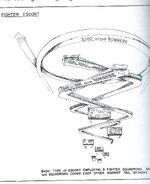
My note: This statement in the thesis pertains to the second Schweinfurt raid 14th October 1943 and here written in black and white is a clear intention to escort the bombers within the range capabilities of the escorts. So if the P-47 really could carry a 200 gallon tank at this time and extend the escort range even further, then why didn't they fit it? Well probably simply because it was not feasible to do so.
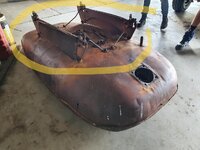
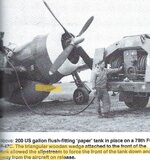
The P-47 C/D/G etc. were indeed capable for carrying a 200 gal belly tank. Trick with that tank was that it was not possible to reliably pressurize it (sorta big deal when 25000+ ft operations are in question), and that there was probably a meager amount of these manufactured (see how difficult is to find a photo of it), since the role of that tank was to be used in ferrying the fighters, that did not required high altitude operation, and thus the need for pressurization was not an issue.
USAAF used to fill it to half of the volume, in order to use up the fuel before climbing up to the hi alt (= low pressure).
That tank was also found difficult to jettison.
Due to further political pressure applied by the Combined Chiefs, a suitable 150 gallon drop wing tank was quickly developed. In September of 1943, the monthly production of 150 gallon wing tanks for the P-47 was only 300; by December it was 22,000.
The P-47s outfitted with wing racks in 1943 were as rare as hen's teeth. Yes, a number of them was outfitted, and were ferried via Greenland and Iceland to the UK, but most of P-47s arrived by ships. The 150 gal drop tank was in no need to be developed by mid-1943, since both Grumman and Lockheed have these in production. Problem was that the tanks of circular cross-section and that big will not have enough of ground clearance on a P-47.
If the tasking was taken seriously a year earlier, this one innovation could have decreased bomber losses during the fall of 1943 but emphasis arrived too late.
USAAF certainly missed the train with specifying the wing tanks facility for the P-47s from day 1.
The P-47 was supplemented by the P-51 Mustang, in numbers by the summer of 1944, which exploited the victory.
Which expolited the victory? That's blatantly short-selling the P-51s.
See
the impact the P-51s have had already during the Big Week, despite the low number deployed (roughly 1 per each 6 P-47s).
Also, the USAAF's disinterest in the P-51 Mustang prevented the plane from being in action six months earlier and at a crucial time.
USAAF disinterest in the P-51 was indeed a bad thing.
So was the 2-stage Packard Merlins being a bit too late, that saw about 360 engine-less P-51s to gather dust in June 1943, awaiting for engines. So we'd need also Packard to somehow hand-wave a few hundreds of the required engines, months earlier than it was the case.
I suppose there is always a risk that those who do not like the conclusions from this document may say that an officer like Greg Grabow has a horse in this race for some reason. However, it's a thesis after all and if what is written here is not historically correct then there would not only be a problem of some isolated individuals attempting to rewrite history, but a huge academic problem.
Greg Grabow was doing his thesis for the US Army,
not the USAF, 45+ years after the combat. How much of a 'heavy-weight' connoisseurs were the Army officers into what is not their cup of tea in 1990?
Why? Well because in that case a masters thesis at the U.S. Army Command and General Staff College has passed muster but completely missed the fact that the P-47 actually could escort all the way to Schweinfurt with a 200 gallon tank and that some dog headed Generals sabotaged this opportunity.
Note that G. Grabow says that combat radius of the P-47, after the increase of both internal and external fuel, was 400 miles*. It is about 520 miles from Dover and Schweinfurt.
Granted, P-47's will need to reach at least RAF bases in Kent, since East Anglia is too far away. This also assumes no wiggle room - ie. an ideal path to the target and back.
*wrong numbers, though
And in summary, to me Greg Grabow makes a very strong case in his masters thesis that the P-47 was unable to provide long range escort at the time simply because a suitable drop tank was not available. And in my opinion, the onus lies on those who think this thesis is wrong (about the 200 gallon tank) to provide credible evidence to support that. Not the other way around.
Trick was, partially, that "suitable drop tank was not available". Other part of the trick to reach Schweinfurt was in having more fuel internally.