The Great P-47 Range Debate on you tube now. (2 Viewers)

Ad: This forum contains affiliate links to products on Amazon and eBay. More information in Terms and rules

I might be wrong about this but it was my impression they were used on 6 March for Mission 250. They may have used smaller tanks. I had the impression the 108 gallon tanks were fitted from Jeff Ethell and Dr Alfred Price's book "Target Berlin: Mission 250, 6 March, 1944". But when I looked for that information, I couldn't find it.
Both the 355th and 4th FG histories from USAFHRC note the arrival of the 150-gal (flat) centerline tanks for Big week. Ditto Zemke's biography written by Freeman. The 4th was all P-51B on Feb 28th so only 75-gal tanks were used for the March 4 and 6 Berlin missions. The 355th converted on March 9 to all P-51B.
On 6 March, 1944, P-47s got as far as just north west of Magdeburg and I couldn't see how that would be possible without 2x10⁸ gallons externally. I'm going to confess to a level of conjecture here but please hear me out. Your P-51 book gives the P-47 a radius of 475nm in April, 1944, equipped with 2x150 gallon tanks. From what I've been able to glean, while the biggest gains were made with smaller tanks, it doesn't scale linearly and sooner or later you run into a law of diminishing returns.
The 56th, 355th and 78th all escorted to Misburg/Hannover area with 1x150-gal tanks. There is often a contrast between FAREP published data (which is Escort mission with combat assumptions for 20 minutes) and Fighter Mission in which there is no close escort duty. An example would be a sweep in front (56th FG on March 6) and a Withdrawal Support, where the escort R/V is with bombers returning at the far end of the combat radius. The farthest victory credits were NE of Dummer Lake, nowhere near Magdeburg. The 56th achieved VCs from Minden/Osnabruck all the way to NE Dummer Lake before returning. Another deceiving fact is that the 56th was at Halesworth on the east coast and the 355th and 78th were based ~40 miles further away.
Johnson talked about a battle over Dümmer Lake. In the above mentioned book, it's described as "Clash over Haseluenne".

But as to the exact size of the tanks, I'm not sure. As an aside, I have been tempted to set up a spreadsheet and see if I can actually get a reasonable trend line for centreline and under wing tanks of different sizes. I don't wish to get into competition with Greg for whose calculations are better. He can have that on his own. But it might be useful to know what was and was not possible.
His calculations are not better. Greg correctly finds Operating data from the Pilot Operating manuals, but all those range data are contractor Calculations for 'yardstick' range with reserves as noted. Greg completely ignores the fuel consumption data presented in FAREP for single ship legs of 'takeoff and climb', 'cruise', 'fight', 'cruise back', 'land with 1/2 hour reserve'.

He ignores the significant drain on internal fuel experienced by 50 fighters warming up, squadron level gaggle taxiing in an elephant walk to the active runway while the other two squadrons idle, taking off in pairs, forming flights and squadron while the next squadron repeats, and so on as the entire group positions in the complete formation and begins climb to altitude. Here is where the P-47 departs from P-51 in that the P-47 switches to the external tank, where the Mustang might continue burning internal fuel, switching to fuselage tank from left main.

Further the P-47 takes a couple more minutes to climb to 25 (or 30000 feet) on climb power before throttling back to cruise MP. Each one of the configurations of external fuel impose higher drag conditions, requiring greater fuel consumption to maintain desired escort cruise speeds perhaps 50mph TAS faster the the bombers they are escorting.

Both Chris Fahey, Delta Captain, HOF Warbird pilot (usually P-38, F6F, F4U, P-51, Mig 15, F-86) and former Lawn Dart driver for 8th FW, and I have corrected Greg on his assumptions, but he responded with 'settled science'. Chris did fighter mission planning for a living in single engine F-16s and thoroughly acquainted with all the warbird characteristics named above (vs zero experience for Greg on anything but straight-line travel planning in jet transports). I have a MS in Aero and have done many calculations using the same math as North American, Republic, etc. in their Performance Analysis Reports to Mat.Cmd. Those report data and tables are the same source documents used by Mat.Cmd to develop the FAREP charts and tables.

Perhaps the most egregious example was his attempt to present the case that the Republic 205-gal ferry tank would easily enable the P-47 to escort to Schweinfurt !!!!, thereby making the case that Mustangs were never required for ETO escort (or P-38). Despite a flood of documents showing the limitations of feeding fuel via suction (non-pressurized) to the 18-22K altitude range he first persisted that the tanks could be filled to max and still permit escort at 30,000 feet. Because the P-47 needed to provide escort at 25K to 30K operating altitudes, not fly under the bomber stream VIII FC correctly limited to 100 gallons so that the tank could efficiently use that fuel to climb to 20,000 feet, drop the tank and fly the rest of the mission on internal fuel. The tanks were jettisoned over the Channel or N.Sea. He completely ignored that there were sound reasons why the longest actual escort mission flown with the205-gal ferry tank was to Emmerich from Debden (260mi) and Aachen from Halesworth (250mi) - a little over halfway to Schweinfurt.

The first actual, near-Schweinfurt length mission flown by P-47D-15/16 equivalent with 2x150 gal drop tanks was May 19, 1944 to Halberstadt from Boxted by 56th FG (420mi).

I have sourced and sent Greg volumes of data, but nothing changes his mind.

On the matter of Greg... What Greg is doing is building a tribalist narrative. He's deaf to history because it's lethal to his position of "standing up for the little guy and the underappreciated" and "all the commanders were self-interested dolts". These are the usual clarion calls for someone trying to appeal to a very broad base, one that's, for the most part, more invested in tee shirts than text books.

I have questioned him twice on points he was making. On the first occasion he - unusually - backed down. On the second occasion I asked for a simple historical context and he told me he was only interested in technical arguments. But this is a historical matter, not a technical one.

He knows exactly what he's doing, of course.
I agree. I don't attribute to stupidity.
My background is journalism, PR and academia. I don't have any misapprehension about people's perceptions of that. But the first thing I learnt in journalism was "to get the best available version of the truth". That means getting both sides of the story but it doesn't mean equal air time for flat earthers. What Greg is doing is intellectually dishonest. Even if he truly believes the P-47 was better, his lack of willingness to defend the weak parts of his argument - "That's already settled" - his lack of willingness to correct the appalling nonsense that comes up in the comments section on his channel and his outright dismissal of historical record, mark him as a bit more than merely misguided. Everyone has their own favourite, even me but that's not the same thing. His videos have never had to be peer reviewed before he posted them.

Hundreds of thousands of people have been directly influenced by this and I note that even the IWM videos have started to lean into the hyperbole.

Thanks for your information. It's an interesting story and one that I never expected to go this deep into.

I think I'd better stop here for now!

By the way, if you need anyone to help proof read your manuscript, let me know.
I appreciate but that horse is out of the barn and in final layout.
 
The farthest victory credits were NE of Dummer Lake, nowhere near Magdeburg.
Yes, I saw that on the map. The reason I mentioned Dümmer Lake is a bit complicated. Magdeburg - or at least, just short of it - was where they were due to be relieved by P-51s. I mentioned Dümmer Lake because it was well beyond the range of the vast majority of P-47 FGs that flew on that mission.

Point taken on the 75 gallon tanks.

Both Chris Fahey, Delta Captain, HOF Warbird pilot (usually P-38, F6F, F4U, P-51, Mig 15, F-86) and former Lawn Dart driver for 8th FW, and I have corrected Greg on his assumptions, but he responded with 'settled science'. Chris did fighter mission planning for a living in single engine F-16s and thoroughly acquainted with all the warbird characteristics named above (vs zero experience for Greg on anything but straight-line travel planning in jet transports). I have a MS in Aero and have done many calculations using the same math as North American, Republic, etc. in their Performance Analysis Reports to Mat.Cmd. Those report data and tables are the same source documents used by Mat.Cmd to develop the FAREP charts and tables.
I have sourced and sent Greg volumes of data, but nothing changes his mind.
He can't hear you. It's the sad reality with some people, even intelligent ones and he's obviously that.

I just think it's ironic that in the face of such solid information from people who actually know, he bases his entire hypothesis and conclusions on something that turns out to be little more than a box label.
 
The first actual, near-Schweinfurt length mission flown by P-47D-15/16 equivalent with 2x150 gal drop tanks was May 19, 1944 to Halberstadt from Boxted by 56th FG (420mi).

Allow me to stir the pot.

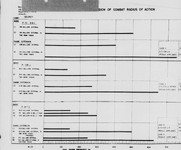
This is the chart that Greg uses in his video. There are a couple of things that I noticed.

1. The range shown for 370 gallons and twin 150s is 700 miles in this estimate.
2. The range for 305 gallons and twin 150s is 500 miles as well.
3. The range for 305 gallons internal no tanks is 150 miles.
4. The range for 370 gallons internal no tanks is 250 miles.
5. By this prediction the 2 x 150 gallon tanks will increase range by the following; 350 miles for earlier P-47 and by 450 miles for later P-47. I am simply taking the difference between internal and external ranges to quantify the predicted range increased based on the data in the chart.

500mi Total - 150mi Internal = 350mi (Early P-47)
700 mi Total - 250mi Internal = 450mi (Late P-47)
1782793947634.png


This chart was later corrected to the one that is found in Case History Of Fighter Range Extension / Droppable Fuel Tanks. The only figure that is changed is the 370 gallon estimate is reduced from 700 miles to 625 miles. This gives a new figure of around an additional 375 miles increase in estimated range.

Another thing that I think that is noteworthy about these figures is that they are simply calculations and not based on practical testing. The mission profile also appears to be something that AAC invented to approximate the bomber escort mission so that calculations could be made.

1782795799484.png


1782795873203.png


1782795985533.png


The study produces range figures for the P-47 that are basically identical to the ones that we see in the FAREP chart. This puts P-47 total range with 2x150 tanks at 1045 miles. If we consider half of that to be the radius then that gives us a radius of 520 miles.

The same study produces figures for planes that would not have enough internal fuel to make it home without retaining the external wing tanks.

What is interesting is that both mission profiles appear to be slightly different with the paper study not requiring to accompany bombers flying at 165mph IAS which is present in the first profile.
 

Attachments

  • 1782795067697.png
    1782795067697.png
    273.5 KB · Views: 18
  • 1782795351523.png
    1782795351523.png
    406.7 KB · Views: 22
Allow me to stir the pot.

This is the chart that Greg uses in his video. There are a couple of things that I noticed.

1. The range shown for 370 gallons and twin 150s is 700 miles in this estimate.
2. The range for 305 gallons and twin 150s is 500 miles as well.
3. The range for 305 gallons internal no tanks is 150 miles.
4. The range for 370 gallons internal no tanks is 250 miles.
5. By this prediction the 2 x 150 gallon tanks will increase range by the following; 350 miles for earlier P-47 and by 450 miles for later P-47. I am simply taking the difference between internal and external ranges to quantify the predicted range increased based on the data in the chart.

500mi Total - 150mi Internal = 350mi (Early P-47)
700 mi Total - 250mi Internal = 450mi (Late P-47)
View attachment 885436

This chart was later corrected to the one that is found in Case History Of Fighter Range Extension / Droppable Fuel Tanks. The only figure that is changed is the 370 gallon estimate is reduced from 700 miles to 625 miles. This gives a new figure of around an additional 375 miles increase in estimated range.

Another thing that I think that is noteworthy about these figures is that they are simply calculations and not based on practical testing. The mission profile also appears to be something that AAC invented to approximate the bomber escort mission so that calculations could be made.

View attachment 885441

View attachment 885442

View attachment 885443


The study produces range figures for the P-47 that are basically identical to the ones that we see in the FAREP chart. This puts P-47 total range with 2x150 tanks at 1045 miles. If we consider half of that to be the radius then that gives us a radius of 520 miles.

The same study produces figures for planes that would not have enough internal fuel to make it home without retaining the external wing tanks.

What is interesting is that both mission profiles appear to be slightly different with the paper study not requiring to accompany bombers flying at 165mph IAS which is present in the first profile.
There are several errors in the above charts. They were later corrected when FAREP (April 45) presented tables for all conditions of fuel and gross weight by model. There is also

The P-51B yardstick range was 975 mi with 180-gal internal fuel only. GW =9237. Escort range 175mi.
P-51B Internal fuel 269 gal range, GW = 9830. Yarstick Range 1,350. Escort range 375mi
P-47D yardstick range was 835mi with 305-gal internal fuel. GW=13, 580mi. Escort range=125mi.
P-47D yardstick range (D-25) was 1020 mi, GW=14,400. Escort Range=275mi.

Additionally the tables you retrieved were incorrect in the following:
P-51B with only 180 (184) gallons internal fuel had GW=9237 (not 9,050) pounds, never carried 108 0r 150-gal drop tanks. Only when all P-51Bs were upgraded to 269-gal internal fuel (kit and factory by Feb 1944) were 108-gal tanks added to inventory for Mustangs in May 1944. Heretofore all 108-gal drop tanks went to P-47 missions.

The label 'Two 150-gal tanks' for the gross weight addition of ~2,100 pounds over the GW of P-51B w/o 85-gal fuse tank would have been correct ONLY for the addition of 2x10⁸-gal drop tanks plus the 85-gal fuse tank. In any case the yardstick range for P-51B with only 180 gal Internal fuel plus 2x75-gal wing tanks was 1575mi.
The Yardstick range of the P-51B with 269gal (265 in chart and table) plus 2x75-Gal was 1850.

Additionally incorrect in the above table for the P-47D with 305 gal internal and 2x150-gal externals. The GW is correct (15,600) but the yardstick range was 1,525mi, much more than 1,045mi shown (but still 300mi shorter than P-51B with 180-gal internal plus 2x75-gal externals.

The P-38H/J/K on internal fuel of 300-gal was also severely understated. All at 17,000 to 17,600 pound GW had yardstick ranges near 900 mi, which increased to 1,175mi when the 2x55-gal LE tanks were added.

Suggest you find AAF Tactical Planning - Characteristics and Planning Chart, AAF Materiel Command, Technical Division. It is a monthly release of performance, range and weight tables for all AAF aircraft (incl. XP-51F and XP-72). These reports are the source data for FAREP, although FAREP made multiple mistakes in the transformation of the data. Also The Characteristics and Performance Charts from same sources are what you see in the contractor Pilot Operating Manual


In turn, the sources for the AAFTP and CPC chart data were the actual contractor Performance Analysis Reports for each model.


The AAFTP data is what I founded all my FAREP tables presented in my new book.
First
 
A word about the 200-gallon Republic / Ohio Rubber Company Ferry Tank as it has been called in this thread. I am not entirely sure that it was purely intended as a ferrying tank, or at least that Republic and the AAC were possibly under the impression that it was usable as a combat tank. The reason that I say that is because there are not any explicit developments of a distinct combat drop tank for the P-47 until theater commanders developed their own and the AAC decided to shit-can the Republic Tank. However at a glance it looks like the AAC was acquiring these 200 gallon tanks in large enough quantity that it is apparent they intended to use them for both ferrying and combat range extension. At least you would think that when the 8th Airforce was explicitly increasing its request for combat drop tanks for Bolero that someone in the chain would have pointed out that the 200-gallon tank was only suitable for ferrying.

Here is a short chronology of events that are from Case History DFT/FAREP that I have composed.

1. Republic was directed to construct a leak-proof 200 gallon streamlined tank for combat range extension before March 27 1943. This arrangement was chose in-lieu of equipping the plane for the Lockheed-style attachment system for fuselage and wing tanks that every other fighter plane use because they were deemed unsuitable. This memorandum does not make it clear as to why the triple-tank arrangement was deemed unsuitable or who deemed it unsuitable. This memorandum also does not make it clear whether or not the 200-gallon combat tank is to be droppable or not; however it was only a few days prior that it had been decided that combat drop tanks did not have to be leakproof but non-droppable tanks would be.

There is an argument to be made here that the 200-gallon tank that Republic was told to develop was a form-fitting tank that was not droppable. Regardless this decision is also why there are no triple-tank P-47s until the middle of 1944.

2. During approximately the same time period; days before or days after this memo, the AAC made it policy that all fighters should be delivered with 1 set of ferry tanks and 6 combat drop tanks.

3. The 200-gallon tank that Republic designs is initially made out of metal but is also able to be produced as a fibre tank. Initially they had thought that U.S Rubber Company and McKenzie Muffler Company would produce the tanks. The contractor that they had actually decided on was Ohio Rubber Company and this tank would start production in around October of 1942.

4. In July of 1942 the 8th Airforce increased it's tankage requirements from 6 combat drop tanks per fighter to 34 combat drop tanks per fighter. This set off a chain reaction that caused the AAC to reassess their previous policy and basically tailored the tankage stockpile requirements based on location and theater. In these memos the tank requirement is mentioned for the P-47 and does appear to operate under the assumption that there is in development a 200 gallon tank for the P-47.

5. By February 1943 the Ohio Rubber Company had only shipped around 60 of the 200 gallon Republic tank. This tank was delayed in large part due to Republic having to redesign the crash skid and because the tank initially failed vibration testing. This was not the only ORC tank to fail vibration testing but also was not uncommon.

6. The Army Air Corps had ordered 6800 of this 200-gallon ORC tank; these are quantities that are similar to orders for P-38 and P-39 tanks.

7. This tank was tested in Europe and was unsatisfactory and was discontinued around June 1943. It did not have enough ground clearance, caused the aircraft to fly like shit, and couldn't draw fuel at high altitude.

8. However in July 1943 the Ohio Rubber Company was also vibration testing a 200 gallon tank with a K-1 wind driven pump. It is unclear whether or not this was an entirely new tank design for the P-47 or an adaptation of the tank design that they had already been manufacturing. The K-1 wind driven pump was the Army's preferred solution in-lieu of supercharging the fuel tanks.

I will do file attachments later but all of these points are in FAREP Case Histories.
 
Last edited:
Recall that Greg asserted that Arnold sent Kenney 'P-39 drop tanks' which Kenney did not state on pg 264 pf Kenney Reports. That aid, ANY tank sent would have standard 14" OC lugs which would not fit the P-47C until B-7 racls were sent out late August 1943. Ref. Attached below.

Does this state what kind of tanks were sent?

The reason I asj is because it was determined in around June 1943 that the 150 gallon P-39 ferry tank was suitable as a centerline combat tank for the P-47 and appears to be the de-facto solution after the cancellation of the 205 gallon Republic/ORC tank.

I'll have to look at the case study but the impression that I got that the initial solution in the SWP was to modify 150 gallon P-39 tanks for the Republic attachment system or adapt Kenny's P-47s to the standard centerline attachment.
 
Does this state what kind of tanks were sent?

The reason I asj is because it was determined in around June 1943 that the 150 gallon P-39 ferry tank was suitable as a centerline combat tank for the P-47 and appears to be the de-facto solution after the cancellation of the 205 gallon Republic/ORC tank.

I'll have to look at the case study but the impression that I got that the initial solution in the SWP was to modify 150 gallon P-39 tanks for the Republic attachment system or adapt Kenny's P-47s to the standard centerline attachment.
No, because he didn't know but they were standard 75-gal and Lockheed 150/165-gal with standard 14" OC attach scheme - which needed much modification to attach to P-47 skid plate. Besides the 150 gal was too large for C/L. Ditto the P-39 ferry tank.
 
A word about the 200-gallon Republic / Ohio Rubber Company Ferry Tank as it has been called in this thread. I am not entirely sure that it was purely intended as a ferrying tank, or at least that Republic and the AAC were possibly under the impression that it was usable as a combat tank. The reason that I say that is because there are not any explicit developments of a distinct combat drop tank for the P-47 until theater commanders developed their own and the AAC decided to shit-can the Republic Tank. However at a glance it looks like the AAC was acquiring these 200 gallon tanks in large enough quantity that it is apparent they intended to use them for both ferrying and combat range extension. At least you would think that when the 8th Airforce was explicitly increasing its request for combat drop tanks for Bolero that someone in the chain would have pointed out that the 200-gallon tank was only suitable for ferrying.
It was never conceived as a droppable combat tank. As designed, when jettisoned (with difficulty) itfrequently hit the empennage. VIII ATS devised a 'glued bow plane' to push it away from the Airframe. The P-47 was not intended for the 8th AF until Eisenhower denuded it to form 12thAF in mirror image. It was only when the longer range P-38s were pulled that the 56 FG was tasked to go to ETO.

Materiel Command had no clue that the Ferry tank was a.) unique in mounting scheme, and b.) was incapable of 7.5 psi internal pressure. It could only use the standard fuel pump draw/suction which was inadequate from 18 to 22,000 feet.
Here is a short chronology of events that are from Case History DFT/FAREP that I have composed.

1. Republic was directed to construct a leak-proof 200 gallon streamlined tank for combat range extension before March 27 1943. This arrangement was chose in-lieu of equipping the plane for the Lockheed-style attachment system for fuselage and wing tanks that every other fighter plane use because they were deemed unsuitable. This memorandum does not make it clear as to why the triple-tank arrangement was deemed unsuitable or who deemed it unsuitable. This memorandum also does not make it clear whether or not the 200-gallon combat tank is to be droppable or not; however it was only a few days prior that it had been decided that combat drop tanks did not have to be leakproof but non-droppable tanks would be.
Go find the Kelsey memo of March 27, 1942. He also instructed Republic to modify wing and belly racks to mount 3x75-gal 'droppable' standard tanks to improve ferry range, but short of 3,000 miles intended for 600-gal tank. The memo did not deem the three mount system 'unsuitable', Republic merely ignored materiel Command Fighter Branch.
.
There is an argument to be made here that the 200-gallon tank that Republic was told to develop was a form-fitting tank that was not droppable. Regardless this decision is also why there are no triple-tank P-47s until the middle of 1944.
Look to Branshaw correspondence with Echols re: ordering Republic on June 1, 1943 to once again devlop adaptors so that the VIII FC P-47s could use the 150gal and 75-gal tanks remaining in 8th AF inventory following the Bolero migration. Republic did respond, delivering two modified D-4s in July and testing both wing and belly 'std2 lug racks'. The flight tests noted the dwindling capablity to draw fuel above 18-20,000 feet using std G-9 internal fuel pump. The belly rack was delivered beginning with D-5 and wing racks in October for D-15. Kits for C/L mounted 75 gal were delivered just after the August 17 raid, workable for the 108 and 150-gal flat tank as they became available

2. During approximately the same time period; days before or days after this memo, the AAC made it policy that all fighters should be delivered with 1 set of ferry tanks and 6 combat drop tanks.

3. The 200-gallon tank that Republic designs is initially made out of metal but is also able to be produced as a fibre tank. Initially they had thought that U.S Rubber Company and McKenzie Muffler Company would produce the tanks. The contractor that they had actually decided on was Ohio Rubber Company and this tank would start production in around October of 1942.
A total of 1400 were produced. Clearly not intended as droppable combat mission tanks.
4. In July of 1942 the 8th Airforce increased it's tankage requirements from 6 combat drop tanks per fighter to 34 combat drop tanks per fighter. This set off a chain reaction that caused the AAC to reassess their previous policy and basically tailored the tankage stockpile requirements based on location and theater. In these memos the tank requirement is mentioned for the P-47 and does appear to operate under the assumption that there is in development a 200 gallon tank for the P-47.

5. By February 1943 the Ohio Rubber Company had only shipped around 60 of the 200 gallon Republic tank. This tank was delayed in large part due to Republic having to redesign the crash skid and because the tank initially failed vibration testing. This was not the only ORC tank to fail vibration testing but also was not uncommon.

6. The Army Air Corps had ordered 6800 of this 200-gallon ORC tank; these are quantities that are similar to orders for P-38 and P-39 tanks.
Define ORC tank? Mat.Cmd had also put in motion the 150gal flat tank and the 110gal steel tank modified from 75gal tank.
7. This tank was tested in Europe and was unsatisfactory and was discontinued around June 1943. It did not have enough ground clearance, caused the aircraft to fly like shit, and couldn't draw fuel at high altitude.
The 205gal Republic tank first Op was July 28th and last was August 26th when everyone converted to the superior 75gal drop tank on the new Keel/rack.
8. However in July 1943 the Ohio Rubber Company was also vibration testing a 200 gallon tank with a K-1 wind driven pump. It is unclear whether or not this was an entirely new tank design for the P-47 or an adaptation of the tank design that they had already been manufacturing. The K-1 wind driven pump was the Army's preferred solution in-lieu of supercharging the fuel tanks.

I will do file attachments later but all of these points are in FAREP Case Histories.
a standard G-9 as an immersible pump improved fuel feed slightly and was sent along with P-47D-4 to SWP for the Brisbane tank. When all the new D-6 arrived with standard two point attach, the Brisbane tank was modified from 2 pairs of 28" OC on the sway brace to one set of 14" OC on the tank itself.
 
No, because he didn't know but they were standard 75-gal and Lockheed 150/165-gal with standard 14" OC attach scheme - which needed much modification to attach to P-47 skid plate. Besides the 150 gal was too large for C/L. Ditto the P-39 ferry tank.


June 16 1943 memo fof 20,000 P-39 Flat Top Tanks

1782859156132.png


July 1943 Memo
1782859538380.png

The second page of the same memo.

"e. 200-gallon, droppabe, range extension, (fiber) tank. This is the tank that gave unsatisfactory flight characteristics to the P-47; for this reason its production and use have been discontinued."

This is also the only place that I have seen the 200-gallon Republic Tank referred to as a range extension tank and not a ferry tank. But I think it is likely that Republic made it to fulfill both roles.
1782859756071.png


25 July 1943 Memo to 5th AF
1782860018039.png


1 August 1943 Memo

It appears that AAC did send some of the much-vaunted 200-gallon Republic/ORC tanks.
1782860131924.png

27 Aug 1943 Memo

Note that the last paragraph. "The P-47 belly tank fuel system they use is essentially the same as is incorporated in our modification for adapting P-39 and P-40 belly tanks to this airplane." I would argue that it does appear that the AAC had some method for adapting P-39 / P-40 tanks to be used with the P-47 and was the immediate option they were pursuing with the cancellation of the P-47 Republic/ORC tank.
1782861092012.png


To my recollection the P-39 150 gallon flat-tank was also produced by Ohio Rubber Company.
 
Last edited:
Hey Squish,

The SWP P-47 units adapted the P-38's 150/165 USgal streamlined DTs (these are sometimes called 'Lockheed' tanks) for use on their wing stations. The 8th AF did the same in the ETO at some point. I do not have any info on which theater did it first.

RAF P-47D with the steel Lockheed tanks in the SWP or CBI.
P-47D w:165 USgal DTs copy2.jpg


USAAF P-47D with the (aluminum?) Lockheed tanks headed for the ETO.
P-47D 2x165 USgal DTs_101 copy.jpg


As opposed to the early-200 USgal 'fibre' ferry tank made by Ohio Rubber.
P-47 200 USgal ferry DT_10 copy.jpg
 
Last edited:
Go find the Kelsey memo of March 27, 1942. He also instructed Republic to modify wing and belly racks to mount 3x75-gal 'droppable' standard tanks to improve ferry range, but short of 3,000 miles intended for 600-gal tank. The memo did not deem the three mount system 'unsuitable', Republic merely ignored materiel Command Fighter Branch.
1782861869360.png

This is the memo I am referring to. 1943 was a typo.
"This study involved mounting beneath the fuselage and outboard on the wings but was generally speaking was a poor solution. Republic has been instructed been instructed to proceed with a 200 gallon leakproof faired belly tank for increased combat range and to continue study and development of a larger tank..."

This memo does not indicate why the triple tank solution was considered poor or what side of the fence that claim came from. Did the AAC tell Republic to put drop tanks on the plane and the designers say "No...it will make it too slow. No it will take too long. Etc" However it does establish that the AAC did want some form of combat range extension tank for the P-47.
Look to Branshaw correspondence with Echols re: ordering Republic on June 1, 1943 to once again devlop adaptors so that the VIII FC P-47s could use the 150gal and 75-gal tanks remaining in 8th AF inventory following the Bolero migration. Republic did respond, delivering two modified D-4s in July and testing both wing and belly 'std2 lug racks'. The flight tests noted the dwindling capablity to draw fuel above 18-20,000 feet using std G-9 internal fuel pump. The belly rack was delivered beginning with D-5 and wing racks in October for D-15. Kits for C/L mounted 75 gal were delivered just after the August 17 raid, workable for the 108 and 150-gal flat tank as they became available

I am well aware.
1782866982925.png


1782867102624.png

A total of 1400 were produced. Clearly not intended as droppable combat mission tanks.

There were only 59 available in early 1943.
1782862723392.png


They ordered roughly 7000 of the ORC tanks by February and wanted production scaled to 300 tanks per week in 1943. Admittedly it is far less than the quantity of Lockheed tanks ordered but it should also be noted that the requirements for the P-38 was double that of single engine fighters.

1782864702200.png


1782862860106.png


If we rewind to July 1942 we have this memo from Echols. This requests 34 combat extension tanks per single engine fighter in support of Bolero.
1782863066545.png

This is the 2nd page of the memo. Note they are suspending shipment of P-39 expendable combat tanks in order to get more tanks for P-38 and P-47 to Europe. Note that at this time the 200 gallon ORC tank does not exist. This is in-between the March 27 1942 directive and the actual deliveries only being 60 tanks in early 1943. But one of the things that you will not in looking through the DFT/FAREP case study is that there is basically no explicit distinction between the 200 gallon ferry tank or any explicit mention of developing a combat tank.
1782863237494.png


I think it is reasonable to consider that the 200-gallon Republic tank was billed as a combat capable tank and it was simply a piece of shit. It might have been so much of a piece of shit that T.I 1016 was revised to include a paragraph about the tank not altering the directional stability of the aircraft.
 
Last edited:
Define ORC tank? Mat.Cmd had also put in motion the 150gal flat tank and the 110gal steel tank modified from 75gal tank.

I am defining the 200-gallon fibre tank as the Republic/ORC tank. This is the actual design of the Republic tank that went into production.

1782863822668.png
1782863897784.png


This is a July 1942 memo. Note that Republic only had one drawing number for their 200-gallon tank and their expected vendor was going to be US Rubber Company (Fibre) and McKenzie Muffler (Metal). There is no novel 200-gallon metal drop tank design that is different from the fiber one; they both appear to fill the same requirement and the tank can be made out of either material.

Ohio Rubber Company is also on the list of vendors. We know that ORC was chosen based on the following memo.

1782864302609.png


By January 1943 the Republic/ORC tank was failing vibration testing. At a glance I cannot find an instance of this tank passing the vibration testing in the case history but I might have glanced over it.
1782864183314.png


By July 1943 it appears that ORC was experimenting with adding K-1 Wind Driven pump to their 200 gallon Republic tank. It is unclear if this is a clean sheet design or a modification of the existing tank.
1782865074254.png
 
Hey Squish,

The SWP P-47 units adapted the P-38's 150/165 USgal streamlined DTs (these are sometimes called 'Lockheed' tanks) for use on their wing stations. The 8th AF did the same in the ETO at some point. I do not have any info on which theater did it first.

RAF P-47D with the steel Lockheed tanks in the SWP or CBI.
View attachment 885568

USAAF P-47D with the (aluminum?) Lockheed tanks headed for the ETO.
View attachment 885572

As opposed to the early-200 USgal 'fibre' ferry tank made by Ohio Rubber.
View attachment 885570

Your top photo is of a 1944+ P-47D model. You can tell by the bubble canopy if nothing else.
Your middle photo with the Lockheed tanks is a ferrying arrangement and was not suitable for combat.

The ability to carry Lockheed style wing tanks into combat was not a capability that the P-47 would begin to incorporate until late in 1943. Initially planes that were already in the field were thought to require too many man hours to modify but eventually a solution was found; but once again...not until very late in 1943.
1782865917347.png


In fact Republic had to be urged to expedite this modification as well. They had initially said the modification would only be possible by Mid-December 1943.
1782866272401.png


1782866347055.png
 
On the matter of Greg... What Greg is doing is building a tribalist narrative. He's deaf to history because it's lethal to his position of "standing up for the little guy and the underappreciated" and "all the commanders were self-interested dolts". These are the usual clarion calls for someone trying to appeal to a very broad base, one that's, for the most part, more invested in tee shirts than text books.

This is something of an underexplored aspect when it comes to Greg's videography and how he chooses to cover topics. I think that in a lot of ways Greg sees himself as something of a disciple of John Boyd and his line of thinking. He might not be directly a "Reformer" like Pierre Sprey but he is definitely intellectually downwind of them. If we look at Greg's channel we will see that in his coverage of Boyd that he basically repeated the Robert Coram book "Boyd: The Fighter Pilot That Changed The Art Of War" at face value. The Coram book is very representative of how Boyd and his followers perceived him and does a lot to exaggerate his actual accomplishments. Boyd was largely a legend in his own mind and nearly a deity in the minds of his followers. There is not a good idea that the US Military has had in the past 80 years that cannot be attributed to Boyd according to his followers. "Flying Camelot: The F-15, F-16, and the Weaponization of Fighter Pilot Nostalgia" by Michael W Hankins is probably the only credible scholarly work that adequately tackles the mythology and actual accomplishments of Boyd, and does a good job of reconciling the legend with reality, as well as the difficulty of covering Boyd in general.

Basically Boyd has a few very significant accomplishments in the form of Energy Maneuverability Theory, his participation in the F-15 program, and more or less driving the design of the YF-16 and YF-17. Hankins book is available on JSTOR if you have access to it and goes much more into depth than I can in this post. It should go without saying that one of the ways that Boyd always framed himself and his friends was that they were part of the "Fighter Plane Mafia" and they were locked in a pitched moral battle to wrestle control of the USAF from the "Bomber Mafia". Boyd and his followers also never abandoned this framework regardless of whether or not the Pentagon was doing what it wanted or letting them run the show. Even when they "won" in the case of shoving the F-16 down the throat of the USAF...they still wouldn't claim victory because it was "ruined" by the USAF equipping it with a decent radar and air to ground ordnance.

Even after Boyd died and a lot of his followers still carried the mantle; the most notable in the public eye was Pierre Sprey. My personal opinion is that the phrase "Bomber Mafia" and it's use as a pejorative term can probably largely be tied back to Boyd or Sprey. In that they also embraced the narrative of the P-51 as an upstart cheap high performance alternative to the far too complicated and expensive P-47 and used it as allegorical of what they were trying to accomplish in the 1970s-1980's. It also might be where the idea that the P-51 could only be designed by a German immigrant might have originated from because both Boyd and Sprey were enamored with the German fighter pilot mythos and that probably just extended to Germany in general. Now that is speculation on my part; I am still in the process of tracking down Boyd's correspondence, writings, etc to see what he and his followers had to say about the P-51.

This is an example of a presentation that Stevenson/Sprey were giving in 2006. This is a slideshow criticizing the USAF procurement of the F-22 for basically the same litany of reasons they always have. For anyone with even a passing understanding of modern aviation this presentation is maybe one of the funniest things you will ever see. However the oddity aside, the important thing here is that they tie their then present day criticism of the USAF directly back to the AAC in the 1940's. In the slide deck you will also see the perpetuation of some historical myths.


The reason that I bring this is up is that it is helpful to understand where the use of "Bomber Mafia" as a pejorative most likely originates from. Also that we can trace Greg's claims regarding the "Bomber Mafia." If we watch his first video on it we will see that it originates to a Chicagoboyz.net article from Trent Telenko that was published sometime in 2013. This same article was then referenced in an article that was co-wrote by Pierre Sprey and posted on David Axe's website in 2016. The main author for the medium article was James Perry Stevenson; he is most well known for his book basically lambasting the F-18 as a huge waste of money and being a close associate with Sprey.

My theory is that Greg's attachment to this terminology and framing of historical events is because it is something that he had already internalized previously due to being a contrarian and wanting to embrace the same style and framework that Boyd himself would have used. It makes for a much more cathartic historical narrative if the P-47 was held back by the "Bomber Mafia" and is a much easier story to tell with clearly defined good and bad guys; rather than the reality which is that the AAC was fairly pro-active in its use of drop tanks and fighter aircraft in general, but also spent a good portion of 1942-1943 operating under rosy predictions at times, and did spend a lot more effort muddling about. And in the greater historical narrative, this was not something that was unique to the Army Air Corps in 1943. On the whole they did about as well as could have been reasonably expected; yes it could have went better, but also it could have went a hell of a lot worse.
 
Last edited:
It also might be where the idea that the P-51 could only be designed by a German immigrant might have originated from because both Boyd and Sprey were enamored with the German fighter pilot mythos and that probably just extended to Germany in general. Now that is speculation on my part;
It was around a lot earlier, and was corrected, way, way earlier - Flight Magazine UK, 1 October 1942, article outlined in red.

Flight October 1942 Mustang Origins.jpg
 
Hey Squish,

re
Your top photo is of a 1944+ P-47D model. You can tell by the bubble canopy if nothing else.
Your middle photo with the Lockheed tanks is a ferrying arrangement and was not suitable for combat.

The ability to carry Lockheed style wing tanks into combat was not a capability that the P-47 would begin to incorporate until late in 1943. Initially planes that were already in the field were thought to require too many man hours to modify but eventually a solution was found; but once again...not until very late in 1943.
Yes, I know.

I posted the two images upthread to show the use of the 'Lockheed' 165 USgal tanks on the P-47. FWIW all the Lockheed type 165 USgal DTs were sometimes referred to as 150 USgal, and are still referred to as 150 USgal in the P-38Illustrated Parts Catalog dated Aug'45, and the P-51B/C/D/K PFOI manual dated from 1944. These are the first '150 gallon' tanks used by the P-47, either in the SWP/PTO/CBI or in the ETO.

This is an example of the 150 USgal fibre Lockheed type DTs, recovered over German occupied territory after being dropped - IIRC during operations over Yugoslavia. They were made as 'knock down' kits by Ohio Rubber in order to take up less cargo space in shipping, and assembled in-theater, both in the SWP/PTO and ETO/MTO (I do not know if any were sent to the CBI).

165 USgal fibre DTs - damaged.jpg


FWIW

Here is an image of a P-400 (I think) at RAF Burtonwood aka Base Air Depot 1 (USAAF Station 590) in Mar'43, where a very large amount of the USAAF materiel was received, modified, repaired, etc. This aircraft is being readied for deployment to North Africa in advance of Operation Torch and is fitted with a large 'flat' ferry tank - but it appears to be made of steel. However, I have never found any reference to these tanks being used in the SWP/PTO/CBI.
P-400 w200 USgal ferry DT RAF Burtonwood Mar'43.jpg


FWIW here is an image of the 200 USgal 'Brisbane' tank fitted to a P-47.
P-47 200 USgal Brisbane DT_10.jpg


and a picture of (possibly) the only surviving 'Brisbane' tank known as of today
200 USgal 'Brisbane' DT.jpg
 
Last edited:
This is something of an underexplored aspect when it comes to Greg's videography and how he chooses to cover topics. I think that in a lot of ways Greg sees himself as something of a disciple of John Boyd and his line of thinking. He might not be directly a "Reformer" like Pierre Sprey but he is definitely intellectually downwind of them. If we look at Greg's channel we will see that in his coverage of Boyd that he basically repeated the Robert Coram book "Boyd: The Fighter Pilot That Changed The Art Of War" at face value. The Coram book is very representative of how Boyd and his followers perceived him and does a lot to exaggerate his actual accomplishments. Boyd was largely a legend in his own mind and nearly a deity in the minds of his followers. There is not a good idea that the US Military has had in the past 80 years that cannot be attributed to Boyd according to his followers. "Flying Camelot: The F-15, F-16, and the Weaponization of Fighter Pilot Nostalgia" by Michael W Hankins is probably the only credible scholarly work that tackles adequately tackles the mythology and actual accomplishments of Boyd, and does a good job of reconciling the legend with reality, as well as the difficulty of covering Boyd in general.

Basically Boyd has a few very significant accomplishments in the form of Energy Maneuverability Theory, his participation in the F-15 program, and more or less driving the design of the YF-16 and YF-17. Hankins book is available on JSTOR if you have access to it and goes much more into depth than I can in this post. It should go without saying that one of the ways that Boyd always framed himself and his friends was that they were part of the "Fighter Plane Mafia" and they were locked in a pitched moral battle to wrestle control of the USAF from the "Bomber Mafia". Boyd and his followers also never abandoned this framework regardless of whether or not the Pentagon was doing what it wanted or letting them run the show. Even when they "won" in the case of shoving the F-16 down the throat of the USAF...they still wouldn't claim victory because it was "ruined" by the USAF equipping it with a decent radar and air to ground ordnance.

Even after Boyd died and a lot of his followers still carried the mantle; the most notable in the public eye was Pierre Sprey. My personal opinion is that the phrase "Bomber Mafia" and it's use as a pejorative term can probably largely be tied back to Boyd or Sprey. In that they also embraced the narrative of the P-51 as an upstart cheap high performance alternative to the far too complicated and expensive P-47 and used it as allegorical of what they were trying to accomplish in the 1970s-1980's. It also might be where the idea that the P-51 could only be designed by a German immigrant might have originated from because both Boyd and Sprey were enamored with the German fighter pilot mythos and that probably just extended to Germany in general. Now that is speculation on my part; I am still in the process of tracking down Boyd's correspondence, writings, etc to see what he and his followers had to say about the P-51.

This is an example of a presentation that Stevenson/Sprey were giving in 2006. This is a slideshow criticizing the USAF procurement of the F-22 for basically the same litany of reasons they always have. For anyone with even a passing understanding of modern aviation this presentation is maybe one of the funniest things you will ever see. However the oddity aside, the important thing here is that they tie their then present day criticism of the USAF directly back to the AAC in the 1940's. In the slide deck you will also see the perpetuation of some historical myths.


The reason that I bring this is up is that it is helpful to understand where the use of "Bomber Mafia" as a pejorative most likely originates from. Also that we can trace Greg's claims regarding the "Bomber Mafia." If we watch his first video on it we will see that it originates to a Chicagoboyz.net article from Trent Telenko that was published sometime in 2013. This same article was then referenced in an article that was co-wrote by Pierre Sprey and posted on David Axe's website in 2016. The main author for the medium article was James Perry Stevenson; he is most well known for his book basically lambasting the F-18 as a huge waste of money and being a close associate with Sprey.

My theory is that Greg's attachment to this terminology and framing of historical events is because it is something that he had already internalized previously due to being a contrarian and wanting to embrace the same style and framework that Boyd himself would have used. It makes for a much more cathartic historical narrative if the P-47 was held back by the "Bomber Mafia" and is a much easier story to tell with clearly defined good and bad guys; rather than the reality which is that the AAC was fairly pro-active in its use of drop tanks and fighter aircraft in general, but also spent a good portion of 1942-1943 operating under rosy predictions at times, and did spend a lot more effort muddling about. And in the greater historical narrative, this was not something that was unique to the Army Air Corps in 1943. On the whole they did about as well as could have been reasonably expected; yes it could have went better, but also it could have went a hell of a lot worse.
Daniel - I believe you have accurately covered the underlying opinions supporting Greg's operating thesis.

I devote a lot of ink in my Lightweight Mustang book on this subject because I simply despise the thinking that AAF senior command would jeopardize 'the Dream' of a separate arm of the Armed Forces (USAF) by callously sacrificing thousands of airmen on the stubborn belief that the 'bomber will always get through', therefore escort fighters will not be required. IIRC Sprey also was at Republic?

Greg is fixated on the belief that Arnold was both evil and incompetent without having studied him, either from the reproduction of daily (real time) diaries, his documented actions across the years, his autobiography, or the historical research on the AAF.

As to John Boyd.I am not one to speak ill of the dead, but Boyd deserves a counter-story.

One of my treasured friends was Colonel Billy Sparks, a legendary Thud 'nose gunner' Wild Weasel innovator with the 355th TFW out of Takhli. Before Vietnam he served a tour as instructor at the Nellis fighter school with F-100s and introduced me to another Nellis Legend, Al Boyd. Over a bottle of fine Scotch brown water on an all night talkathon, the subject of Boyd came up. He did indeed challenge all comers of the Nellis team to the challenge and each one that accepted the bet whipped his ass, until he quit talking. His 'flat plate' stall maneuver when attempted was easy to spot and the trailing pilot was able to stay with him, pipper on dead center. When Boyd hosted USMC pilots in an informal setting at the Nellis bar, Boyd had a projector set up to show about 45 seconds of gun camera film of Boyd in dire straits.

One of my father's best friends, Gordy Graham - fellow 354th FS leader that took over when dad became Deputy 355 FG CO, was a MG in the 'fighter mafia' (plans) with the F-15 program in motion. Graham was a fierce advocate of gun armed fighters and air to air capability. He was simply disgusted with the circus (including Sprey) that Boyd brought to the Pentagon. That said he agreed (and understood the concept of energy maneuverability and gave Boyd credit for forcing the discussion to the multi-role fighter advocates.
 
Hey Squish,

The SWP P-47 units adapted the P-38's 150/165 USgal streamlined DTs (these are sometimes called 'Lockheed' tanks) for use on their wing stations. The 8th AF did the same in the ETO at some point. I do not have any info on which theater did it first.

RAF P-47D with the steel Lockheed tanks in the SWP or CBI.
View attachment 885568

USAAF P-47D with the (aluminum?) Lockheed tanks headed for the ETO.
View attachment 885572

As opposed to the early-200 USgal 'fibre' ferry tank made by Ohio Rubber.
View attachment 885570
The above RAF P-47 is a model between D-15 and D-23 with factory delivered wing pylons. I have not found evidence that SWP received D-25 (with bubble canopy and 370-gal internal fuel) until 1945. EDIT - I just noted the windshield belonging to a bubble canopy, so it is a D-25 or subsequent. Guessing RAF/CBI.

The middle picture is of a D-5which was first model with new skid plate design for B-7 type rack delivered in production. The wing tanks are removable but not droppable. Note the truss type braces on the Lockheed 150/165-gal tanks. That photo is circa July 1943 Ferry mission to ETO.

The bottom image is ETO based P-47C in late July/August with the Cass Hough designed 'bow plane' to force the dropped tank away from the P-47 when ejected. The four point attach system was cumbersome for fighter operations and frequently broke loose during take off.

The August deliveries of the new Keel/B-7 bomb rack kits for existing P-47C through D-4 in ETO upgraded all ETO P-47s to carry both the existing 75-gal tank in-theatre as well as soon to arrive 108-gal Bowater as well as soon to be shipped 110-gal steel tank for SWP.
 
Last edited:
Squish/Daniel - without replying in detail to speculation why Republic basically ignored Mat.Cmd. 'suggestions, instructions' until Branshaw ordered the installation of 'three adaptors to carry standard droppable tanks', I have a theory somewhat in line with Bodie in his Thunderbolt book.

I believe that Kartveli was appalled at the notion of adding drag to the P-47. He designed a slow climbing but high-altitude capable Interceptor whose performance could only be degraded when converted to a 'bomb truck'.

When you look at the 1943 P-47 Operating Instructions, the cruise data only shows 12,000 feet altitude in the tables. Hough and AAF found that with the 200gal tank that a.) cruise speed should not exceed 200mph IAS, and b.) that the tank would not draw fuel above 22,000 feet.

It was never designed as a 'combat tank' for several reasons. First, it was extremely draggy and dangerous to jettison in flight. Second, the original four point design created difficulties to correctly mount and secure with the four point mount scheme. Last but not least it was not designed to be pressurized internally to enable forced pressure from the engine vacuum system. The G9 and K-1 submersible pumps enabled higher altitudes but equally cumbersome to install in the tank.

The flying qualities above 200 mph degraded quickly making the P-47 increasingly unstable and difficult to fly in formation. Note again that 200mph IAS is the upper limit cruise speed at 32" MP.
 

Attachments

  • P-47 C and D range tables 3-43.pdf
    12.9 MB · Views: 17

Users who are viewing this thread

Back