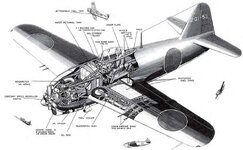
Moreover, countries such as Imperial Japan depended heavily on machine tools imported from the West before the war; once hostilities began, those tools could no longer be updated or replaced, which affected production qualities like the Homare engine.
I have heard this claim before, but it lacks any attribution. The only source that I found both negates that claim and introduces a new one: Japanese industry used
capital-
labor substitution where they employed a higher percentage of skilled labor than other nations.
By 1945 the Japanese produced almost all industrial tools found in the West, according to the article "
Japan's Deus Ex Machina: Western Technology in the 1920s". It was in the 1920s that Japan had attempted to catch up to Western nations in machine tooling. According to Yamamura, Japanese industry could produce a variety of machine tools but these were bad copies of products found in the West. In 1924, the Japanese had to import as much as 41.3% of tools in some industries. In more sophisticated markets, as much as 80% were imported. They could not even make a competitive bicycle because of a lack of precision tooling.
However, by the 1940s Japan had developed its industrial base to the point where it had become largely self-sufficient.
As with all nations that play catch-up industrialization, Japan's initial efforts at technological transfer from Western nations was imitative, but effective. By 1932, the Japanese had reduced dependence on tool imports down to 4% for "ordinary" tools and 56% for specialized machinery (Yamamura, 82). By 1940, tool imports shrank to 1% (because of sanctions). I'm sure some industries were still dependent on the West, but it would have been a tiny subset of Japanese industry and probably not strategically significant to the war effort.
The Japanese reduced their dependency on imports of Western tooling by using import substitution and labor substitution industrial policies. In other words, the government crafted policy that improved domestic tools and substituted skilled machinists in place of machinery.
Getting back to the Shiden-Hellcat matchup, this industrial policy explains why the Japanese had poor electric motors and electric components (as well as low-voltage electronics). They were still playing catch up in the electric motor industries.
Also, I'm guessing that the landing gear falling down in dives may be related to a defective electrical system that created EMF when the prop reached an overspeed condition in a dive. Too much resistance on the prop governor in a dive probably generated EMF and triggered the landing gear to partially drop. This could be caused by defective or poorly designed components.
And while Japan's electronics were not quite yet on par with the US, it's worth noting that the Shiden's radio was among the first good radios fielded by the Japanese during the war. So while these two aircraft were closely matched on paper, there may have remained a radio quality advantage (in range and reliability) in the Hellcat's corner.