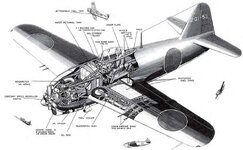
The N1K2-J Shiden Kai vs Its US Counterpart

Regarding the fillet, you could be correct. The Wikipedia article mentioned that the vibrations occurred following the retraction of the flaps. So this implies a high angle of attack, but I'm not certain. But also, it wouldn't make sense to keep a feature from a seaplane in a land-based fighter. Why wouldn't they remove the fillet?
As both Shiden and ShidenKai needed to keep the flight characteristics and overall configuration of the N1K Kyofu, they had to inherent the wing dihedral and wing incidence, otherwise the airplane had to be reworked --- lift distribution, stability, tail-placement... all would change and that is unacceptable. As the N1K has dihedral from the wing-root, the wing can't be perpendicular to the fuselage and thus will cause interference and thus the fillet can be necessary. Look at F4F and P-47, they are both mid-wing designs with dihedral on wing-root, thus they had fillet despite been mid-wing.
 
Something else that's interesting about the N1K1-J vs. the N1K2-J. As we've discussed earlier, the Shiden-Kai lacked pilot armor, although it used marginally protected fuel tanks combined with a highly effective automatic fire extinguisher system. According to Japanese Wikipedia, this made the Shiden-Kai superior to American fighters in terms of combustibility. Additionally, the Shiden-kai was said to weigh around 550 pounds less. What's not mentioned is why it weighed less:

The Shiden-Kai removed the armor plate in the rear-cockpit. According to TAIC's analysis of the N1K1-J Shiden, there was an armor plate behind the pilot's seat.

I could find no other information on it, other than the graphic provided by TAIC.

The other reason for the 550 pound drop in weight is the use of shorter landing gear in the Shiden-Kai.

Furthermore, the N1K2-J had a center of gravity issue that was corrected in the N1K3-J (which never entered production for unknown reasons). It's reasonable to conclude that the N1K2-J did not have pilot armor because of a center of gravity issue. And that by adding a 13.2mm heavy machine gun to the fuselage, this allowed the designers to stick an armor plate behind the pilot.

Getting back to the main comparison between the Hellcat and the Shiden, I do not think the Hellcat had the same level of design flaw that the Shiden-Kai suffered from. And while they were apparently closely matched on paper, Kawanishi did not have the same design acumen for building fighters as Nakajima or Mitsubishi.
 

Attachments

  • img_89-1.jpg
    img_89-1.jpg
    120.9 KB · Views: 29
Last edited:
Furthermore, the N1K2-J had a center of gravity issue that was corrected in the N1K3-J (which never entered production for unknown reasons).
My theory for the N1K3 not entering service is because the main focus was on the N1K3-A carrier fighter (which should've been a priority from the moment the N1K was first chosen to become a fighter with landing gear, although not the with the landing gear the collapsed on the N1K1-J). The N1K3-A was tested on the Shinano in November 1944 with good results, however the sinking of the Shinano ruined this plan. After this, the next focus was the N1K4 with a more reliable Homare engine. This too got a carrier based prototype, though this didn't enter service either (apparently because the Ki-84 needed the engine more). In my opinion, the other reason behind why the N1K3 didn't enter service is because of the need for the N1K5-J interceptor. This was in turn superseded by the "High Performance Shiden-Kai", which was an evolution of the N1K5-J with a high altitude Homare engine and six 20mm cannons. Basically, the N1K3-A/J were cancelled because of the Shinano sinking, the N1K4-A/J, and the need for an interceptor to counter B-29s flying over. The latter is important because it explains why there were never any tests on any Unryu class carriers, though that still is a bit odd nonetheless...
 
Last edited:
My guess is that the Shiden's poor rate of climb would have put the ki-bosh on any mods that increased all-in weight without increasing horsepower.

I don't know if there are any sources, but the N1K3-A prototype was modified to accept a Homare-23 (or Ha-45-23) which had low pressure fuel injection. I found a Polish source which claims that the low-pressure system caused the Homare to output 1900 HP at max instead of 1975HP.

But the Polish book was not sourced and I could not find anything corroborating this claim elsewhere. But it's possible that the increased weight of the 13.2mm guns, armor plate, and reduced horsepower would have made it a poorer interceptor. Although a direct injection engine would have made the Shiden a better B-29 interceptor.

The Ha-45-23 never reached full production status though and all units that were produced were used in the Ki-84 Hayate.

Regarding the IJN's lack of a replacement carrier fighter, I believe the IJN forced Mitsubishi to use a competitor's engine in the A7M Reppu. According to Jiro Horikoshi in "eagles of mitsubishi" the engines were virtually defective (probably intentionally, the two firms were great rivals) rather than Blueprint engines. The Homare had been ready for production much earlier but in 1941 Japanese war planners forced Nakajima to redesign the engine to run on lower octane fuels. This would be like having to redesign the R-2800 to run on 87-octane fuel. Predictably, this led to a massive delay and operational issues. It would have been much simplier to have provisioned their fleet carriers with 100-octane fuel and had at least a few elite squadrons equipped with next generation fighter aircraft.


The N1K1-J being produced in December of 1942, could probably have been a presence in 1943 had the engine problems been solved earlier.
 
The Homare had been ready for production much earlier but in 1941 Japanese war planners forced Nakajima to redesign the engine to run on lower octane fuels. This would be like having to redesign the R-2800 to run on 87-octane fuel. Predictably, this led to a massive delay and operational issues. It would have been much simplier to have provisioned their fleet carriers with 100-octane fuel and had at least a few elite squadrons equipped with next generation fighter aircraft.
Now this is some info I wasn't aware of! It looks like another example of higher ups ruining something that could've been great.
 
It is only great if you can provide the needed fuel in quantity. Making 100 octane fuel was not easy.
We also don't know what the Japanese fuel was when running rich. The Dutch East Indies fuel had lots of aromatics. Perhaps too much?

A huge thing with air cooled engines was the heat problem. Using more boost makes more power but you are burning more fuel per minute to get the power and that means you have to get rid of higher amount of heat. Switching to 100 octane fuel keeps the engine from going into detonation right away. But what happens in 3-5 minutes (or even two minutes) into combat when the cylinder temperatures go into the red zone?
The Homare was too ambitious. Trying to equal the power of the R-2800 when the R-2800 was 28% bigger was going to be very hard. With an Air cooled engine it is even harder than a liquied cooled engine. The R-2800 had more fin area although only around 12% (?) or rather more cylinder wall area, actual area of the fins might not be known.
Homare tried to compensate by using water injection.

Edit. The Homare did use more RPM, 3000rpm instead of 2700rpm but spinning 11% faster does not make up for the 28% difference in displacement. As far as heat goes. How much heat is being generated in each cylinder per minute? More RPM means more firing cycles per minute and more heat for the smaller cylinder to try to rid of using less fin area.
Heat is the amount of heat being generated in the cylinders which it total heat. Power to the prop, power used up in friction, power to run the superchargers.
Power to the prop can be deceptive. P-47 with 2000hp at 22,000ft was making very close to same heat as the F4U-1 was making at 1650hp at 22,000ft. P-47 was using the turbo (not quite free power) instead of 350hp (?) to drive the auxiliary supercharger. The two engines were making very close to the same heat in the cylinders.
Homare used a single stage, two speed supercharger that seems to have been much better than the P&W supercharger/s.
The Homare 12 used a redesigned cylinder head with fine pitch fins and this worked better than an experimental fan cooling system. Most later late model Homares got the better cooling fins.
What the supply situation for fuel looked like in the summer/fall of 1942 was different than the supply situation in the fall of 1943. US Subs (and aircraft) were taking a higher toll of Japanese shipping despite the Japanese instituting convoys and increasing ASW efforts.
 
Last edited:
It is only great if you can provide the needed fuel in quantity. Making 100 octane fuel was not easy.
We also don't know what the Japanese fuel was when running rich. The Dutch East Indies fuel had lots of aromatics. Perhaps too much?

A huge thing with air cooled engines was the heat problem. Using more boost makes more power but you are burning more fuel per minute to get the power and that means you have to get rid of higher amount of heat. Switching to 100 octane fuel keeps the engine from going into detonation right away. But what happens in 3-5 minutes (or even two minutes) into combat when the cylinder temperatures go into the red zone?
The Homare was too ambitious. Trying to equal the power of the R-2800 when the R-2800 was 28% bigger was going to be very hard. With an Air cooled engine it is even harder than a liquied cooled engine. The R-2800 had more fin area although only around 12% (?) or rather more cylinder wall area, actual area of the fins might not be known.
Homare tried to compensate by using water injection.
S Shortround6 I believe you are right. While the Japanese had a number of facilities that made synthetic fuel,100-octane was not easily made in large quantities. It's mentioned that they had mostly lab-made 100 octane as well as one pilot plant. But the problem was that the brass wanted to jump from lab to industrial scale and none of the catalysts and processes were able to scale up from lab to full production.

I found one source which mentioned that a pilot facility produced precursors to isooctane (100-octane). The scale was not large. The isooctane precusors were created at a pilot plant using a catalyst that wore out quickly and this was in 1943 and 1944. This would have been too late because the Homare redesign to use 87 octane had already been completed by then.

The reality is that the Japanese had no way to get 100 octane once the US hit them with sanctions.

As you said, the oil from the Dutch East Indies was too volatile. The synthetic oil was also too volatile. Apparently shale oil and coal oil have a high aromatic content. Or perhaps the sources that the japanese used had too high an aromatic content.

This information originates from unpublished academic article which uses primary sources:


Mitsui's laboratory investigations at 275°-280°C, 15 atm, and a CO : H2 synthesis gas mixture gave a 44 percent conversion to gaseous hydrocarbons (50 percent propane and 20 percent butanes) used to prepare isooctane. Investigations on iron catalysts continued in its small pilot plant (10 m3/hr synthesis gas throughput) and from 1942 in its full-scale plant at Takikawa (Hokkaidô).35 Matsubara tested a natural iron catalyst in 1943-1944, but he obtained a maximum liquid hydrocarbon yield of only 86 g/m3. Kita's best iron catalyst, when reacted in the laboratory with 40 cm3/hr of a CO : 2 H2 synthesis gas mixture at 240°C and l atm, gave maximum liquid yields of 98-102 g/m3. This was lower than the 151-158 g/m3 obtained with the best cobalt-thorium catalyst. His iron catalyst had about
a one-month lifetime before carbon poisoning of its surface destroyed its effectiveness.

Getting back to the matchup between the Hellcat and Shiden and Shiden Kai, it seems that a big part of the Allies superiority lay in their infrastructure. They were able to attract the intellectual capital to develop fluidic cracking and then they had the industrial base to roll out a new technology in a very short period of time.
 
Last edited:
Getting back to the matchup between the Hellcat and Shiden and Shiden Kai, it seems that a big part of the Allies superiority lay in their infrastructure. They were able to attract the intellectual capital to develop fluidic cracking and then they had the industrial base to roll out a new technology in a very short period of time.
Most countries relied on pre-war NACA research papers and airfoil data to design their aircraft. The new knowledge developed during the war, however, was kept classified and was no longer shared. The Axis countries lacked full-scale wind tunnels to refine their aircraft designs, while the US had the Full-Scale Tunnel (FST) at Langley and the USSR had the T-101, the largest full-scale tunnel at the time. The Germans, however, were able to use French wind tunnels, most notably the Chalais-Meudon wind tunnel (S1Ch), but seemed less convenient and the airflow was less clean.

Moreover, countries such as Imperial Japan depended heavily on machine tools imported from the West before the war; once hostilities began, those tools could no longer be updated or replaced, which affected production qualities like the Homare engine.

Another factor was that Allied air forces were already deployed worldwide before the war, giving their designers and manufacturers first-hand experience with a wide range of climates and fuel qualities. For example, fuels produced in the Dutch East Indies proved corrosive to self-sealing fuel tanks—a problem the Allies discovered and solved before 1941, while the Japanese encountered it much later and had still not resolved it by 1944.
 
Last edited:
The Axis countries lacked full-scale wind tunnels to refine their aircraft designs, while the US had the Full-Scale Tunnel (FST) at Langley and the USSR had the T-101, the largest full-scale tunnel at the time. The Germans, however, were able to use French wind tunnels, most notably the Chalais-Meudon wind tunnel (S1Ch), but seemed less convenient and the airflow was less clean.
The Germans had a large wind tunnel facility at Braunschweig, which was one of the largest at the time.

The wind tunnel at Kochel (Bavaria) was used for jet aircraft testing and could develop Mach 4 conditions, which was seized by U.S. forces after the war and shipped to America, being used until the 1990's.

The Japanese had a full scale wind tunnel at the Yokosuka Naval Arsenal which had been used to develop advanced designs.

The Italians had an advanced aeronautics research facility near Rome that included a full scale wind tunnel, which was world class.

So perhaps you may want to consider a little more research on the subject?
 
The Germans had a large wind tunnel facility at Braunschweig, which was one of the largest at the time.
The wind tunnel at Kochel (Bavaria) was used for jet aircraft testing and could develop Mach 4 conditions, which was seized by U.S. forces after the war and shipped to America, being used until the 1990's.
The Japanese had a full scale wind tunnel at the Yokosuka Naval Arsenal which had been used to develop advanced designs.
The Italians had an advanced aeronautics research facility near Rome that included a full scale wind tunnel, which was world class.
So perhaps you may want to consider a little more research on the subject?
 
The Germans had a large wind tunnel facility at Braunschweig, which was one of the largest at the time.

The wind tunnel at Kochel (Bavaria) was used for jet aircraft testing and could develop Mach 4 conditions, which was seized by U.S. forces after the war and shipped to America, being used until the 1990's.

The Japanese had a full scale wind tunnel at the Yokosuka Naval Arsenal which had been used to develop advanced designs.

The Italians had an advanced aeronautics research facility near Rome that included a full scale wind tunnel, which was world class.

So perhaps you may want to consider a little more research on the subject?
It seemed you have messed up supersonic wind tunnel with the full scale tunnel.

The Bavaria tunnel was a supersonic/ variable density tunnel, which is quite common at the time. The British and Americans had similar facilities to study compressibility.

The Yokosuka tunnel also not full scale, I saw data of A7M's test in the tunnel, and only part of it with horizontal fin was able to fit and tested for moments.

Only full scale tunnel is valuable to study aircraft'a drag in service conditions, but fst during ww2 could only make airflow less than M0.2.
 
The subject of Wind tunnels is sparse in common books. Not helped by lack of data on actual size and speeds.
Full scale is also subject to interpretation. Full scale for a single seat fighter or full scale for a twin engine bomber.

In any case the US before WW II is supposed to have had 12 wind tunnels, not counting relics like the Wright bother's wind tunnel.
Most of these varied from 5ft to 10ft in size (diameter or width) and only the 1927 20ft round Langley tunnel and the 1931 rectangle (full scale) Langley tunnel were larger.
In 1936 Langley had an 8ft round 'High speed' tunnel but speed is not given. By the end of WW II the US had around 40 wind tunnels. I have no idea of the sizes and speeds.
5 of the wind tunnels were at Langley. I have no idea if all were operational right before WW II.
Only Curtiss had it's own wind tunnel among aircraft manufacturers but it was a 1923 tunnel of 7ft diameter, Most of the rest were owned by various universities.

edit, a lot of the work on the P-51 was done at the Calif. Institute of technology in their 1930 (?) 10ft round wind tunnel. I don't know if it was upgraded or rebuilt.
 
Last edited:
Moreover, countries such as Imperial Japan depended heavily on machine tools imported from the West before the war; once hostilities began, those tools could no longer be updated or replaced, which affected production qualities like the Homare engine.
I have heard this claim before, but it lacks any attribution. The only source that I found both negates that claim and introduces a new one: Japanese industry used capital-labor substitution where they employed a higher percentage of skilled labor than other nations.

By 1945 the Japanese produced almost all industrial tools found in the West, according to the article "Japan's Deus Ex Machina: Western Technology in the 1920s". It was in the 1920s that Japan had attempted to catch up to Western nations in machine tooling. According to Yamamura, Japanese industry could produce a variety of machine tools but these were bad copies of products found in the West. In 1924, the Japanese had to import as much as 41.3% of tools in some industries. In more sophisticated markets, as much as 80% were imported. They could not even make a competitive bicycle because of a lack of precision tooling.

However, by the 1940s Japan had developed its industrial base to the point where it had become largely self-sufficient.

As with all nations that play catch-up industrialization, Japan's initial efforts at technological transfer from Western nations was imitative, but effective. By 1932, the Japanese had reduced dependence on tool imports down to 4% for "ordinary" tools and 56% for specialized machinery (Yamamura, 82). By 1940, tool imports shrank to 1% (because of sanctions). I'm sure some industries were still dependent on the West, but it would have been a tiny subset of Japanese industry and probably not strategically significant to the war effort.

The Japanese reduced their dependency on imports of Western tooling by using import substitution and labor substitution industrial policies. In other words, the government crafted policy that improved domestic tools and substituted skilled machinists in place of machinery.

Getting back to the Shiden-Hellcat matchup, this industrial policy explains why the Japanese had poor electric motors and electric components (as well as low-voltage electronics). They were still playing catch up in the electric motor industries.

Also, I'm guessing that the landing gear falling down in dives may be related to a defective electrical system that created EMF when the prop reached an overspeed condition in a dive. Too much resistance on the prop governor in a dive probably generated EMF and triggered the landing gear to partially drop. This could be caused by defective or poorly designed components.

And while Japan's electronics were not quite yet on par with the US, it's worth noting that the Shiden's radio was among the first good radios fielded by the Japanese during the war. So while these two aircraft were closely matched on paper, there may have remained a radio quality advantage (in range and reliability) in the Hellcat's corner.

 
Last edited:
I honestly doubt "EMF" could be created by an engine over-speeding, however, if the aircraft was in a high-speed dive, then it's enterely possible that the increased airflow over the wheel wells created a vacuum, which in turn overpowered the landing gear and sucked them outwards.
I know what you're saying. Your theory is solid. Kawanishi did not have a lot of experience with landing gear.

I'm probably wrong about back electromotive force (EMF) triggering the landing gear because the Shiden's prop was a Sumitomo licensed build of the Hamilton Standard or VDM hydraulically actuated prop.

In an aircraft with an electrically operated pitch control motor, an overspeed condition might cause EMF because it would turn the motor into a generator. But this issue was never reported on the Ki-84 so it's almost certainly false.

Another hypothesis is that an overspeed condition on the hydraulic governor might cause the hydraulic systems to malfunction. The hydraulic system is all interlinked. So the hydraulic undercarriage, engine, and governor share the same oil reservoir.
 

Users who are viewing this thread

Back