VLR B-24 Liberators and the Mid-Atlantic Gap

Ad: This forum contains affiliate links to products on Amazon and eBay. More information in Terms and rules

I know that some silly propositions are coming out of this debate, so here's the thing, the British did not do nothing to stop the U boats in the first few years of the war and yes, they knew they were a threat. Remember that the Lockheed Hudson was ordered from Lockheed - 200 of them in the first order in 1938 - the year before the outbreak of war; it was the largest single order of aircraft Lockheed had ever received, in fact. Not only that but the RAF had the Anson and the Sunderland entering service, and following came an order for PBYs from the United States in early 1940 and one for Liberators, albeit transport aircraft in late 1940, with more orders of Liberators for maritime patrol and bombing duties in 1941. The Royal Navy had more destroyers in its Home and Channel Fleets than the Germans had submarines and they were pinging away looking for the things every day, so there was effort, huge amounts of effort to counter the U boats in the early days of the war. British bombers were attacking German ports on a seemingly daily occurrence, too.

The reality was that a great deal of priority was being placed on the Kriegsmarine surface fleet by the Germans themselves - mainly because they didn't really have enough U boats to launch a sustained campaign for the first year of the war and their torpedoes were inexplicably refusing to work properly. The British were also prioritising the surface fleet, which resulted in the scuttling of the Admiral Graf Spee, the sinking of the Bismarck, the Channel Dash - a tactical German victory but a strategic British victory and so on keeping tabs on them. So, protecting shipping in British waters was a huge effort.

For the British the big issue facing the counter-U boat offensive was one of equipment, not priority of effort. As previously mentioned, the British had no idea how many or how few submarines the Germans had, nor how many were at sea at any given time, or even where they were. How did you find a submarine if it doesn't want to be found? Centimetric radar was not readily available en masse until late 1941/early 1942, and Ultra decrypts really didn't start becoming totally effective in determining where and when the subs were out until late 1942 (They only figured out how to read them in mid 1941 and when the navy put a fourth wheel on their Enigmas it threw them a curve ball), so until all that happens you have destroyers equipped with Asdic pinging away and planes flying round in circles using the Mark One eyeball in ever increasing numbers. That WAS happening, a lot.

One the USA joins the war, more ships and aircraft become available, but availability of these takes time because the USA has been busy building up what it thinks it needs. Again, see the pattern here. It wasn't that the British were doing nothing, but what they were doing was within the constraints of what they had available at the time. Memory telescoping by saying they should'a known from the previous war doesn't take any of that evolving situation into consideration.
 
Actually the British had a pretty good idea of the size of the German Submarine fleet in 1939-40. After that it gets more "iffy". By good idea I mean within around 5% plus or minus.
Germans started the War with 52 boats. Of 4 different classes. The British seem to have known the launch and/or completion dates of many of the early boats.
I am going by an original 1942 "Jane's fighting ships book" so that was available to the public knowledge as published in early 1943. I do not have access to an earlier volume of the book. The book doesn't give much information for boats after 1940, which is rather understandable.
The British knew the size of the boats and a close guess as to the tonnage. The number of torpedo tubes (maybe not the number of stowed torpedoes) and close estimates/guesses as to power and speed both surface and submerged. Range is not given in Janes. What the admiralty knew may be different. For instance we now know that the Type VIIB (U-45 commissioned 25 Jun 1938) had 33 tons more oil fuel than the 10 VIIA's. I have no Idea when the British learned that.
British probably had a good idea how many boats were under construction and where. Prefabrication was not yet being done and there were only a few yards building U-Boats in the 30s or 1940.
After Sept 1939 information out of Germany got a lot harder to come by. Germans added production facilities, changed the speed of construction. British were guessing at the German losses. British officers could not take a sailing trip past a German shipyard :)
Germans did not keep all of their existing subs on active duty at the Beginning of the war (First year?) with the many of the 6 type IIAs cycling in and out of the U-boat school. This 6 boats only had a range of 1600 miles and most of them only did 2-5 patrols in-between tours of duty at the school. I have not looked at the type VIII boats.

Even with photo recon exact numbers of German construction gets a little murky and the actual losses and not suspected losses confuses things.
Donitz estimated he needed 300 boats to succeed against the British. This would allow for 100 boats to be on active patrol areas at the same time. The other 200 are transiting back and forth, repair/refitting, training. It was Aug 1942 before the Germans had 100 boats at sea at the same time. The Germans kept over 100 boats at sea for just about all of the next 11 months. Peaked in April 1943 with 159 boats, just in time for the Allies to sink 41 boats in May 1943. See
Combat strength of the U-boat Force - Kriegsmarine U-boat Operations - uboat.net

As Nuuumannn has stated, it took a lot to come together to really beat the U-boats.
A bit more could have been done but that is arguing over around 10%. (Blenheims instead of Ansons?).
We have written a lot about the British 100lb AS bomb.
But.
The British had plans for the Flower class corvettes. They didn't have the money or the ship yards to begin constructing them sooner until they had built some other, higher value ships first.
Let's remember that the British Type U class got it's start as a "clock work mouse" to train the ASW forces that was given torpedo tubes "just in case".
I don't thing anybody else spent much time designing a training sub for the ASW forces. Everybody else just shuffled off old, obsolete boats to the ASW school, if they even had one, Which meant their ASW forces knew how to deal with old, obsolete, needing repairs subs. (slow, shallow diving, noisy, etc) not new, up to date boats.
There is a lot more to effective ASW forces than just a few more escorts and/or a few extra depth charge racks.
The British did some things wrong and they did something right.

Getting back to the B-24s and Mid Atlantic gap, I have said before that the mid Atlantic gap didn't ever really exist for the first year or more of the war (maybe not until 1942?)
The Germans had very few boats that could operate in the mid-Atlantic until after they captured the French bases and even then the Germans didn't use even the new Type IIDs in the mid Atlantic. German boats were limited as to the number of torpedoes carried and until they were forced out of closer, more lucrative areas, the Mid Atlantic was not attractive to them .
The First 2 Marks of Liberator's did not have turbo charges and would have been rather useless to Bomber Command. The MK Is didn't have power turrets, even with .303 guns.
I don't think they had self sealing tanks? So there wasn't any conflict with BC. That came later.

Planning for the mid-Atlantic gap before the Germans had subs that could operate in the mid Atlantic is using the retrospectroscope.
A handful of subs is not really operating in the area. A handful of planes is not sealing the gap.
 
the British knew
That is what I said so again...

Do you honestly think the Germans planned for the River Plate action, the loss of the Bismarck and the Channel Dash just so they could build more U boats
I did not state such nonsense.

That was the British priority from the very first day of the war - Churchill said that, too. You should know this already.
That is the point. Britain set every card on destroying a surface fleet that was not that great a threat against the the very large english navy.
It took them till 1943.

I will not discuss this any further. You are free to your opinion.
 
"It is interesting to compare the size of the pre-war German U-boat fleet as now known to us with the contemporary Admiralty assessment of its strength. Two days after war broke out the Director of Naval Intelligence informed the First Sea Lord that they had completed thirty coastal and twenty-nine ocean-going boats--three more than the correct total." See page 59 of the link below.

 
One very reasonable planning assumption of the time that we would not think of with hindsight is that there was a whole air force, navy and hundreds of kilometres of Atlantic coast running far south of Britain which was expected to shoulder some of the Atlantic air and sea burden. Who then would have expected all of this to vanish in mid 1940?

Suddenly no French Air Force, Navy nor bases from Spain to Brittany and the Royal Navy and Royal Air Force having to shoulder the task of the Mediterranean Sea as well as the whole of the North Atlantic and North Sea.

When planning has being projecting for 1941/2 and production of two years ahead it has to change entirely within weeks with no new resources.
 
The saying is a picture paints a thousand words. I 'm sure I've posted these maps before but they are worth viewing again in this discussion.

1739093939530.jpeg


Note how the limit of convoy escort to / from Britain had to move westward from July 1940 AFTER the capture of the French ports. Convoys south also required routed further out into the Atlantic and escorted further south than previously. This was something no one envisaged in the inter-war period.

In Oct 1939 the Pan-American Neutrality Zone was set up, in which it was announced that the signatories would not tolerate belligerent acts. The KM largely observed that to avoid provoking war with the USA. It was extended to nearer Iceland in April 1941.

1739095164678.png


And another map showing the position through to the end of 1941.

1739094441974.gif


Britain occupied the Faroe Islands on 12 April 1940, following the German occupation of Denmark, and Iceland on 10 May. The US took over the garrisoning of Iceland in July 1941. In Sept the USN began to escort convoys as far West as the Mid Ocean Meeting Point.

The principal airfield in Iceland in May 1940 was a grass strip at Reykjavik on very boggy ground. Work began in Oct 1940 to turn it into a facility useable by Coastal Command aircraft but with the poor ground conditions and winter conditions it was a lengthy process. While some aircraft like Hurricanes used it in the early days, it was Sept 1941 before it was fit for use by larger CC aircraft, the Wellingtons of 221 squadron being the first to move in.

Another airfield was built at Kaldadarnes. While it was used by the Battles of 98 squadron from Aug 1940, it was June 1941 before all 3 runways were completed and it formally opened as an RAF station. It was a less than ideal site, but the best identified in 1940 after Reykjavik, being prone to flooding. Aircraft couldn't afford to venture off the hard runways. The Hudsons of 269 squadron arrived in June 1941. The airfield closed entirely in late 1943, following flooding in March which undermined one of the runways.

In the interim a flying boat base was set up in July 1940 with the depot ship Manela to service detachments of Sunderlands before 204 squadron moved in completely in April 1941.
 
I'll have a crack at my big picture view of air support for Coastal Command. It is more bullet points than a comprehensive argument or history. It does not address B-24s specifically so is off topic!

Portal (CAS) (Following Trenchard) promoted the strategic bombing campaign and Churchill bought into that as the one way of directly attacking Germany without the nightmare of a continental land war, at least in the first few years of the war. Lindemann/Cherwell, Churchill's close scientific advisor, backed the strategy forcing the sceptics like Tizard and Blackett away from the table.

Harris took the demands for the campaign to an even higher level describing Coastal Command as an obstacle while displaying very poor understanding of ASV and ASW. Coastal operations were seen as defensive and Harris wanted offensive action. He fought consistently hard to build his bomber fleet.

The 1941 Butt report detailed how ineffective the bombing campaign was with poor navigation being a big factor. One result was a shift to area bombing and de-housing rather than targeted industrial bombing which just reflected the reality.

Pound and the Admiralty were more comfortable seeking additional escorts for close convoy defence. They also hoped that CVEs would plug it first. Efforts to obtain VLR/LR aircraft were ineffective against the entrenched views of Portal, Harris & Lindemann. At the end of the aircraft supply chain to Coastal Command sat Joubert and Slessor who did their best but who were fighting against overwhelming odds.

Despite all his oft-quoted comments about the U-boat peril, etc. Churchill made a call that the level of ship losses was acceptable and that the land bombing campaign was the priority. Eventually the losses and the clearly less than desired results from bombing caused his stance to change.

Some efforts were made to disrupt the building of the French U-boat bases and the finished structures but these were ineffective. Harris regarded such attacks as a distraction and suggested using inexperienced crews as if a training mission.

Coastal Command could order aircraft but they were at the whim of King in the US, with his preference for the Pacific, in what was actually sent to the UK and then the Air Staff and their allocation of Liberators to transport tasks and non-Coastal regions.

Blackett and the OR team produced evidence that greater air cover for convoys would materially reduce the ship losses. While closing the air gap completely would take time while aircraft were modified to VLT status LR and medium range aircraft could cover much of the Atlantic and certainly the transit points of the Bay and the GIUK gap, the former being much more active and important with repeat trips to and fro.

So I see Churchill carrying the can as the man at the top and able to change things with one of his famous "Action this day" decisions. Harris took matters to an extreme and was deaf to contrary arguments. Beyond them the Air Staff were slow to accept OR assessments and the Admiralty showed relative weakness when it came to fighting for air support. Lindemann was a loose cannon and Blackett was able to demonstrate that Lindemann's bombing damage forecasts were overstated by a factor of five (post-war – reality was a factor of ten). But Lindemann had Churchill's ear.

Easy to criticise with hindsight. But the quote about the citizens of a German city not noticing if they were bombed by 1,000 or 900 aircraft appeals to me. 100 aircraft to Coastal Command would have made a difference, Not by shifting them from Bomber Command with all the training and re-fit issues but built for Coastal based on decisions six months earlier.
 
The shipping shortages were persistent, even as late as 1945 Churchill made it clear the British Pacific fleet size started with firstly removing the shipping needed for UK imports, not with the number of warships available. In terms of range the further out from shore convoys can expect air or surface escort cover the further out the U-boats have to operate and so reduce their effectiveness. Coastal Command had around 250 aircraft in September 1939, 200 of which were short range, basically Ansons. At the end of 1941 it had around 400 aircraft, only 18 of which were considered short range.

The Cost of Seapower by Philip Pugh, his theoretical model says the break even number of escorts per convoy was 10, which would normally give a ratio of 1 submarine sunk per 5 merchant ships, which meant both sides lost an equivalent monetary amount of ships. Going to 14 escorts near doubles the kill ratio in favour of the defenders. If there are only 2 escorts the chances of a submarine being sunk are effectively nil. Overall he says the ratio of submarines to merchant ships sunk is proportional to the square of the number of escorts.

The RN calculated in 1942 that each U-boat sunk saved 4.8 merchant ships because it took the Germans 6 months to train a new U-boat crew. In the second half of 1942 long range anti submarine aircraft operations were calculated to save the following number of merchant ships per 100 sorties.
Continuous Convoy Escort, 3
Bombing U-boat bases, 1
Bay of Biscay patrols, 3
Escort of convoys known to be under attack, 30.

In 1940 to 1943 the HX convoys consisted of 7,285 ships of which 77 were lost in convoy, 46 while straggling and 34 after being detached or the convoy dispersed. The SC convoys had 4,251 ships, lost 115 in convoy, 41 stragglers and 12 after being detached or the convoy dispersed. According to the RN official history from January 1942 to May 1943 inclusive 537 ships were sunk in convoys (411 to subs), versus 1,067 ships sailing independently (934 to subs). Even in the first 5 months of 1943 the convoys lost 193 ships versus 105 sailing independently. It looks like the U-boats only sighted a minority of convoys in the Atlantic and converted about half the sightings into attacks on the convoy.

U-boat numbers went from 56 pre war to 50 by the end of 1939, bottomed out at 45 in April 1940, were 82 by the end of 1940, 244 by the end of 1941, 407 by the end of 1942, 471 by the end of 1943, 467 by the end of 1944. At the end of 1939 some 35 U-boats were front line, the rest were working up or training boats, at the end of 1940 there were 22 front line boats, end 1941 91, end 1942 213, end 1943 around 160. (From Germany and the Second World War volumes V part 1 and part II and volume VI). According to the RN Official History 9 U-boats were sunk in 1939, 24 in 1940 (including U-32 sunk twice), 35 in 1941, 87 in 1942, 237 in 1943, 242 in 1944 and 151 in 1945.

UK merchant ship building had dropped to around 133,000 GRT in 1933, had risen to 500,000 GRT in 1935, 920,000 in 1937. A major driver of new merchant ship construction was how much was laid up, in 1932 around 4.4 million GRT, in 1932 13.6 million, in 1935 5 million, in 1937 1.7 million, in 1938 2.3 million. The production by the US of dry / US all cargo ships / UK all cargo ships by year in GRT was
1939 121,000 / 242,000 / unknown
1940 301,000 / 449,000 / 810,000
1941 546,000 / 768,000 / 1,156,000
1942 4,571,000 / 5,247,000 / 1,301,000
1943 9,803,000 / 12,309,000 / 1,204,000
1944 6,859,000 / 9,703,000 / 1,014,000
1945 4,231,000 / 6,714,000 / 512,000 (UK to end September)
Canada figures are in deadweight not gross tons, dry cargo only, yearly 1941 to end August 1945, 10,000, 843,000, 1,370,000, 981,000, 315,000 DWT (US WPB report, US Maritime Commission says its 1939 to 1945 production in GRT was 71% of the DWT figure). US production exceeded UK production in the first quarter of 1942, US data from the Maritime Commission Summary report, the UK figures from the UK statistical digest of the war.

The Kriegsmarine lost 23 U-boats to the end of April 1940. Those early allied successes had a hidden bonus, most of the crews were lost to Germany and contained mainly pre war regulars, the cadre for the expanded fleet. In exchange for the losses the U-boats had sunk some 751,877 GRT of shipping (including ships of neutral countries) according to Lloyds, maybe around 770,000 GRT when you add in the ships "Axis Submarine Successes" lists but Lloyds mark as unknown. So around 33,500 tons per sunk boat, and around 96,000 GRT sunk per month, but that figure includes neutral shipping, allied shipping lost comes to 454,950 GRT, maybe 460,000 GRT with the unknowns included. The ratio is then 20,000 GRT per U-boat loss and 58,000 GRT per month for allied merchant shipping alone. (In 1944 submarines sank around 60,000 GRT per month, and in the first 4 months of 1945 71,000 GRT per month of allied shipping). The invasion of Norway in April 1940 curtailed the U-boat war against commerce for a while as the U-boats were deployed to try and protect the invasion. This is where the faults with the German magnetic torpedoes were exposed, another fault with the contact exploder was rectified by using the RN design, a more subtle fault was not discovered until much later, the atmospheric pressure in the U-boat, which rises with the length of time submerged, effected the torpedo depth setting. Between 1 May 1940 and 1 March 1941 the Kriegsmarine would lose 10 U-boats and sink 2,102,027 GRT of shipping according to Lloyds, plus maybe around 150,000 GRT more if Axis Submarine Successes is correct, or around 10 times the exchange rate of early in the war. In June 1940 the number of front line boats dropped to 27, after starting at 39 and staying above 30 until that time, during June allied losses to U-boats were 269,119 GRT. The number of front line boats stayed at 30 or below for the rest of the year, allied losses July to December 1940 were 1,246,841 GRT, over 200,000 GRT per month.

Front line boat strength increased to 38 in July 1941, so back to the opening of the war strength. By December 1941 front line strength was 88 (out of 236 boats available). Diversions to the Arctic and Mediterranean started in August 1941 and by December 5 boats were in the Arctic and 23 in the Mediterranean. Even so the number of boats in the Atlantic in the second half of 1941 was around twice that of the first half of the year. Losses to U-boats January to June 1941 1,317,268 GRT, July to December 676,298 GRT. In the 6 month time period July to November 1941 the sinkings of allied ships by U-boats had declined to their lowest levels since the defeat of France, according to Lloyds around an average of 140,000 tons per month versus 210,000 tons per month in the first 5 months of 1941. In the North Atlantic where over 90% of the U-boat successes were according to the RN November and December 1941 losses were a little under 101,000 tons. This was due to a combination of more and better escorts, diversions of U-boats to the Baltic, Arctic and Mediterranean, intelligence (including Ultra), raising the speed at which a merchant ship could sail alone and the US exclusion zone. (I am ignoring the Mediterranean and Arctic boats since they had few merchant ship targets). U-boat losses (all causes) were some 12 in the first 6 months of 1941 and 25 in the second 6 months, so the escorts were improving as well. The U-boats in the second half of 1941 were running at about 1/4 the productivity of the first half and the cost per merchant ton sunk had increased by a factor of 8. On the basis of the performance in the second half of 1941 the Germans were not going to starve out Britain quickly, but nor were the British building the surplus merchant ships needed to keep a large military fighting on distant shores.

During 1941 the tonnage sunk per boat day at sea for the Atlantic boats peaked at 637 in February, it then declined to 66 in August (the big drop was from 314 in June to 73 in July) picked up to 190 in September but was down to under 100 in November and December. It jumped to 223 in January 1942 and kept above 200 before rising to 301 in May and peaking at 341 in June, then largely staying between 150 and 200 until November, declining to 96 in December.

From the USN official history, "knowing that a convoy without adequate protection is worse than none, Admiral Andrews decided that convoys were then inadvisable. But on 1 April a partial convoy system was inaugurated whereby ships were moved by anchorage to anchorage escorted by such local craft as were available in the various Naval Districts under the direction of Commander Eastern Sea Frontier." If I read this correctly the USN believed it was best to avoid convoys unless they were "adequately protected". This is contradicted by the WWI and 1939/40/41 experiences.

A factor hampering early allied efforts was the initial refusal to believe the U-boat tactics of night surface attacks. While U-boats operated independently there was little information for allied tracking to work from, wolf pack tactics changed that, a risk Doenitz had accepted. Experience and an expanded direction finding network then enabled forecasts to be made of U-boat movements. Next came Ultra following successful operations February to June 1941, when the U-boats went over to their own version in 1942 the surface ships that escorted them in and out of ports stayed on the old version which remained largely readable. This at least enabled reasonable tracking of numbers at sea. While regular photographic coverage of German ports etc. enabled accurate tracking of new construction and training progress regardless of any Ultra information.

Coastal Command mainly Anti Submarine aircraft 1939 to 1942, Anson, Battle, Canso, Catalina, Fortress, Halifax, Hudson, Lancaster, Lerwick, Liberator, London, Northrop, Stranraer, Sunderland, Tiger Moth, Ventura, Wellington, Whitley, of these the overlap with Bomber Command was Halifax, Lancaster, Ventura, Wellington, Whitley

1939 to 1942 hours flown per year, first list 23,885, 113,942, 98,177, 141,473 of these the Bomber Command types flew 0, 1,721, 19,309, 43,526. Meaning doubling the Bomber Command types activity in 1941 would give around another 20% patrol time, in 1942 around 31% more. Bomber Command flew around 180,000 operational hours in 1942, including Blenheims etc. end of February 1942 it had 2 Halifax squadrons, nominal strength 32 aircraft, 27 serviceable 17 of them had a crew. Wellingtons were 264 authorised strength, 197 serviceable aircraft with crews, Whitley 88 authorised strength, 41 serviceable aircraft with crews. Along with 6 serviceable Lancaster with crews, 25 serviceable Stirling with crews. As of 1 March 1942 Coastal Command (no crew data available) had 6 serviceable Wellingtons, 25 Whitley, 4 B-17 and 9 B-24. Strength wise Coastal Command had 15 four engine land types and 24 Sunderlands, Bomber Command units if at full strength had 128 four engine types.

1 January 1943, Coastal Command had 118 land based 4 engine types and 81 Sunderlands, Bomber Command had 163 Halifax, 246 Lancaster, 54 Stirling, total 463. The losses Bomber Command was taking suppressed the growth of itself and Coastal Command.

So how much of Bomber Command is transferred?

As I am sure everyone is desperate to know in 1939/40 Tiger Moths flew 2,815 sorties taking 4,567 hours, no losses recorded.

 
A few years back I analysed out details of RAF Liberator deliveries by model for my own interest based on Halley's Liberator book and using the delivery dates in Canada.

LB30A (ex YB-24) - 6 aircaft delivered Jan-May 1941. Used as transports.
LB-30B (ex B-24A) - 19 delivered April-Aug 1941. 11 were converted to GR.1 on arrival in Britain with first being issued to 120 squadron in Aug. (note 120 began receiving Liberatorss for training in June with GR.1 conversions arriving later). Remainder as transports.

LB-30
These came from the French order taken over by Britain in June 1940. 139 aircraft.

Delivered Aug-7 Dec 1941 - 64 arrived in Canada before PH. The remaining 75 were retained by the USAAF. Of these
11 became transports.
9 were converted as Liberator GR.II, with the first going to 120 squadron at the end of Nov 1941.
44 were converted as B.II

These were all delivered without armament, turrets being fitted on arrival in Britain. 108 squadron in the ME began to receive some of the B.II from Nov 1941 to equip one flight, becoming operational with them in early 1942. The B.II were also used to equip 159 & 160 squadrons which formed in Jan 1942. The history of these 2 squadrons in early 1942 is not entirely clear with ground echelons leaving for the MIddle East in Feb leaving the crews to convert to Liberators between May & July before heading east.

Between April & July 1942 23 of the 75 aircraft retained by the USAAF were belatedly delivered to the RAF (replacements for B-24D which it wanted to retain). Of these 13 initially became transports, 9 B.II and a single GR.II which spent most of its early life as a trials aircraft for centimetric radar both in Britain and the USA.

B-24D / Liberator III/IIIA/V
Production of the B-24D began in Jan 1942 following completion of the LB-30 order. The USAAF had a large requirement for these to build its own bomber force, so the RAF was not exactly the highest priority, despite the orders already placed.

The first of these to be received by the RAF was an early emergency batch of 11 designated Liberator IIIA diverted from USAAF stocks for use by Coastal Command. Delivered Mar-Apr 1942 with first going to 120 in May 1942.

The first batch of Liberator III from RAF orders were 32 delivered April-Jul 1942 (FK*** serials). 30 became GR.III for CC with the first going to 120 squadron in June followed by the second CC Liberator squadron, 224, in July. The other pair were retained for ferrying purposes.

The next batch of 90 were delivered between June 1942 & April 1943 (FL*** serials). Of these 27 became GR.III and 50 GR.V (with centimetric radar, only 4 of the latter delivered in 1942) for CC. GR.V began to be issued to squadrons in Feb 1943. Of the remaining 13 (labelled B.III) 9 were retained as transports while 4 went to 111 OTU in the Caribbean training Liberator crews for CC.

Of the next batch of 248 delivered Mar-Nov 1943 (BZ*** serials), 170 became GR.V for CC. The remainding 78 were B.III, the first two of which went to 111 OTU in May 1943. The rest mostly ended up reinforcing the bomber forces in the ME & FE from June onwards.

B-24J Liberator VI
A batch of 40 Liberator VI was delivered between Nov 1943 & May 1944. 19 were B.VI and 21 were GR.VI. The GR.VI began to be issued to CC units in March 1944. Simultaneously another batch of 188 (EV*** serials) was delivered split 110 B.VI and 78 GR.VI. These B.VI were again being used to expand the striking power of the bomber forces in the ME & FE.


More batches followed after that, with the emphasis definitely shifting towards bomber variants for use in the ME & FE.

The Liberators used by 100 Group from Aug 1944 in Britain came from USAAF theatre transfers (21 aircraft given TS*** serials)
 
So how much of Bomber Command is transferred?

As I am sure everyone is desperate to know in 1939/40 Tiger Moths flew 2,815 sorties taking 4,567 hours, no losses recorded.
A lot depends on when. The end of 1942 and/or beginning of 1943 gets a harder decision. In part because it will take a number of weeks to convert a squadron over to Coastal Command. Even if you just grab 12-18 planes and give them to CC for one or two existing CC squadrons the bombers do not have the search radar, or other CC equipment (survival gear, perhaps different radio equipment, flare chutes, smaller ammo tracks/racks) so there is going to be some delay refitting. And while trading Wellingtons for Halifax's is an improvement, it is not the same improvement as adding 12-18 planes to the total CC force. Now there is also the delay in training the BC crews or assigning at least some CC crewmen over to the BC squadron/s. Flying hundreds of miles over water is not the same as flying over land, even at night.

I am desperate to know if the losses were no losses to the U-boats or no operational losses (crashes) to the Tiger Moths ;)

The whole Anson and 100lb AS bomb has never been really explained. Yes times were desperate but 8-10 squadrons carrying a lighter war load than most 1917-1918 AS planes carried?

Not transferring over 4 engine bombers that could carry 10-13,000lbs of bombs in 1942/43 is one thing. Not transferring over small twins that carried 1000lb bomb loads away from BC to CC to replace even smaller, shorter ranged twins that carried an earth shattering (sea shattering?) 200lb load in 1939 is rather different. Just on range/endurance a squadron of Blenheim's could replace two squadrons of Ansons.
 
The whole Anson and 100lb AS bomb has never been really explained. Yes times were desperate but 8-10 squadrons carrying a lighter war load than most 1917-1918 AS planes carried?

The Anson was only ever intended as a stopgap in CC pending delivery of the new types ordered in 1936. The Anson and its competitor from De Havilland were deriviatives of small airliners. As a result the Anson was able to move from a Spec issued in August 1935 to service entry in March 1936. The Blackburn Botha and the Bristol Beaufort to Spec 10/36 were the intended successors. Eventually the Botha was seen as the Anson replacement and the Beaufort as the Vildebeest replacement. Delays with developing both types meant the RAF turned to Lockheed in 1938 for the Hudson, which began to be delivered from Feb 1939.

In 1938 their main area of operations was seen as being over the North Sea, with their primary role being reconnaissance (searching for the enemy fleet, blockade runners etc with the emphasis on reporting back), with the bombs intended for use against surfaced U-boats, AMCs or hostile aircraft carriers that they might chance across. That becomes apparent when you look at how they were employed at the start of the war (for example flying searches out towards the Norwegian coast). It was the flying boat squadrons that were expected to operate anti-sub searches in conjunction with RN surface groups, so the intention was to base them in the south west & Orkneys, covering the SW Approaches and Northern Channels from Germany to the Atlantic.
 
The problem I have is that Bristol had designed a maritime recon version of the Blenheim for Canada starting in 1937. Much of it was adapted for the MK IV Blenheim. It was during this time that the British decided they wanted a 4 man crew and not the 3 man crew which lead to the utter failure of the Botha (large fuselage and weight without significant increase in power).
Now maybe the Blenheim IV didn't have the desired vision arcs the Air Ministry wanted (turns out the Botha didn't either). Maybe there was some other problem, but it was placed in large scale production (airframe shadow factory) including a engine shadow factory for the Mercury engines. But they all went to Bomber Command until 2 Squadrons were transferred over in the fall of 1939(?)
How much screaming, kicking and threats of violence did it take to get a few more squadrons (2 -4?) of Blenheims to be transferred over to CC in 1940?
I am not asking for Wellingtons or Hampdens or even Whitley's in 1939/40. I am wondering why the lowest hanging fruit in the twin engine bomber orchard was so jealously guarded by Bomber command?

The idiocy of the 100lb AS bomb has been gone over before. Not doing a live test of your most mass produced aircraft anti-sub sub weapon for several years ???? :banghead:
 
Actually the British had a pretty good idea of the size of the German Submarine fleet in 1939-40. After that it gets more "iffy". By good idea I mean within around 5% plus or minus.
Germans started the War with 52 boats. Of 4 different classes. The British seem to have known the launch and/or completion dates of many of the early boats.
I am going by an original 1942 "Jane's fighting ships book" so that was available to the public knowledge as published in early 1943. I do not have access to an earlier volume of the book. The book doesn't give much information for boats after 1940, which is rather understandable.
The British knew the size of the boats and a close guess as to the tonnage. The number of torpedo tubes (maybe not the number of stowed torpedoes) and close estimates/guesses as to power and speed both surface and submerged. Range is not given in Janes. What the admiralty knew may be different. For instance we now know that the Type VIIB (U-45 commissioned 25 Jun 1938) had 33 tons more oil fuel than the 10 VIIA's. I have no Idea when the British learned that.
British probably had a good idea how many boats were under construction and where. Prefabrication was not yet being done and there were only a few yards building U-Boats in the 30s or 1940.
After Sept 1939 information out of Germany got a lot harder to come by. Germans added production facilities, changed the speed of construction. British were guessing at the German losses. British officers could not take a sailing trip past a German shipyard :)
Germans did not keep all of their existing subs on active duty at the Beginning of the war (First year?) with the many of the 6 type IIAs cycling in and out of the U-boat school. This 6 boats only had a range of 1600 miles and most of them only did 2-5 patrols in-between tours of duty at the school. I have not looked at the type VIII boats.

Even with photo recon exact numbers of German construction gets a little murky and the actual losses and not suspected losses confuses things.
Donitz estimated he needed 300 boats to succeed against the British. This would allow for 100 boats to be on active patrol areas at the same time. The other 200 are transiting back and forth, repair/refitting, training. It was Aug 1942 before the Germans had 100 boats at sea at the same time. The Germans kept over 100 boats at sea for just about all of the next 11 months. Peaked in April 1943 with 159 boats, just in time for the Allies to sink 41 boats in May 1943. See
Combat strength of the U-boat Force - Kriegsmarine U-boat Operations - uboat.net

As Nuuumannn has stated, it took a lot to come together to really beat the U-boats.
A bit more could have been done but that is arguing over around 10%. (Blenheims instead of Ansons?).
We have written a lot about the British 100lb AS bomb.
But.
The British had plans for the Flower class corvettes. They didn't have the money or the ship yards to begin constructing them sooner until they had built some other, higher value ships first.
Let's remember that the British Type U class got it's start as a "clock work mouse" to train the ASW forces that was given torpedo tubes "just in case".
I don't thing anybody else spent much time designing a training sub for the ASW forces. Everybody else just shuffled off old, obsolete boats to the ASW school, if they even had one, Which meant their ASW forces knew how to deal with old, obsolete, needing repairs subs. (slow, shallow diving, noisy, etc) not new, up to date boats.
There is a lot more to effective ASW forces than just a few more escorts and/or a few extra depth charge racks.
The British did some things wrong and they did something right.

Getting back to the B-24s and Mid Atlantic gap, I have said before that the mid Atlantic gap didn't ever really exist for the first year or more of the war (maybe not until 1942?)
The Germans had very few boats that could operate in the mid-Atlantic until after they captured the French bases and even then the Germans didn't use even the new Type IIDs in the mid Atlantic. German boats were limited as to the number of torpedoes carried and until they were forced out of closer, more lucrative areas, the Mid Atlantic was not attractive to them .
The First 2 Marks of Liberator's did not have turbo charges and would have been rather useless to Bomber Command. The MK Is didn't have power turrets, even with .303 guns.
I don't think they had self sealing tanks? So there wasn't any conflict with BC. That came later.

Planning for the mid-Atlantic gap before the Germans had subs that could operate in the mid Atlantic is using the retrospectroscope.
A handful of subs is not really operating in the area. A handful of planes is not sealing the gap.

That's all very well, but the main point I was making was that the thing the British didn't have was where the U boats were at any given time. Until they knew that for certain, the rest is academic. Ultra was the key here, and even then it was a closely guarded secret, but without it, it was a damn sight harder to find the submarines. As I mentioned, it wasn't until late 1942 that they were able to accurately predict where the submarines were going to be.
 
which lead to the utter failure of the Botha (large fuselage and weight without significant increase in power).

Nah, the thing that led to the failure of the Botha was simply bad design. 😆 I read once a quote attributed to the Botha that says it all. In a test report, the pilot wrote "Access to the cockpit is difficult, it should have been made impossible..."
 
That's all very well, but the main point I was making was that the thing the British didn't have was where the U boats were at any given time. Until they knew that for certain, the rest is academic. Ultra was the key here, and even then it was a closely guarded secret, but without it, it was a damn sight harder to find the submarines. As I mentioned, it wasn't until late 1942 that they were able to accurately predict where the submarines were going to be.
Thanks to Ultra decrypts, the allies many time knew the noon positions of many of the boats.
 
There's a lot of info in this book. Its most highly recommended.

There are a lot of good books on the subject. Station X, Action this day, and many more. Another good book on the Battle of the Atlantic is John Terraine's classic Business in great waters. Bletchley Park is a visitor centre now. There are working models of the Bombe computers and the Colossus, the world's first super computer. I visited many years ago.
 
Thanks to Ultra decrypts, the allies many time knew the noon positions of many of the boats.

But it wasn't until late 1942 as I mentioned, that they were able to do this. The firs time the cryptanalists got to grips with the naval codes was in mid 1941 but then the Kriegsmarine quite inexplicably put a fourth wheel on the Enigma, which meant they had to start again. Ultra was a secret until the mid-1970s and no one, except those who had worked on it or with it directly knew about it until then. To keep the Germans guessing, lest they get suspicious about how U boats were suddenly being discovered in the middle of the Atlantic, the British made up various rouses that the Germans fell for, one was the Metox radar warning receiver, which British Intelligence surreptitiously let slip that the British could home in on its signals to attack submarines on the surface. It was a necessary deception, but the Germans fell for it. I remember reading an interview with Donitz after the war and he refused to believe that the naval Enigma codes had been cracked, the Germans roundly believed that it was impenetrable.

48216701926_f6a6df8d65_b.jpg
Europe 175
 
Everyone concentrates on the Ultra and breaking German codes at Bletchley Park to determine where the U-boats wrre. But have you ever stopped to think about where Bletchley got the messages to decode in the first place?

That work was carried out by the 'Y' Service. A network of radio intercept stations across the UK run by the RN, Army, RAF and the GPO. Many of these sites also had a direction finding function. So even If codes couldn't be broken enough information could be gleaned from direction finding alone to locate, with a fair degree of accuracy but not down to an exact to the mile position, where a U-boat was located. That allowed warnings to be given to escort groups or evasive routing of convoys. That could be done immediately a 'fix' was obtained.


As for breaking the KM codes, Bletchley had success from mid-1940. However, it was the introduction of a new Enigma machine with a fourth rotor in combination with a new code that rendered them blind for most of 1942.

But it wasn't just a question of breaking codes and being able to read messages. It was the speed with which it could be done to make the intelligence derived there from useful. Reading within 24 hours was only achieved from about autumn 1943.
 
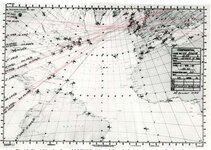
Shore-based HF/DF was a very useful technique for U-boat tracking and a slick mirror operation was built up in the US and the UK to plot the results and make use of the findings very swiftly. However the various bearings were rather more inaccurate than many accounts make clear. Attached is a plot from the US plotting team and included in RIP480. At first sight it just looks like a waste of time given the variances. A number of techniques were developed to allow a focus on likely accurate bearings to whittle down the estimated U-boat position and a good probability could be fed to the operational HQs. Related techniques such as RFP (radio fingerprinting) and Tina allowed an attempt to be made to identify individual U-boats tracked from several transmissions. A way to verify the location was if the D/F'd message was decrypted and the U-boat's own position was given in the message. Even that was less than perfect as the U-boat position could easily be 25 miles or more out depending on when it last had a clear sky and the ability of the navigator. The plotters then had to carefully match the real-time HF/DF location with the delayed decrypted position which would often be a couple of days apart.
 

Attachments

  • Plot RIP480.JPG
    Plot RIP480.JPG
    67.6 KB · Views: 22

Users who are viewing this thread

Back