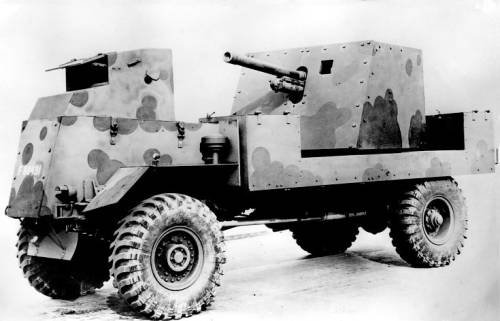
Are those 'Decons'? yeah this was tried but I think not so successful. They were used on the Mareth line in 1943. There were a lot of early attempts at stuff like that, this was an early US ... thing (M6 GMC, with a 37mm gun), which they amazingly made 5,000 of:
These saw action in Tunisia but were not very well liked though and quickly taken out of the front line after getting slaughtered at Sidi Bou Zid, though they did use them in the Pacific somewhat where the He and especially cannister round on the 37 mm could be useful. I gather in many cases they just took the gun off in the field, the 37mm was small enough that it could be manhandled by an infantry squad.

As I'm sure you know, this is the M3 GMC - self propelled light (WW I type) field gun. They could use the same 75mm ammunition as the M3 and M4 medium, so they had decent penetration and could kill German medium tanks, while also having some utility against AT guns or other crew served weapons. They were used as "Tank Destroyers" and got some tank victories at El Guettar in 1943, but losses were prohibitive and they were swiftly relaced by M10s like most of these Allied 'mobile AT guns'. The M3 GMC was more useful as an indirect fire support weapon, (arguably with a bit more agility in rough terrain than an M7?) in which mode they were actually used with some success in Tunisia and later in Sicily and Italy.

The chief defensive advantage of the smaller caliber AT guns was their small size and silhouette compared to tanks, making them easy to hide and put into a cunning ambush. Obviously with these kinds of rigs that went out the window - it's a big fat and all to soft target. The problem with all these was they were too vulnerable. Although the M3 halftrack had some armor, in practice they were not immune to German machine guns which would often be in range of them when used, were vulnerable to light mortar fire, and any kind of AT gun or AA gun would kill them quickly.
The Germans too had a variety of halftracks with AT guns and field guns, and used them with some success but they took heavy losses.
There were as we know many different approaches to how much to armor mobile AT guns, the Germans tried various options, probably their most successful was the StuG III, which had enough armor to protect against anything up to a high velocity AT gun, at least on the front. The US answer was the also successful M10, which had enough armor to protect against MG 42s and probably light AA guns, and at range maybe even the lighter AT guns, but relied on ambush and 'shoot and scoot' tactics beyond that. M36 or Biritsh M10 hack "Achilles" relied on having a big enough gun to 'kill anything that moves', while arguably the most successful Allied TD was the Hellcat which basically had just enough armor to protect from machine guns and mortar fragments, but a very high mobility (plus the controversial open turret for increased situational awareness).
don't get too carry away with the M7, nice bit of kit. But.......
A four hour barrage firing at even one shot per minute is 240 rounds per barrel.
M7 carried 73 rounds of ammunition.
Artillery needs a crap load of logistic support.
fire rates for the US 105mm
1st 1/2 minute..................8rpm
first 4 min...........................4rpm
first 10 mi...........................3rpm
sustained..........................100 rounds/hour.
You could fire faster at times, however you are juggling barrel life with rates of fire and with charge loads (range)
US 105 barrel was good for around 10,000 rounds.
In NW Europe in 1944 they were replacing barrels in 5,000 rounds. warn barrels are not accurate and they don't give the expected range.
If worn enough they can give "pre-matures" (round going off in the barrel, ruins everybody's whole day)
I wouldn't compare it to a HIMARS, but I think it was a pretty big step forward in 1942. All armored vehicles had to be resupplied quite often, they will be bringing ammunition up at least every day when they are in action and probably more like 3 or 4 times a day during a major battle like either El Alamein engagement. But this thing could move around quickly. 73 rounds was actually a lot of 105mm (compare to Wespe with 40 rounds, Hummel with 18 rounds, Bishop with 32 rounds of 88mm. Sexton had a respectable 105 rounds.
M7 also had some armor, and even with the open top probably enough to protect against those pesky German machine guns and light mortars, shell fragments etc., probably enough to get out of trouble unless faced with a tank or AT gun.
The lighter field guns (75 and 105mm) and medium mortars (81, 82 or 85mm) were sometimes more useful in battle than the really big (4-5-6" on up) guns, precisely because they did carry more rounds (this is true for towed guns too because they don't keep an infinity of ammunition next to each artillery piece). The vast majority of artillery rounds expended in any war don't hit anywhere near their intended target. So you want to be able to shoot a lot of rounds and shoot again and again as your spotter directs and corrects. The 25 pounder is a pretty good compromise with a high rate of fire (from 6-8 down to 3 rounds per minute, similar to the M7) but the 105mm M1 / M2 howitzer has that same rate of fire with nearly twice as much explosive. So 4-5 rounds per minute with a substantially wider kill radius for each round.
These days most armies around the world have gone to towed or self propelled 155mm guns, which do have a much bigger bang, (the Russians stuck largely though not entirely to 122mm which seems to be causing them problems in Ukraine) and good range, but those are big shells to carry around and big rigs to shoot them. I suspect there could still be a niche for a good fast firing 105mm even today.