Surface-to-Air Missiles
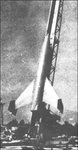
Enzian
The design of Enzian was inspired by the Me 163 rocket-powered fighter aircraft. Its delta-wing layout and relatively fat fuselage were similar. It had four boost engines and a sustainer. A small number was built, but problems with the engines and the guidance system were never resolved.
Feuerlilie
Anti-aircraft missile. It had a streamlined body and twin tail fins. It was powered by a rocket engine and had radio command guidance. Although development continued until the end of the war, it was never ready.
Hecht
Surface-to-air missile, in development until it was replaced by more promising designs in 1941.
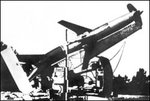
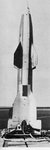
Henschel Hs 117 Schmetterling
Of all experimental surface-to-air missiles, this one came closest to an operational weapons system. At the end of the war it was in production, but it was never operationally used. With a length of 4.29m, it was a relatively small missile. Its shape was that of a small aircraft, with a sustainer rocket engine in its body, and two boost engines, mounted above and below its fuselage. Range was about 32km, and it could be used against targets up to 10,000m high, although in such cases guidance problems were considerable: Aiming was visual, by means of a radio command link. There were also experiments with air-drops, with the use of radar for guidance, and with proximity fuses.
Rheintochter
This was a large anti-aircraft missile, rather crude in design. It had four tail fins, six fins on the center body, and four canard control fins. It had a boost engine in the tail, and a sustainer in the front fuselage. Control was again visual aiming with a radio command link. Rheintochter III was smaller than Rheintochter I, but had better performance. The project was abandoned in December 1944.
Taifun
This was an unguided anti-aircraft weapon. It was a simple, 1.93m long, spin-stabilized rocket with a 0.5kg warhead. Taifun was accelerated to Mach 3+, and could reach altitudes up to 15000m. It was intended to fire salvos of 30 rockets. At the end of the war it was in mass production.
from
http://www.csd.uwo.ca/~pettypi/elevon/gustin_military/gweapons.html
Henschel Hs.117
Schmetterling ("Butterfly") Surface to Air Missile.
Schmetterling was a surface-to-air, anti-aircraft missile designed to be small enough to be deployed by small teams of men without the need for heavy lifting equipment, and with a warhead with sufficient power to severely damage a B-17 enemy bomber with a proximity burst.
Designed by Professor H. Wagner, and developed by F. Henschel under his guidance, Schmetterling was on the drawing board comparatively early in the war. It comprised a liquid fuel, rocket-powered, winged missile with a warhead, launched with the aid of solid fuel boosters from a special firing rig.
Wagner's initial proposals were for a winged, powered, air launched, "stand-off" anti-ship missile, in competition with Dr. Kramer's free-falling Fritz X. Out of the series of weapons which Henschel derived via the Hs.293, the 1941 Hs.297 project was conceived as an anti-aircraft rocket. However, at this time, the defence rocket concept was not a requirement for the Reichsluftministerium and development was halted after two months' work as "uninteresting".
With a radical change in the fortunes of the war, defence weapons became a priority, and under the new designation 8-117, the Schmetterling project was reactivated in March 1943.
Schmetterling was designed to fly subsonically to target, but close to the speed of sound, at a constant mach number. Tested in wind tunnels at DVL and AVA, the most satisfactory design was a symmetrical shape with a circular cross section fuselage, swept back wings with a NACA 0012-0,825-40 profile, a tapered tailplane and a fin. Two solid booster rockets were used to launch the missile from the firing unit and raise it to flying speed, at which point the liquid-fuelled rocket motor was used to fly the missile to target, under radio control from an observer. A proximity fuse detonated the warhead.
from
http://www.walter-rockets.i12.com/missiles/hs117.htm




 Anything the Mossi can´t do?