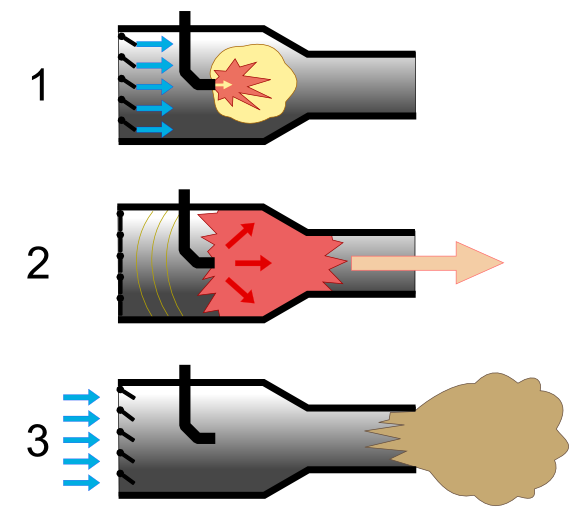
Everybody forgets that there are 3 basic sections to a jet engine.
The compressor is just one.
However if you get the the burner section and the turbine right then you can design/build engines of either type.
However if your burner section or turbine is not right it doesn't matter what type of compressor you are using.
I need to be a bit picky here. The jet engine does indeed have three "components" and each one has its own development issues but I want to expand on the compressor component comparing the axial to the centrifugal compressors. The axial compressor typically has separate stages each consisting of compressor blades and stator blades. We could say the stators are a stage in itself as all calculations are similar and designs are unique, but I'll combine them here for simplicity. The compressor function is to take ambient air and compress it, increasing pressure but also changing velocity and increasing temperature. This is accomplished by the design of both the compressor blades and the stator. Each stage, including stator, must be carefully designed to ensure compressor stalling does not occur over the ambient operation range, including changes in inlet velocity and pressure, and that the output is compatible with the next stage. Each stage sees a different environment than the stage before it. This analysis and design must be repeated for every stage including stator. All of the design work and manufacturing must be very precise. In WW2 up to early 50s stator blades were fixed. When variable stator blades became available, J79-GE-1, much more powerful and efficient engines became available (Turbojet History and Development1930-1960, vol 2M Kay). Modern engines have many compressor stages, 15 on the TF-33. Mucho analysis and design work.
It is intuitively obvious that the centrifugal engine design is much simpler. There is only one analysis for compressor and stator design (some design had two sided compressors but the same design was effective for both sides). There are much fewer problems to overcome. Also, centrifugal jet engines are much shorter coupled between turbine and compressor. When you are transferring 3,000 hp or higher (much), the shorter the shaft the less the problems.
As stated, burner design had it's own issues which had to be addressed, but was common to all designs.
Also, turbine design, while similar aerodynamically to the compressor, kind of a reverse design, was very difficult due to the heat environment. Metal had to be developed along with cooling designs to make it operational. This is again, independent of compressor design.
All in all, I think if Germany had put money into the centrifugal compressor, they would have had a solid 2-3k lb thrust engine a couple of years before the axial engine, couple that with Germany's advanced airframe designs and Germany gets a lot tougher.
But, as Shortround6 says, it all has to come together.