Maybe there is a plausible reason... Some feedback from people who were engaged in analysis of the Me 262 wing using the then new technique of finite elements:
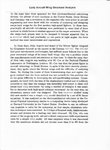
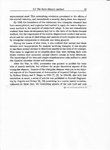
Finite element analysis for ... - Google Books
Quote:
"...The Me 262 had good aerodynamic performance, but suffered many failures due to the poor structural design of its swept back wings; this was a problem which the manufacturers could not overcome at that time..."
The need to carry out stress analysis on swept back wings forced the development of finite element methodology. This didn't really get under way until the digital computer became generally available after the war.
Was the rate of turn of the Me 262 limited by structural considerations, engine operational stability (tendency to flame out), or a combination of both?
I rather suspect the latter...
Regards,
Magnon
Magnon - why are you dabbling in a field in which you have a.) no theoretical knowledge and b.) try to apply this lack of knowledge to resolve questions you do not understand.
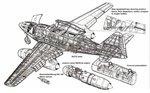
First - look at the cutaway drawing of the Me 262 that you presented. The wing was built up of orthoganally placed structure perpendicular to the spar. In the future, the wings had more sweepback and had a more drastic taper in chord depth in attempts to reduce drag and shift the aerodynamic load distribution inboard to reduce the structural loads on the wing due to both torsion and bending. In such wings the ribs were first designed at an acute angle to the spar. later the airframe design approach varied from orthogaonal to angular depending on other factors.
NASTRAN, curiously developed in part by Larry Ellison IIRC, (computer modelling aspects of relaxation methods between 'elements' to achieve the equillibrium aspired to in your article) was a finite element modelling tool in which Trianglular Plates, rectangular plates, shear panels, beams and Rods were the tools of the structural modeller. This application was the first successful computer model for complex structures and first used in the US Space Program, then shortly afterwards in the Aerospace industry.
IIRC NASTRAN used a combination of Displacement/Node Relaxation methods to iterate to the solution.
The structural failures of the Me 262 were dominantly at >.85 M when the jet was in a dive and in the transonic range which caused the aft movement of the aerodynamic center and a nose down pitch moment requiring enormous stick forces to pull out. In this mode the eppenage was the first failure mode - similar to P-38s and P-47s in a similar dive... and had NOTHING to do with primary failures in the wing spar. The required forces applied to the aft section of the airframe by the elevator to counteract the pitch down moment simple exceeded the design ultimate stress... if the pilot was strong enough.
Similarly, any high speed 'snaking' would introduce asymmetric loads on the eppenage - another hard to predict failure mode in pre-design and very hard to correct in production. That would not have anything to do with the design philosphy regarding Limit and Ultimate Loads - it would simply introduce them in an unexpected (and unanalyzed) flight condition.
Nothing about the article has anything to do with Messerschmidt design philosopy and actually seems to demonstrate some ignorance regarding the actual layout of the Me 262 wing structure.
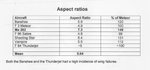
A competent structures engineer would not model the Me 262 wing with triangular elements if he wished a close approximation of the actuasl to predicted stress levels for the assumed loads. The more difficult problem is the analysis for the applied loads with greater magnitude of spanwise components of lift than a 'straight wing'. This would also result in greater induced drag than predicted by simply applying the equation and using the geometric AR, rather than a 'fudge factor' to compensate for sweep.
Further, the nature of the triangular 'elements' are not clarified. If the model presumed triangular plates and beams as the primary structure - the results would be to create a significantly 'stiifer' (i.e. less displacement) model than real life and yield results that were treading dangerously with respect to underestimating stresses at the joints.
The article didn't specify which side of the "9%" approximation, or I overlooked it ... was it high or low?