I can not say for sure that it was a truck bomb, but . . .
The spans where the blast occurred are deck type construction (ie the spans are self supporting, with the ends resting on piers).
A semi-trailer could easily hold 10-15 and maybe 20 tons of explosives.
A blast of that size in the middle of a span could cause a downward movement exceeding what the structure is designed to withstand. Even if it withstood the downward movement it is possible it would not not survive the rebounding upward movement. The blast might also cause a whipping movement in the nearby spans, possibly with enough amplitude to cause unseating and/or failure of the deck structure and/or connectors to adjacent spans/decks. Bridges are designed to resist come up-down and side-side movement, whether due to wind, wave, or seismic forces, but there is a limit.
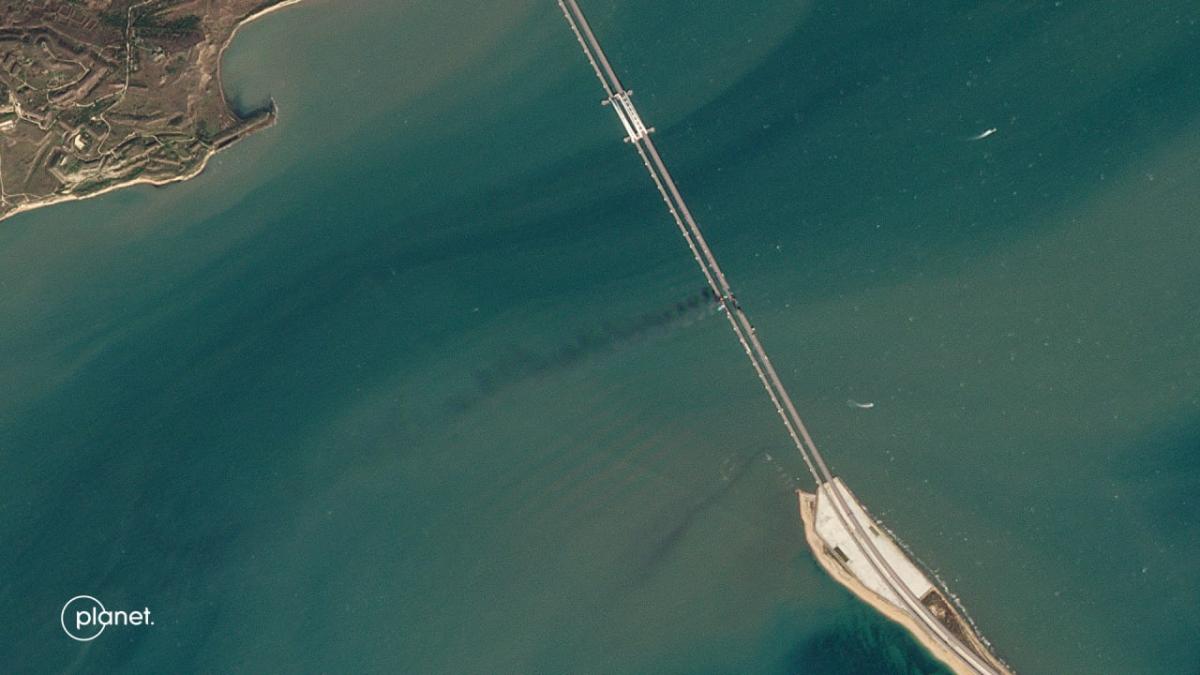
From the video it appears as if the explosion originated on the vehicle deck, approximately where the truck was. In the images it appears as if the blast took place mid-span, possibly destroying the immediate support structure under the span. The span then slid partially off the nearest(?) pier, the movement causing stresses farther away resulting in failure of the connectors at the end of one adjacent span, and at the end of a span one span removed from the first.
With modern computer modeling of stresses in structures (whether of steel, reinforced concrete, a combination thereof, or a host of other materials/combinations) it would not be too difficult for someone with knowledge of such structures to predict where the blast should be located. If the planners have specific knowledge of the structure it could be relatively easy.
Also, the shockwave from a blast of that size could easily breach nearby tanker cars. In railway disasters involving tanker cars with explosive content there is often a chain reaction where the adjacent cars in the string, or nearby cars on other rails such as in railroad yards, are breached by the explosion of other tanker cars.





 )


