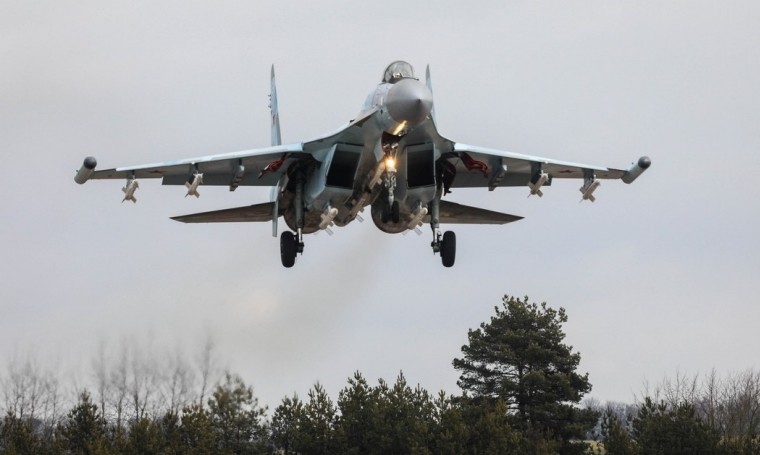
Indeed. The paper tiger is still a paper tiger. I think this aspect of the war has exposed one of the fundamental emerging problems with modern airpower, be it western or Russian.
Aircraft that are too few, too expensive, and too time consuming to replace according to the likely attrition rates of being used in anger, are too valuable an asset to be hazarded in the roles for which they were actually designed, aren't they?
Airpower in anything other than an environment of total air supremacy is starting to seem a little reminiscent of the fleets of WW1: Both sides are husbanding them as a resource and only using them sparingly and in the lowest threat environments. It more important for both sides to have an air-force 'in being' as a strategic check to the other's.
Whilst aipower remains capable of crushing much weaker opponents over the skies of places like Iraq, in the same way as the big gun fleets of before, are they now too vulnerable to comparatively inexpensive MANPADs and SAMs over the battlefield - or drone, missile attacks on fixed bases? Have the gen 4 fighters and beyond become the dreadnaughts of the 21st century? Humbled in the same they were by mine and torpedo?
"Have the gen 4 fighters and beyond become the dreadnaughts of the 21st century?" In a word, no.
Apart from the very start of the conflict, the Ukrainian Air Force has been considerably more active than its Russian counterpart. Given the integrated SAMs in the Russian battlegroups, there aren't any "lowest threat environments" anywhere near the Russian front lines.
The Russian Air Force is suffering from a decades-long dearth of training. Even maintaining basic proficiency has been challenging, so it's not surprising that they suffered heavy losses in combat over Ukraine and are nervous about overstepping their abilities.
SAMs are undoubtedly a challenge but the combination of 5th and 4th generation capabilities, stand-off munitions, and integrated joint fires can do much to neutralize the threat of ground-based air defences. SAMs will always be a threat...but good tactics, effective training, and high aircrew proficiency can greatly impact their effectiveness.
Back in the mid-90s, I worked on a Tornado squadron coming off the back of decades of preparation in case the Cold War turned hot. We took our jets to an exercise in the US that had instrumented threat emulators as part of the bombing range. The range officer, a former Wild Weasel back-seater, did a "show-and-tell" that stitched together videos from boresighted cameras atop the threat system emulators. Our Tonkas went in at operational levels (100ft AGL) and the SAMs never got a shot off because there was simply insufficient time from unmask to the target aircraft going behind the next ridgeline. One of our pilots, a Flt Lt (O-3), led the mission to neutralize a target. He led planning for the entire gorilla package--escorts, AWACS, etc--that ensured his 8-ship of Tonkas could get to the target. He delivered one of the all-time great post-mission debriefs (usually, these were long, drawn-out affairs where everyone chimed in on what worked and what didn't work). Our pilot stood up in the briefing room, asked the range officer to pull up a graphic of the target area, declared "Bombs on target, on time" and sat down. The range officer looked at the target image, with red crosses showing the bomb hits directly on the target, and said "I have nothing more to add." I was never so proud to be part of an organization as I was in that moment.
Bear in mind that most of the SAM systems in use by Russia date from the 90s (and many are earlier). There are some very capable, and more modern, systems. However, the human in the loop will always have an outsized impact on the SAM's engagement. Response times will be non-existent if the SAM operators have left their vehicle and gone diving into trenches.
Good tactics, well executed, ensure that manned combat aircraft still have a role to play in the modern battlespace.


 www.abc.net.au