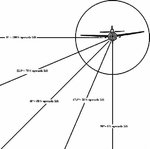
Ummm no.
Let me try to explain.
First I'm going to assert that the "lift" created by the wing passing through the air at a constant speed is perpendicular to the wing and does not change regaurdless of orientation. As long as the speed remains the same, the force in the direction of the top of the wing will remain the same. Furthermore, we will not consider the effect of changing angle of attack.
Furthermore, I'm going to define this force to be a unit vector with a strength of 1 Gravity. That is, we will assume that in level flight the total lift generated by the wing at the given constant speed is exactly sufficeint to counter the force of gravity. This is not necessary, but as you will see using 1 will make the math cleaner and easier to follow.
It is true that at 45 degrees the upward "lift" force equals the sideways "lift" force. However,
it is not equal to 1/2 the wings lifting force!.
It is easier and more logical, at least for me, to work in radians. A radian is defined as the length of the radius of a circle meausured around its arc (i.e. in a curve). A circle is 2 x Pi radians in circumfrence. For a unit circle, a radian = 1 so that part drops out, and we can simply say a unit circle is 2 Pi in circumfrence.
So if a unit circle has a circumfrence of 2 Pi (radians). Half a circle has a of 1 Pi, a quarter circle (i.e. 90 degrees) is 1/2 Pi, an eight circle (45 degrees) is 1/4 Pi, and sixteenth circle (22.5 degrees) is 1/8 Pi.
Now, since we are working from the angle it is useful to use the sine and cosine (rather than derive them which would take a lot more text), which are defined as:
sine = In a right triangle, the ratio of the length of the side opposite an acute angle to the length of the hypotenuse. This is our sideways force vector.
cosine = In a right triangle, the ratio of the length of the side adjacent to an acute angle to the length of the hypotenuse. This is our upward force vector.
When the wing is angled at 45 degrees (1/4 Pi), down and to the left, the 1G lift vector will point up and to the left, and this unit vector forms the hypontenous of a right triangle, with the sides pointing horizontally to the left and vetically up.
sin(0.25 x Pi) = 0.707106781 {you can enter "sin (0.25 x Pi) =" into google and it will give you this result}
and (for this angle)
cos(0.25 x pi) = 0.707106781
So, as I hope you can see, at 45 degrees of bank the loss upward lift is only about 30%, not the 50% you thought.
You can confirm this by using the pythagorean theorim, which says that the squareroot of the sum of the squares of the sides of this triangle should equal 1.
Now, applying the same math to the angle of 22.5 degrees we can see that:
sin(0.125 x pi) = 0.382683432
cos(0.125 x pi) = 0.923879533
So for a bank angle of 22.5 degrees (1/8 Pi) the loss in upward lift is only about 8.6%.
=S=
Lunatic