Alternative airborne guns (3 Viewers)

Ad: This forum contains affiliate links to products on Amazon and eBay. More information in Terms and rules

Smothered with 30mm hits, hit multiple times with an aerial 105mm howitzer (larger than anything employed in WW2, the Piaggio P.108 with a 102mm/4 inch) , and the USS Mobile Bay (CG‑53) had to be sunk with a real ship killing weapon, a torpedo. Aerial cannon are not effective in destroying large ships.


View: https://www.youtube.com/watch?v=-25qudVrUnU&t=315s

The P.108A was NEVER used in combat - Ju87G-2s sank more vessels than your posts denying aircraft cannon were never successful. :thumbleft:
 
MG 131 started, on paper, in 1933, It didn't get much further until 1938. It was a functioning weapon in 1940 and was being fitted to the Me 210 and the Do 217. Why is took until 1942/43 to get into single seat fighters I don't know.
The MG 131 installation was guilty for the sped loss of ~10 km/h on the fighters, in the exact time (1943-44) when the Allies started deploying their best kit. The installation did barely anything in increasing the chances of downing the Il-2s or 2-engined bombers,, let alone of the prime targets - the bombers trying to wreck Germany proper.

FN was certainly selling 13.2mm machine guns but I don't know if Colt or FN was making the barrels for these guns and fitting them to Colt receivers. Might depend on batch of guns in question. The Germans did not capture a factory capable of making hundreds of heavy machine guns per month. They captured a factory capable of making a lot of rifles, pistols, shotguns and light machineguns (BAR) with the drawings and some small scale tooling for the belt feed guns.
Germans needed to make new production lines (or re-tool the existing ones?) for the HMG anyway. So going on with a more powerful weapon would've been better.
But the main kicker is the bad timing of the MG 131.

MG 131 was the most weight efficient HMG except for the Soviet 12.7mm UB. Sometimes by a lot (Breda 12.7mm) and sometimes by only a little (Ho-103). The MG 131 was very similar in cartridge power to the Italian guns and the Ho-103. It fired faster than the Italian guns and it was lighter than the Italian guns and the Japanese gun.
Weight efficient as it might be, and win the bar bets in that regard, IMO takes the 2nd row seat against the target efficiency. Sorta like the very efficient 20 liter aero engine not being as a good choice to power the fighters as the less efficient 30-50L aero engine.
Italian gun have had much better timing than the MG 131, so I rate it much higher as a real weapon of war.

Well, if you are saying it could have been used in place of heavy machine gun/s you either need to lighten it or accept the weight penalty.
What time frame do you want to use? Adopt the Oerlikon guns in 1939 so you can have fast firing, light guns in 1944?

MG FF was of the weight of a powerful HMG, so I don't see much of a need for making it lighter. Use the twinned belt-fed LMGs if the place if really weight-sensitive.
Germans adopted - bought licence - of the Oerlikon gun in 1935, and started installing it on their aircraft in 1938. The faster-firing version should've been available by 1942, IMO.
(British should've been doing the same)
As for what was used in place of what, the MG 131 sometimes took the place of the MG FF, like in the nose of the He 111.

And what did that contraption weigh?
I'll lok it up.
 
The P.108A was NEVER used in combat - Ju87G-2s sank more vessels than your posts denying aircraft cannon were never successful. :thumbleft:
I never said the P.108a was used in combat. They were still trying to develop it and make it work when the armistice occurred for Italy.

Where is your proof on the many antiship kills by cannon armed Ju-87s? What size vessels? Your fantastic and unsupported claim a few days ago, "Plenty of instances where the cannon armed B-25s raped Japanese shipping" wasn't true either for anything larger than a motorized barge, and not many of them. B-25s and JU-87s both sunk a lot of ships, actual ships, not barges, but with bombs, not 37mm or 75mm cannon.

Aircraft cannon may have experienced the odd lucky shot against ships or a sub or two, but they were not as effective as bombs or rockets. If heavy cannon armed aircraft were so great for antishipping, they would have been much more widespread and have been fielded much longer than these "flashes in the pan" were. They were a waste of resources. Large cannon armed aircraft were replaced by those armed with rockets as quickly as rockets could be employed. Today's AC-130 is a special case, with extremely sophisticated targeting capabilities unheard of in WW2, but even it with the best circumstances possible don't make it a real ship killer, and that's with a 105mm shell that weighs more than twice what the B-25's 75mm shot.
 
Last edited:
The MG 131 installation was guilty for the sped loss of ~10 km/h on the fighters, in the exact time (1943-44) when the Allies started deploying their best kit. The installation did barely anything in increasing the chances of downing the Il-2s or 2-engined bombers,, let alone of the prime targets - the bombers trying to wreck Germany proper.
The main problem seems to be the timing; the Germans didn't get into production/service soon enough. The gun was ready in late 1940 (unless faults are hidden) and that is about one year earlier than the Japanese army was coming up with the Ho-103 12.7mm.
Weight efficient as it might be, and win the bar bets in that regard, IMO takes the 2nd row seat against the target efficiency. Sorta like the very efficient 20 liter aero engine not being as a good choice to power the fighters as the less efficient 30-50L aero engine.
Italian gun have had much better timing than the MG 131, so I rate it much higher as a real weapon of war.
German 13mm is rated at 9600 joules for HE ammo and 9700 joules for the AP ammo.
Italian & Japanese 12.7mm is rated at 9800 joules for HE and 10,600 joules for AP.
Yes, the American .50 cal had ammo from 16,600 to 17,400 joules but the American gun (and Belgian and Japanese navy) was bigger, heavier and the ammo was bigger and heavier, no free lunch. maybe I am not looking in the right places but weight of the German 13mm ammo is hard to find. Italian/ Japanese/British 12.7/.5in ammo was about 80g per round. American .50 cal was around 120g depending on bullets. 20mm MG-FF/M ammo was about 160-180g depending on shell.
The Italian/Japanese 12.7m guns shot down a lot of allied planes in 1941-42-43 and they were the primary armament and not supplements to one or two 20mm guns.
The MG 131 was about twice as effective as a 7.9mm gun so instead of having one 20mm and two 7.9mm the Germans could have had one 20mm and four 7.9mm equivalent.
Pulling the cowl guns out and trying to use a MF 151 in the fuselage and a 20mm MG-FFM in each wing (even with belts) was not a good idea. Germans loved to use miss-matched guns with different times of flight and different trajectories. It was not really a good idea.
MG FF was of the weight of a powerful HMG, so I don't see much of a need for making it lighter. Use the twinned belt-fed LMGs if the place if really weight-sensitive.
It was actually heavier. The weights of the HMGs include the feed system. The MG FF does not. Both types often do not include cocking systems.
Not to pick on the MG FF too much, very few 20mm guns include the feed system. MG 151 and ShVAK (?). Fitting pneumatic cocking cylinders to wing guns added a few kgs.
The twin LMGs might not have been given enough credit at the time. Large HMG (Browning and UB) looked cool but trying to aim them by hand at high speed was very difficult. US waist guns generally had terrible accuracy and the gunners could use their whole bodies (legs) to swing the guns. Trying to aim from the waist up was hard.

To get away from the Germans, the Japanese were the champions of shooting themselves in both feet. A Zero with a pair of Ho-103s in the cowl and a type 99-2 in each wing?
Italians; why did the Breda weigh as much as the US Browning and yet fired the smaller, lower powered cartridge and fired slower (never got over 700rpm).
 
The MG 131 was about twice as effective as a 7.9mm gun so instead of having one 20mm and two 7.9mm the Germans could have had one 20mm and four 7.9mm equivalent.
Pulling the cowl guns out and trying to use a MF 151 in the fuselage and a 20mm MG-FFM in each wing (even with belts) was not a good idea. Germans loved to use miss-matched guns with different times of flight and different trajectories. It was not really a good idea.

One 20mm and two MG 131s (or 4 LMGs) is behind what the LW have had as standard from late 1938 when the 109E-3 was entering service.
I still think that a MG 151/20 + MG FFMs would've been a far better set-up, despite the 100 m/s difference in the muzzle velocities (both guns firing the Mine shell).

To get away from the Germans, the Japanese were the champions of shooting themselves in both feet. A Zero with a pair of Ho-103s in the cowl and a type 99-2 in each wing?

For 1942-43 - excellent, and, for 1944-45, still very useful.

Italians; why did the Breda weigh as much as the US Browning and yet fired the smaller, lower powered cartridge and fired slower (never got over 700rpm).
Breda was ripe for improvement of RoF come 1940, let alone 1941. I don't mind if the weapon is on the heavier side if it's good properties, like reliability, RoF, MV and/or shell weight are compensating for it.
 
Breda was ripe for improvement of RoF come 1940, let alone 1941. I don't mind if the weapon is on the heavier side if it's good properties, like reliability, RoF, MV and/or shell weight are compensating for it.
yes the Italians were behind in improving their aircraft guns. Unfortunately, the Breda-SAFAT, however good it may have looked in 1935-39 only had reliability on it's side by 1940-41.
It weighed within 1kg of the American .50 cal and while it had a bit better rate of fire (700 vs 600 both unsynchronized) in 1939-40 that went away in 1941-42. It had a comparable MV up until 1940 but the bullets were around 3/4s the weight.
attribute............Breda-SAFAT......................1940 .50 Browning.............................1941-42.....50 Browning
Weight...................same......................................same........................................................same
RoF..........................700rpm................................slower.......................................................faster
MV...........................2500fpm..............................same.........................................................2880fps(?)
bullet weight......33-35.4g................................48g............................................................43-46g.
Joules.......................10,600..............................13,940..........................................................17,400
The US .50 cal burned over 70% more propellent per shot to get that performance.
Cost in materials and burned-out barrels?
Japanese Ho-103 was lighter and fired faster for the same ammo.

One 20mm and two MG 131s (or 4 LMGs) is behind what the LW have had as standard from late 1938 when the 109E-3 was entering service.
Germans had a lot of problems with the 20mm cannon in the 109. The hoped-for engine mount did not work, gun over-heated and jammed. Which lead to single 7.8mm machine gun in each wing in some of the Jumo 109s. Germans then tried putting a single 20mm MG-FF in each wing. Huge increase in firepower for about 7 seconds. Germans were using about 500 rounds per machine gun for around a 30 second firing time (?). Some of the 109E-3s got 1000 rounds for each cowl gun which was bordering on ridiculous. Ideally they should have developed the belt feed for the MG-FF in the wings and paid for the weight gain by ditching over 1/2 the cowl gun ammo, not an equal trade but something. British used 300-350rpg for the Spitfire and Hurricane. French used 300-500rpg for most of their wing RCMGs although they dreamed of a lot more for future developments.
I am not sure if some of these ammo requirements were actually based on anything (combat experience) or dreams/wishful thinking. US was far from being immune.
Most countries cannon armed fighters were going to run out of ammo fairly quickly.
It took a long time for the Germans to fix the problem in the Bf 110. rear seater was given two extra drums per gun to switch out. Maybe they didn't fix it becasue they were working on the Me 210 with MG 151 guns?
Seems like everybody (mostly) wanted the initial punch of 20mm guns but then were going to hunt cripples, strays/broken formations or get themselves out of trouble using just the machine guns after the cannon ran out of ammo.
A lot of planes were designed and built with very mismatched firing times for their guns. What the men in the field did (not filled the ammo boxes to capacity) changed at times. Trying to find the reasoning behind a lot of this is hard.
 
yes the Italians were behind in improving their aircraft guns. Unfortunately, the Breda-SAFAT, however good it may have looked in 1935-39 only had reliability on it's side by 1940-41.
It weighed within 1kg of the American .50 cal and while it had a bit better rate of fire (700 vs 600 both unsynchronized) in 1939-40 that went away in 1941-42. It had a comparable MV up until 1940 but the bullets were around 3/4s the weight.
Sometimes, the low efficiency of a gun can be solved by installing more of them. A move towards 4 Breda HMGs per a fighter should've been done by the time Italians have the engines capable for 1000+ HP at 4 km. But indeed a working 20mm would've been my suggestion, these don't rely on excellent ballistics and RoF as much as HMGs once armor is in the picture.

Another, perhaps missed, opportunity for an European power might've been the cannon firing the 'small Solothurn' 20 mm cartridge, that was used in some anti-tank rifles of the 1930s. Rimless cartridge, neither too big nor too small, it should've provided the ballistics of the 'middle Oerlikon'( the FFL), in a weapon that is of a modest size & recoil.

The hoped-for engine mount did not work, gun over-heated and jammed. Which lead to single 7.8mm machine gun in each wing in some of the Jumo 109s. Germans then tried putting a single 20mm MG-FF in each wing. Huge increase in firepower for about 7 seconds. Germans were using about 500 rounds per machine gun for around a 30 second firing time (?). Some of the 109E-3s got 1000 rounds for each cowl gun which was bordering on ridiculous. Ideally they should have developed the belt feed for the MG-FF in the wings and paid for the weight gain by ditching over 1/2 the cowl gun ammo, not an equal trade but something.
Agreed.
The motor-cannon idea seem to be working with the Jumo 210s and DB 601Ns, but not with the 601As.

It took a long time for the Germans to fix the problem in the Bf 110. rear seater was given two extra drums per gun to switch out. Maybe they didn't fix it becasue they were working on the Me 210 with MG 151 guns?

They fixed it once the MG 151 became available. The belt-fed FF/FFM would've been and elegant solution for the 110, too. Carrying 4 such weapons (and no nose LMGs) would've allowed for an unprecedented firepower for 1939.

Seems like everybody (mostly) wanted the initial punch of 20mm guns but then were going to hunt cripples, strays/broken formations or get themselves out of trouble using just the machine guns after the cannon ran out of ammo.
Perhaps the target effect of the 20mm fire by a single or twin cannon at bombers was over-rated before the real shooting started, especially once the bombers gotten the self-sealing tanks and some armor? Maybe the expected hit rate didn't panned out - basically instead of, say, 10-12 rounds landing, just three-four did so in many cases before the fighter run out of the ammo? Dud rate being grater than expected? Too sensitive or too insensitive fuses, that either detonated the shell to early, or not detonating them upon contact on fabric, respectively?
Definitely the case for a) at least two cannons to be carried, and b) more shells per a cannon.
Also for pilot's markmanship training not being as good as it was hoped for? Again more cannons and more ammo will be needed, until these mistakes are accounted for and rectified.

A lot of planes were designed and built with very mismatched firing times for their guns. What the men in the field did (not filled the ammo boxes to capacity) changed at times. Trying to find the reasoning behind a lot of this is hard.

One of the reasons I don't like very much the MK 108, the US 37mm M4, as well as the FF/FFF before the light Mine shell earned it another 100 m/s. The very high MV looks great on paper, but it results with either too small the payload, or with too big a gun (looking at MK 101 & 103).
IMO, 700-800 m/s is the sweet area for ww2 - hit probability is still good, but the weapon is handy and practical, and can be made to fire fast enough (here the cannons are, again IMO, already very good at above 600 rd/min for the 20mm, and above 500 for the 30mm).
All of this is for air-to-air fighting.
 
While a more potent gun battery would have been nice to have, perhaps we're running into the carrying capacity of the 109 airframe, which had a substantially smaller wing than the Spit and Hurricane? Comparing the gun weights of some of the most produced variants (weight sans ammo from wiki) and a few cowl MG-less hypothetical ones thrown in for good measure:

VariantArmamentArmament weight (kg)
E42 MG FF/M + 2 MG 1773
F41 MG 151/20 + 2 MG 1763
G61 MG 151/20 + 2 MG 13176
G6/U4 & K41 MK 108 + 2 MG 13191
3 MG FF/M79
3 MG 151/20128
1 MG 151/20 + 2 MG FF/M95
1 MK 108 + 2 MG FF/M111
While replacing the cowl MG's with an additional pair of wing mounted MG 151/20 would have produced a fairly potent battery mid-war , 3 such guns would have pushed up the weight to 128 kg, a substantial increase over any of the historical variants. 3 MG FF guns would have been decent, assuming a belt feed could have been provided with, say, 200rpg?
 
FWIW

Not sure how much this actually played in to the equation of the different nations' planning for their guns, but there is the balance of reliability vs striking power (effectiveness of individual or multiple hits, ) vs high MV (and increased chance to hit) vs weight of the system vs ROF vs time of fire (and maybe some other factors that I am not thinking of right now :-k ).

I realize that these factors have been mentioned up thread, but possibly it would be worth looking at in a more detailed manner for the specific guns?

One example is the 20mm 'Hispano' Mk I/II in British service.

It had one of the highest MV so hitting power and chance of hit should have been up near the top of the list.

Reliability was pretty good (after the bugs were worked out - over the first year or so?), but they lowered the ROF intentionally to increase barrel life and.or life of the gun (I am not sure which or if it was for both). Apparently it was capable of firing around 700-750 rpm depending on whether it was using belt-feed / drum-feed, but they settled on 570rpm for belt-fed and 600-650rpm for drum-fed.

The looked-for barrel life was around 10,000 rounds. But research showed that in fighter operations very few airframes survived long enough to fire that many rounds out of the guns. If my information is correct, 5000 rounds fired was considered to be at the high end of likely airframe survival.

Weight of the system with the Mk II gun was considerably higher than for most other 20mm guns used during the war. The bare gun weighted in at 109 lbs, the drum - empty / loaded - weighed 22.2 / ~60 lbs. If belt-fed, the Mk I belt feed mechanism weighed 18.9 lbs and for weight and balance calculations the average round with link was figured at 0.625 lbs. Then you have to add in any mounting bits and pieces. All-up weight of a single gun system for the Spitfire Mk VC was ~220 lbs/gun including a 120-round belt, while for the Hurricane Mk IIC the weight was about 190 lbs/gun including a 90-round belt.

How does this compare with other systems?

By all accounts that I have read the .303 cal Browning that the British adopted was a reliable gun, with a high ROF (1100rpm) and more than enough barrel / gun life. Weight was at about the mid-range of similar guns(?) at 23-24 lbs plus ammo. Hitting power was probably a little toward the low end as was MV.

The US .30 cal and the German [7.92mm] both(?) had higher MV, and the 8.92mm fired a heavier projectile. Did this make any difference operationally?

etc.

What trade-offs were operationally worth it?

{edited: typo of 8.92mm changed to 7.92mm]
 
Last edited:
While replacing the cowl MG's with an additional pair of wing mounted MG 151/20 would have produced a fairly potent battery mid-war , 3 such guns would have pushed up the weight to 128 kg, a substantial increase over any of the historical variants. 3 MG FF guns would have been decent, assuming a belt feed could have been provided with, say, 200rpg?
There is a problem with comparing the MG FF (or any drum feed cannon) with other weapons. Weight of the drums.
MG FF 60 round drums were 8.2kg and the 90 round drums were 12.0kg.
There is another problem with adding multiple cannon to early war fighters (low power).
A loaded 60 round drum was 20.3kg. A loaded 90 drum was 30.2kg.
Even small 20mm ammo was heavy compared to rifle caliber ammo. 6-8 times heavier.

How long the different air forces wanted their aircraft to able to fire for varied and changed.
Gloster Gladiator is supposed to have carried 600rpg for the fuselage guns and 400rpg for the wing guns (2000 rounds total).
Spitfire Is carried 300rpg (2400 rounds total) Spitfire IIs carried 350rpg total and Hurricanes 334rpg.

200 rounds of MG FF ammo averaged 34kg. Does not include belt links or belt feed mechanism.
3 MG FF/Ms with empty 60 round drums would be about 100kg.
With belt feeds a bit less but with more than 60rpg the weight goes up.
What is the performance penalty with an 1100hp engine?
What is the performance penalty with a 1300hp engine?
What is the performance penalty with the 1355hp engine (109G).

If they can't get the 3 20mm cannon into firing position it doesn't matter.
BTW the German 30mm ammo was three times heavier than the 20mm MG FF/M mine ammo (full rounds, not projectiles) and was about 480g per round not including links.
 
The looked-for barrel life was around 10,000 rounds. But research showed that in fighter operations very few airframes survived long enough to fire that many rounds out of the guns. If my information is correct, 5000 rounds fired was considered to be at the high end of likely airframe survival.
Was that barrel life or gun life?
Barrel live was often very much shorter than gun life. Hispano guns (and many others) had changeable barrels. They often varied it how easy was to change them. Oerlikons were rather easy to change, in naval mountings they often had a pair barrel per gun close by and they swapped them during combat to keep the barrels cool (which preserved life). Aircraft guns had the advantage of fast cold air (mostly) and short bursts. 20mm guns did not burn barrels like American .50 and the like (Hotchkiss 13.2mm and Soviet 12.7mm) but a Hispano gun used just over twice the amount of propellent as the 20mm MG FF/M and that was going to significantly affect things.
By all accounts that I have read the .303 cal Browning that the British adopted was a reliable gun, with a high ROF (1100rpm) and more than enough barrel / gun life. Weight was at about the mid-range of similar guns(?) at 23-24 lbs plus ammo. Hitting power was probably a little toward the low end as was MV.

The US .30 cal and the German 8.92mm both(?) had higher MV, and the 8.92mm fired a heavier projectile. Did this make any difference operationally?
Probably not a lot of difference. We can say that some rcmg were around 25-33% more powerful than others but even the low powered 13/12.7mm rounds were around 3 times more powerful and the US .50 and Soviet 12.7mm were around 4-5 times more powerful.
Saying the British should have adopted the American .30 cal rounds/s would have made a measurable difference is going to be hard. A difference yes, trying to shift things more than a few percentage points? A difference of 1-2 mm in armor penetration? a difference of under 10% in incendiary material? A difference of 10% in time to flight to 300 meters or 600 meters?
 
One example is the 20mm 'Hispano' Mk I/II in British service.

It had one of the highest MV so hitting power and chance of hit should have been up near the top of the list.

Reliability was pretty good (after the bugs were worked out - over the first year or so?), but they lowered the ROF intentionally to increase barrel life and.or life of the gun (I am not sure which or if it was for both). Apparently it was capable of firing around 700-750 rpm depending on whether it was using belt-feed / drum-feed, but they settled on 570rpm for belt-fed and 600-650rpm for drum-fed.

The looked-for barrel life was around 10,000 rounds. But research showed that in fighter operations very few airframes survived long enough to fire that many rounds out of the guns. If my information is correct, 5000 rounds fired was considered to be at the high end of likely airframe survival.

Weight of the system with the Mk II gun was considerably higher than for most other 20mm guns used during the war. The bare gun weighted in at 109 lbs, the drum - empty / loaded - weighed 22.2 / ~60 lbs. If belt-fed, the Mk I belt feed mechanism weighed 18.9 lbs and for weight and balance calculations the average round with link was figured at 0.625 lbs. Then you have to add in any mounting bits and pieces. All-up weight of a single gun system for the Spitfire Mk VC was ~220 lbs/gun including a 120-round belt, while for the Hurricane Mk IIC the weight was about 190 lbs/gun including a 90-round belt.

I'd say the Hispano ranks up there with the best all-round aircraft guns of the war once they got the initial reliability issues worked out and a belt feed system. Shame it took so long though. Particularly as the Axis powers didn't really deploy heavy bombers so the Allies had less need to deploy things like 30mm guns, and the high MV and high-ish RoF of the Hispano was arguably a better tradeoff for the mostly anti-fighter and anti-light bomber roles they encountered.

But like you said, the performance of the gun came at a cost in terms of weight. The late-war Hispano Mk V was a bit lighter and had higher RoF, with a modest reduction in MV.

The US .30 cal and the German 8.92mm both(?) had higher MV, and the 8.92mm fired a heavier projectile. Did this make any difference operationally?

To nitpick, the German caliber was 7.92mm, not 8.92. Also called "8x57 IS". It's a bit confusing, depends on whether you measure the caliber by the bullet diameter, land diameter of the barrel, groove diameter of the barrel, or something else? And different nations & institutions of course chose differently.

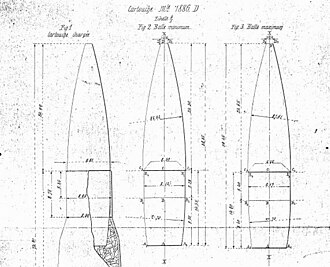
The German gun was also coupled with a very good bullet design, the "s.S Patrone". From wiki: "The s.S. ball projectile with a 5.9 millimetres (0.23 in) long 6° 25′ 51″ boat tail was designed for long range use and offered the best aerodynamic efficiency and external ballistic performance of any standard rifle bullet used during World War II". Now, does this matter significantly for the relatively short range aircraft MG's were usually operated at, probably not. It's all an exercise in hair-splitting compared to HMG's or autocannons.
 
boat tail was designed for long range use and offered the best aerodynamic efficiency and external ballistic performance of any standard rifle bullet used during World War II"
This might be good for winning bar bets.
A number of countries used boat tailed bullets but part of the "trick" here is that the Americans and British did not use them in "standard" rifle ammo. They used them in standard machinegun ammo. What were Aircraft machineguns using?
German bullet might very well be better than the American & British bullets but they are going to be close.
French were using spitzer boat tails from around 1898.
330px-Balle_D.jpg

this may not be as good a design as the German bullet, actual difference may have been small in practice. French bullet design may have been good. The cartridge case sucked.

Germans also used a hotter (higher pressure) loading for aircraft machine gun ammo. Like AP-v instead of AP and API-v instead of API. These 'v' loadings gave about 100m/s more velocity depending on bullet. The cost was greater barrel wear and greater gun wear but as others have said, aircraft guns don't last as long as ground guns on average anyway and aircraft guns do have better cooling.
 
There is a problem with comparing the MG FF (or any drum feed cannon) with other weapons. Weight of the drums.
MG FF 60 round drums were 8.2kg and the 90 round drums were 12.0kg.
There is another problem with adding multiple cannon to early war fighters (low power).
A loaded 60 round drum was 20.3kg. A loaded 90 drum was 30.2kg.
Even small 20mm ammo was heavy compared to rifle caliber ammo. 6-8 times heavier.
(my bolding)
The fellow member was posting about the mid-war:

While replacing the cowl MG's with an additional pair of wing mounted MG 151/20 would have produced a fairly potent battery mid-war , 3 such guns would have pushed up the weight to 128 kg, a substantial increase over any of the historical variants.

200 rounds of MG FF ammo averaged 34kg. Does not include belt links or belt feed mechanism.
3 MG FF/Ms with empty 60 round drums would be about 100kg.
With belt feeds a bit less but with more than 60rpg the weight goes up.
What is the performance penalty with an 1100hp engine?
What is the performance penalty with a 1300hp engine?
What is the performance penalty with the 1355hp engine (109G).
The triple MG FFM battery, belt-fed, and a lot of ammo should've been much lighter than the suggested 2x Ho-103 and 2x Type 99-2 battery for the Zeroes, that were very light on power, and indeed under 1000 HP early on.
For the Bf 109 with 1300 HP engine (and any similar mid-war fighter), the triple FFM battery would've been a great fit.

Two MG FFMs in the wing might've offered less drag than the twin MG 131 installation of the 109s.

If they can't get the 3 20mm cannon into firing position it doesn't matter.
With 1300 HP, and in 1941-43, they will be able to enter into the firing position. Better than the Spitfire Vb with two Hispanos and 4 .303s, or the Zero with the suggested battery, or the Ki-61 with the similar firepower. Certainly no worse than the MC.205 with two cannons and two HMGs, let alone the G.55 with 3 cannons and two HMGs.
 
The P.108A was NEVER used in combat - Ju87G-2s sank more vessels than your posts denying aircraft cannon were never successful. :thumbleft:
This is of course true. But aircraft cannons had reached their limit. There is a reason why the British switched to rockets as the primary anti shipping weapon and stopped producing the 57mm armed Mosquito.
 
Anti-shipping.
What is the definition of shipping, or ship?
What is the dividing line between ships and boats?
A pair of 37-40mm guns could be devastating to some 70-100ft craft (especially wood) but would have considerable trouble with a 140-160ft iron freighter.
Larger commercial craft?
It is possible to sink such ships with aircraft guns but when does possible turn into likely?
75mm gun in a B-25 used a 14.7lb shell holding 1.5lbs of TNT. Very dangerous if it hits in the right spot. A lot less dangerous if it hits 4-6 feet low ( hits the water a number of feet from the hull) or hits 4-6 ft high. A hole several feet in diameter that high depends on the sea (height of waves) to endanger the ship right away. May depend on what is behind the hull plating. Hit in engine room is very bad, hit in a cargo hold carrying coal?

Glider is quite correct. Rockets for the British were a much better solution. 8 shots instead of 2-3 per attack run (57mm or 3 in) even a single hit was much more devastating. Even early MK I HE F using an adopted 4.5in artillery shell warhead was 3-4 time the power of a 3in shell. Later purpose-built SAP HE warheads were much more lethal.
 
All I can add is that the RN found that the 3in was pretty useless for combat. It couldn't penetrate anything of note and the warhead too small to do much damage.

RN A/S trawlers had 4in guns which was able to penetrate a submarine hull and M/S trawlers 3in or 12pd (because we had nothing else in numbers)

I have posted this before but it may be of interest. A number of years ago my son dated a German and her father had served in Norway on the German coastal forces. He told my son that they hated the 'big gun' mosquito as they knew that it was likely to hit was it was aiming for, bridge, flak position etc which made it in some way personal. However they knew that the rocket armed attackers were far more dangerous to the ship.
 
All I can add is that the RN found that the 3in was pretty useless for combat. It couldn't penetrate anything of note and the warhead too small to do much damage.

RN A/S trawlers had 4in guns which was able to penetrate a submarine hull and M/S trawlers 3in or 12pd (because we had nothing else in numbers)

I have posted this before but it may be of interest. A number of years ago my son dated a German and her father had served in Norway on the German coastal forces. He told my son that they hated the 'big gun' mosquito as they knew that it was likely to hit was it was aiming for, bridge, flak position etc which made it in some way personal. However they knew that the rocket armed attackers were far more dangerous to the ship.
That 'big gun' Mosquito had the 57mm 6 Pounder gun chosen to use a solid anti armour round with maximum penetration to put holes into submarine pressure hulls. It had the potential to swap it for the ROF QF 75mm gun which used a chamber and barrel to use the same HE round as the US M3 gun as used in the Sherman tank if it were to be used on targets where a good HE round was ideal*. That swap was done on British tanks. As it turned out the unguided rockets not only could carry a 60lb HE warhead but could also carry a solid steel 25lb warhead to penetrate submarine pressure hulls. The rockets were a more versatile answer in practice with the firepower of a single broadside from a light cruiser. Equally, in practice, the rockets were horribly inaccurate by comparison with the airborne gun as particularly shown by comparison testing of the twin 40mm S Guns of the Hawker Hurricane which were far more likely to hit a small target like a tank or a river boat whist rockets scattered over a wide area and only very rarely hit such a target.

One might consider scenarios like the Fairey Swordfish being able to fire a light cruiser size broadside with 8x60lb rockets and the effect of a long burst of 4x 30mm Aden cannons from a Hawker Hunter on a T54 Jordanian tank target which rendered the vehicle á stationary metal box with it's engine bay on fire.

*the whole gun and Molins loader would have to be swapped but the system would be the same other than rebuilt to accommodate the different ammunition.
 

Users who are viewing this thread

Back