Alternative airborne guns (1 Viewer)

main problem is the sort of lack of performance of the machine. You need a lot more power, which means bigger engines and more weight a redoing more stuff.
None of the 3 engines used were that good and a 10,000lb twin with 304sq ft of wing using roughly 700hp engines was having trouble. Once source says 242mph at sea level at normal gross weight (H-S engines?) 227mph at max gross weight. Roughly 300mph at 16,400ft but strafing seems to be a problem.
Redesigning the plane to use larger engines is possible but that takes time and money, and estimates get a lot more iffy.
Other than the versions with bigger engines, the only other path available was the GR 14S which was to the 14M what the GR 14R was to the 14N.

Then the sea level power increases from about 580 hp for each engine to 640 hp, and even 860 hp when the 14S uses the "overcharge" and 1000 hp at takeoff (14M only had a takeoff setting and no overcharge, though it can theoretically maintain that at 2900m to get 785 hp). At the rated altitude of 4000m or so, the 14M delivers 660 hp while the 14S delivers 680 hp at about 4250m, and 840 hp at overcharge.

So a direct calculation would give a sea-level speed increase of (cubic root(1280/1160)-1)*100=3.3% at sea-level and no overcharge and 14.9% with overcharge.

At the rated altitude, speed would increase by up to 8.4% using overcharge (speed would be only marginally increased if at all when the 14S is at normal power).

But the engine weight would increase by about 100 kg per engine and the engine cowling may change ever so slightly, so the increase would probably be less unless this was coupled with aerodynamic upgrades.

For a sea-level speed of about 375-390 kph, that gives new speeds of up to 387-402 kph using normal power and 425-445 kph using overcharge before arriving on the front.
At rated altitude the speed would be nearly the same when the 14S is running at normal power, and would increase from about 480 to 530 kph using overcharge.

Since the normal speed of 14S is 2700 rpm instead of 3030 rpm on the 14M, it's also possible that the 14S is more durable at normal power and would be able to maintain greater cruiser power than the 14M, so the benefit may be greater when looking at cruising speed.

Still, far from enough.
 
Its an interesting point but Italy in 1926 had the Fiat AS.2 engine developed for the Schnider Race developing 800hp.

Clearly this was a one off design for racing but it would have given the Italian engineers considerable experience in how to develop a powerful engine and could be considered a missed opportunity.
 
Fiat built a lot of V 12 engines in the 1920s.
While this prolific range of engines gave a lot of experience it would not translate well into the 1930s, especially the late 30s.
The low octane fuel of the 1920s would support neither high compression or supercharging.
But since the pressures in the cylinders was low the strength of the parts (piston, con rods, crank and crankcase) could be low and thus the engine was light in weight.
They also used separate cylinders although they used one head for each bank of 6 cylinders. A 6 cylinder block is stronger for the weight but a lot harder to manufacture.
Racing engines don't have to last anywhere near as long as service engine.
The Napier Lion engine of 450-500hp in the 1920s was rated at 700hp in 1925 Schnieder cup racing and at 875-900hp in 1927. By 1929 they got 1350hp out of it with a supercharger and one of Mr. Banks exotic fuel blends.

Fiat built a few high-altitude engines using the "trick" of using high compression but not opening the throttle all the way until higher altitude was reached.
Germans were doing this in WW I with some of their engines. Pilots throttle had 3 'gates'. At low altitude the gate/slot for the handle restricted movement so that the carb/s would not fully open. At a certain altitude the handle would be handle would be pushed through an opening into the center gate/slot that allowed for more travel and at another altitude (higher) the process was repeated, and the 3rd slot would allow for full throttle. It might have also increased minimum throttle setting to keep from running too lean.
Using full throttle at 7.5 compression and poor gas could wreck the engine on take-off in the early/mid 1920s.

Steel and aluminum alloys made considerable advances in the 20s and 30s. As did valves, valve seats, valve springs.
Add casting and forging techniques all changed/advanced.
 
And what did that contraption weigh?
(contraption = the belt feed machanism for the MG FF)
I've stumbled on the info:

gff.jpg

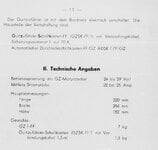
So the mechanism itself is 7 kg, while there is another 1.5 kg for the electric connection box and a 1.5m cable that supplied electric current to the motor. For comparison, the 60rd drum for the MG FF and FFM was 8.2 kg empty. Size of the mechanism was a tad smaller than that of the 30rd drum.
 
Last edited:
I was today's years old when I've found out that there supposedly was the German 24mm spin-off of the known 20x138B cartridge. Unfortunately, any other data seems to be as good as non existing.
FWIW

Perhaps going to 23mm instead of 24mm would've been easier from the logistical point? But, at any rate, the spin-off from the Flak 38 might've been in the ballpark of the 23mm Madsen of the day, that fired a 175 g high-capacity HE shell at 725 m/s, or the similar Soviet post-1945 ammo that grew from the 14.5mm ammo. What does this buy to the LW, providing it gets a real Mine shell? Close to double target effect of the standard 20mm Mine shell, or half that of the 30mm M-shell. Translated into the hits required to down a B-17, it is 10-12 hits, vs, 20 for the 20mm and 5 for the 30mm.
Should be easy to install it into the V of the V12 engines, as well as to make it a synchronised gun for the wing roots of the Fw 190. Also an easy fit for the outer wings of the Fw 190.
No lousy ballistcs as on the MK 108, and thinner ammo will mean more can be carried.
 
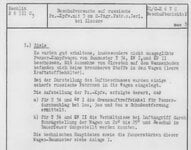
Stumbled into the test results of the MK 101 with cored shot vs. the real-world tanks: T-34, KV-1 (normal armor, IOW no add-on armor) and the KV-II.

(click on the thumbnails)

test.jpg

They took the shots with a static gun 1st against the tanks in the normal, horizontal position, and later with T-34 and KV-2 tanks tilted at sides by 20-25 deg (simulating a slight dive as an aircraft might do it vs. the tanks in real life). Firing was done against the tanks' sides, perpendicular to the tank's direction.
Distances of the test were 100, 300 and 600m.
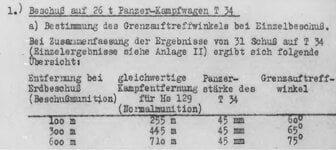
The 45mm armor of the T-34 was pierced up to 600m if the impact angle - Grenzaufteffwinkel - was 75 deg (ie, 15 deg in the NATO speke ) or greater towards 90 deg. Accounting for the flying Hs 129 and firing the normal* ammo and it's speed that is to be added to the MV of the gun, that distance was up to 710m.

101 t34.jpg

The 75mm armor of the KV-1 was pieced at at least 600/710m if the impact angle was at 66 deg or steeper.

101 t34.jpg

The KV-2 was the toughest of the pack, only the turret was penetrated, and at 100 m (calculated at 255m distance equivalent for the Hs 129 and normal* ammo) at 65 deg or greater.

In all cases, the main gun ammo of the tanks detonated, but not catastrophically (perhaps there was only a few in the tanks, I'm not sure). Fuel tanks were empty during the tests.
Excellent results were echieved with the T-34 tilted by 20 deg, allowing for the hits to land more towards the vertical vs. armor. At 300m static range (calculated for the Hs 129 as 445m) and while firing the bursts, the turret, supercstructure and even gun barrel were penetrated with each shot that landed.

The KV-2 results were the same as in the previous tests. Nine hits at 25 deg vs. the roof - none penetrated.

Recomendations of the tasks were, among other:
- attack the tanks from the sides, for the bigger target and possibility to set the fuel and/or ammo at fire
- best vertical anges for the T-34 are steep ones, while for the KV tanks the vertical angle should be as shallow as possible (to account for the different armor slope)
- fire should be opened by the aircraft at under 800m, and the attack to be stopped after the tank is seen as smoking or at fire

* the ammo used during the tests - Beschussmuniton - was found to be a bit too hot, making +-973 m/s at 50 m instead of 940 m/s as the book values - normal - should be, and 803 vs. 779 m/s at 600m; the data for the Hs 129 is for the case when normal ammo is used; ammo was to hot loaded beacuse of a mistake in the factory - doh
 

Users who are viewing this thread

  • Back