Alternative German tanks & AFVs

Ad: This forum contains affiliate links to products on Amazon and eBay. More information in Terms and rules

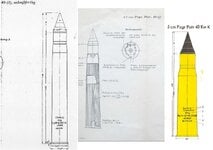
How much the Germans have 'slept' on the captured 47mm stuff. Once outfitted with the cored ammo, the Czech 47mm ATG used 642g of propellant, the French 47mm used 560g of propellant, while the short 50mm used 557 g of propellant.
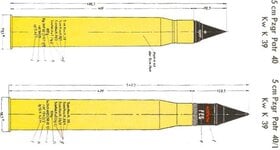
(sorry for the lousy quality of the Czech/German PzGr40 cartridge)
474750.jpg

Respective shot weights were 800g for the Czech gun, 825g for the French gun, and 900g for the 5cm gun.
 
If one had made no diesel engine worth speaking about, and the fuel flow was more or less unproblematic, then keeping it with the gasoline-powered tanks was a no brainer :)
Aside from Russia the other 'major' uses of diesel engines in tanks were the Japanese and Italians.
The Italians tended to bounce back and forth. They wanted diesels but an useable diesel was not always available and they resorted to petrol engines while they sorted out higher powered diesels. How good the 1943 higher powered diesels were may never be known. Not many were built and conditions were not good.
Japanese had started making diesels in very early 30s but getting powerful diesels may have taken a while. Powerful is relative. Japanese were using a 21.7 liter air cooled diesel of 170hp in 1941 in their 15ton (roughly) medium tank at that time. They got 240hp from the engine later (1943?)
The late war Czech diesel used the later 8 wheeled armored cars was 14.8liters and gave 220hp and was air cooled.
In the late 30s Diesels may not have given the power to weight ratios or power to volume ratios that were wanted.
Soviet V2 was powerful, it was also large, and it may not have been very long lived. The Soviets may have accepted the trade-offs. Other countries may not have.

The Japanese appear to have made the worst tank diesels from a power-to-displacement standpoint. The 21.7 L engine on the Chi-Ha had been rushed (barely tested) before approval. The Type 100 employed on the Chi-He and Chi-Nu had got the time to be better designed, hence the 240 hp (1940).

The Type 4 on the Chi-To developped from 1942-43 onwards initially made 412 hp out of 37.7 L and 500 hp when supercharged, which was still mediocre compared to V-2 analogues, but more or less acceptable.

Italian diesels started worse than even some commercial British ones (save for the more convenient V8 form factor). Some were derived into petrol versions in emergency but as they were not built for this fuel from the start, they were not very efficient (as opposed to the gasoline engine made for the Sahariano tank which was efficient). The SPA 242 in the P26/40 did do 330 hp out of 24L which was respectable, and was to be pushed to 430 or 460 hp in the SPA 342 or 343 mooted for faster versions of the tank, but killed by Italy's fall. There was a large 700 hp diesel in development, but displacement is unknown.

Daimler-Benz set for itself the target of getting a very modern and efficient diesel tank engine in 1938 which led to the MB 809. However, they trended towards making a smaller engine rather than keeping displacement the same and increasing power: they went from 400 hp at 24 L to 360 hp at 17.5 L and 300 hp at 14.8 L. The marine MB 507/517 family mooted for the Maus and VK-3002 (DB (800 hp naturally aspirated and 1200 supercharged at around 42-44 L) was also efficient, if a bit large. MAN also worked on a diesel before 1942 but just like the 809, couldn't be upscaled to meet the needs of the VK-3002 program. But from 1942 onwards, almost all new engines in development in Germany were diesels, with only Maybach continuing development of the existing gasoline engines. Even then, they also moved to diesels derived from the HL 230 family towards the end of the war. The issue here was not performance, but simply that it was too late and that the engine couldn't be expected to enter production until late 1945/46.

Britain employed commercial diesels early in teh war which were on the inefficient side but still better than Japanese and Italian early models. Work on (allegedly purpose-made) tank diesels happened some time around 1940-41 but they were made for no more than 350 hp, so unsuitable for the needs of the new tank programs by then. Harry Ricardo briefly worked on a family of H16/24 and I6/8 diesels from 1939 onwards which were quite efficient and could deliver up to 560 hp unsupercharged and 720 supercharged (not even mentionning TOG's Paxman Ricardo), but Ricardo was too busy on aircraft engines and the Army focused more on the Meteor.

America was very unlucky as the Guiberson radials tried before the war were fundamentally flawed and Buda/Guiberson was not actually interested enough to redesign them accordingly. The Detroit Diesels were good but it was too late to expand production enough to make a real surplus, considering these engines were in very high demand for naval assets. Caterpillar diesel radials and half-radials were too late. George H Rarey, an officer involved in tanks in the interwar period, recommended diesels (albeit with a rather ambitious desire for 5 hp per pound of engine weight), especially in flat and radial forms. Ironically, the target power ouputs (25-30 hp per ton on the US interwar tanks) translated to 375-450 hp for the medium tank and 187.5-225 hp for the light tank, which was right in the class needed for the main US tanks fielded during the war.

French tank inspectors were quite interested in diesels ever since 1929 or so, with some in development for Renault FT and FCM 2C modernizations. The B2, B3 battle tanks and BB fortress tank all employed dedicated tank diesels, half or more of the light tank entries in 1933-35 used diesels (but were not adopted for unrelated reasons), the ARL and AMX 45t fortress tanks used diesels (commercial and dedicated alike), and AMX went with only diesels ever since it started working on new tanks. Dedicated engines (instead of commercial/aircraft engines until then) for 65 octane gasoline remained the norm for the new developments of 1939-40 - as by this point, mass adoption of diesels in a sea of gasoline engines would face an uphill struggle just like in the US.

The USSR was unique in that
- it was used to high output tank engines so the V-2 was suitable for the entire war, while even dedicated engines designed elsewhere could well have been too small and weak to serve the entire war (in tanks at least)
- V-2 development started all the way back to 1932, so that the engine was already well-developped (if a little short-lived still) when Barbarossa happened
- the state of the Soviet gasoline process industry and civilian road economy was such that road gasoline engines were not particularly important, unlike certain Western countries.

Even then, Harry Ricardo noted that before WW2, the British had moved on to diesel engines for heavy trucks, such that there weren't many high power gasoline engines in use.

So other than the Soviets, most belligerents had not made a serious dieselization effort (with dedicated, high output designs) until they were already too deep in WW2 to transition.
 
I would note that most (all?) of the Japanese diesels were air-cooled which may affect the power per unit of displacement.
The V-1790 diesel used in the M-60 tank in the late 50s was 750hp from 29.3 liters. Based off the 810hp gasoline version of the engine (which had been cut in 1/2 for a 500hp 6 cylinder engine in the M-41 tank).
Basically in the 1930s-40s you were trading engine size/weight for fuel efficiency when you swapped diesel for gasoline engines. M3 Grant gained about 3000lbs when they stuck in the twin diesels, there were other changes but that was the main change in weight.
Now what is not figured in here is the overhaul life. A lot of these heavy duty engines in later years were rated at different power levels for different applications. Like stationary powerplant, marine, over the road, emergency vehicle and/or military use. There can be further categories or overlaps. Are you going to use that Detroit Diesel 8V-71 in a fishing trawler for days at a time or a ferry boat or a sportfishing yacht a few week-ends a month? All Marine use but different duty cycles.

A Chieftain video says the early T-34 engines were good for about 100hrs before overhaul. Where he got that from I don't know but that is probably a different expectation than AEC or Leyland had for their bus engines. Granted the Buses probably didn't weigh 15 tons or more and rarely drove in dirt or sand for very long in 1-2nd gear.
 
In hindsight and with swapping around of manufacturing capability the Pz II should have been tossed in the rubbish bin in early 1941. Any attempts to keep it in production should have been ruthlessly squashed.
The Pz 38(t) was a superior platform and needed less mucking about with (engine was 25% bigger for one thing).

By the time they got the extended chassis MK II to hold the 15cm Infantry gun they were up to 16 tons, even the V-8 engine was overloaded and at 16 tons they should have been looking at the MK III for any further improvements.
The 15cm inf gun was put into the Pz 38 (t) chassis with a lot less grunting, groaning, and straining and while not ideal, it worked about as well as the Wespe. With expanded manufacturing capacity the Pz 38(t) could have replaces the Wespe and most of the Pz II 75mm AT guns.
 
The Japanese appear to have made the worst tank diesels from a power-to-displacement standpoint. The 21.7 L engine on the Chi-Ha had been rushed (barely tested) before approval. The Type 100 employed on the Chi-He and Chi-Nu had got the time to be better designed, hence the 240 hp (1940).

The Type 4 on the Chi-To developped from 1942-43 onwards initially made 412 hp out of 37.7 L and 500 hp when supercharged, which was still mediocre compared to V-2 analogues, but more or less acceptable.

Italian diesels started worse than even some commercial British ones (save for the more convenient V8 form factor). Some were derived into petrol versions in emergency but as they were not built for this fuel from the start, they were not very efficient (as opposed to the gasoline engine made for the Sahariano tank which was efficient). The SPA 242 in the P26/40 did do 330 hp out of 24L which was respectable, and was to be pushed to 430 or 460 hp in the SPA 342 or 343 mooted for faster versions of the tank, but killed by Italy's fall. There was a large 700 hp diesel in development, but displacement is unknown.

Daimler-Benz set for itself the target of getting a very modern and efficient diesel tank engine in 1938 which led to the MB 809. However, they trended towards making a smaller engine rather than keeping displacement the same and increasing power: they went from 400 hp at 24 L to 360 hp at 17.5 L and 300 hp at 14.8 L. The marine MB 507/517 family mooted for the Maus and VK-3002 (DB (800 hp naturally aspirated and 1200 supercharged at around 42-44 L) was also efficient, if a bit large. MAN also worked on a diesel before 1942 but just like the 809, couldn't be upscaled to meet the needs of the VK-3002 program. But from 1942 onwards, almost all new engines in development in Germany were diesels, with only Maybach continuing development of the existing gasoline engines. Even then, they also moved to diesels derived from the HL 230 family towards the end of the war. The issue here was not performance, but simply that it was too late and that the engine couldn't be expected to enter production until late 1945/46.

Britain employed commercial diesels early in teh war which were on the inefficient side but still better than Japanese and Italian early models. Work on (allegedly purpose-made) tank diesels happened some time around 1940-41 but they were made for no more than 350 hp, so unsuitable for the needs of the new tank programs by then. Harry Ricardo briefly worked on a family of H16/24 and I6/8 diesels from 1939 onwards which were quite efficient and could deliver up to 560 hp unsupercharged and 720 supercharged (not even mentionning TOG's Paxman Ricardo), but Ricardo was too busy on aircraft engines and the Army focused more on the Meteor.

America was very unlucky as the Guiberson radials tried before the war were fundamentally flawed and Buda/Guiberson was not actually interested enough to redesign them accordingly. The Detroit Diesels were good but it was too late to expand production enough to make a real surplus, considering these engines were in very high demand for naval assets. Caterpillar diesel radials and half-radials were too late. George H Rarey, an officer involved in tanks in the interwar period, recommended diesels (albeit with a rather ambitious desire for 5 hp per pound of engine weight), especially in flat and radial forms. Ironically, the target power ouputs (25-30 hp per ton on the US interwar tanks) translated to 375-450 hp for the medium tank and 187.5-225 hp for the light tank, which was right in the class needed for the main US tanks fielded during the war.

French tank inspectors were quite interested in diesels ever since 1929 or so, with some in development for Renault FT and FCM 2C modernizations. The B2, B3 battle tanks and BB fortress tank all employed dedicated tank diesels, half or more of the light tank entries in 1933-35 used diesels (but were not adopted for unrelated reasons), the ARL and AMX 45t fortress tanks used diesels (commercial and dedicated alike), and AMX went with only diesels ever since it started working on new tanks. Dedicated engines (instead of commercial/aircraft engines until then) for 65 octane gasoline remained the norm for the new developments of 1939-40 - as by this point, mass adoption of diesels in a sea of gasoline engines would face an uphill struggle just like in the US.

The USSR was unique in that
- it was used to high output tank engines so the V-2 was suitable for the entire war, while even dedicated engines designed elsewhere could well have been too small and weak to serve the entire war (in tanks at least)
- V-2 development started all the way back to 1932, so that the engine was already well-developped (if a little short-lived still) when Barbarossa happened
- the state of the Soviet gasoline process industry and civilian road economy was such that road gasoline engines were not particularly important, unlike certain Western countries.

Even then, Harry Ricardo noted that before WW2, the British had moved on to diesel engines for heavy trucks, such that there weren't many high power gasoline engines in use.

So other than the Soviets, most belligerents had not made a serious dieselization effort (with dedicated, high output designs) until they were already too deep in WW2 to transition.
I previously posted these US Army memos on their plans diesel engines in tanks.

 
How much the Germans have 'slept' on the captured 47mm stuff. Once outfitted with the cored ammo, the Czech 47mm ATG used 642g of propellant, the French 47mm used 560g of propellant, while the short 50mm used 557 g of propellant.
(sorry for the lousy quality of the Czech/German PzGr40 cartridge)
Respective shot weights were 800g for the Czech gun, 825g for the French gun, and 900g for the 5cm gun.

The Germans certainly did not make good use of the Czech 47mm.
Use of the French 47mm is a lot more debatable. I am assuming that this is the tank 47mm gun.
The Germans had over 1 1/2 years to figure out what to do with the Czech guns/equipment before the attack on France.
Now they have the time between France surrendering and the Attack on Russia to figure out what to do with the French stuff. Under one year? and they could use that same year to figure out more to do with the Czech stuff. They also could figure out what to do with their own short 50 vs long 50 problem.
Germans were handing out AP40 shot like a drunk buying drinks in bar. Everybody get's some. Few people had enough.
When did they figure out they didn't have enough to go around?
When did they figure out that the Somua 35 had no business in the front line in Russia?

Old book, could be in error. The Pak 38 used a 2050 gram projectile and 882grams of propellent for the PzGr39 and a 850 gram projectile and 688 gram propelling charge for the AP40 shot.
Not all powders have the same energy content per gram and since even powders that have similar energy density do not have the same burn rate (release the energy at the same rate) propellent comparisons are interesting but are sometimes misleading. I am guessing that if you pulled the normal AP projectile out of the Pak 38 round and just stuffed the AP40 projectile in it's place you would get either about the same velocity or a bit less and a whole lot more muzzle flash and smoke. Since the light projectile exits the bore in a lot less time you have less time to burn the powder. Smokeless powder is also weird, the more more pressure it is under the faster it burns. Since that light AP40 projectile with it's low inertia is going to start traveling sooner/faster than the standard AP projectile and increasing the volume in the barrel quicker the heavier charge may never reach the desired max pressure and much of the extra powder is wasted.

Perhaps the Germans could have used the towed French 47mm gun to greater effect. But fooling around with captured French guns for ballistics (different projectiles/powder charges) is time that is not being spent on other things. Of course this approach means that somebody should have taken a ruler to the knuckles of the guys fooling around with the taper bored German Anti-tank & tank guns. A great technological solution but it needed raw materials that were not available in Germany ( and were needed for mass production of many other items) and as an added bonus (sarcasm) shot out their barrels in a fraction of the time of a normal AT gun AND had a lousy (or nonexistent) HE shell to boot.
 
Use of the French 47mm is a lot more debatable. I am assuming that this is the tank 47mm gun.
That was the French AT gun. The tank gun was weaker, as you know.

The Germans certainly did not make good use of the Czech 47mm.

The Germans had over 1 1/2 years to figure out what to do with the Czech guns/equipment before the attack on France.
Agreed all the way.

Now they have the time between France surrendering and the Attack on Russia to figure out what to do with the French stuff. Under one year? and they could use that same year to figure out more to do with the Czech stuff. They also could figure out what to do with their own short 50 vs long 50 problem.
Germans were handing out AP40 shot like a drunk buying drinks in bar. Everybody get's some. Few people had enough.
When did they figure out they didn't have enough to go around?
When did they figure out that the Somua 35 had no business in the front line in Russia?

The most useful French stuff for them was probably the classic 75mm gun. The 105mm howitzers were probably also useful. Both can be installed on the Pz-IV (okay, not the 105mm), Stug-III and the spin-off from the Pz-38(t). Or even on the Pz-II or the small French tanks.
The 47mm ATG is in the 3rd place IMO. The 47mm tank gun if out-bored for the Czech or the ATG ammo would've been also very useful. Or, out-bore it for short 50mm ammo?
The 25mm ATG is meh for 1941.

The earlier the Germans forget the short 5 cm, the better for them. The earlier they install a good 75mm gun on both Pz-IV and the StuG-III, the better for them. A good 75mm gun can still kill T-34s without the AP 40 ammo.
As for the Somua 35 for Russia, we can recall that Germans were badly in need for any useful tanks in any year of the war. The S35 makes more sense in Russia than the Pz-38(t) the Germans used there.

Old book, could be in error. The Pak 38 used a 2050 gram projectile and 882grams of propellent for the PzGr39 and a 850 gram projectile and 688 gram propelling charge for the AP40 shot.

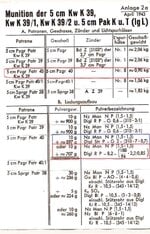
This is what I have:

5cmPak.jpg

As we can note, the types of the main charge (Diglykol types of propellant) differed somewhat. By how much, I don't know.
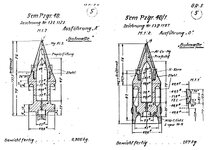
The PzGr 40/1 was with the more aerodynamic body, that featured the cylindrical sheet metal envelope, while the 'normal' PzGr 40 looked like the Soviet arrowhead ammo. Shape of the 40/1 allowed it to be installed on the cartridge in the more forward position - perhaps that was a reason why more of the propellant was also there?

40 401.jpg

50.jpg


Perhaps the Germans could have used the towed French 47mm gun to greater effect. But fooling around with captured French guns for ballistics (different projectiles/powder charges) is time that is not being spent on other things.

If the Germans took a better & earlier look in the Czech gun (they have had almost a year to do so before the attack on the West), they could've cross-pollinated the French 47mm gun(s), too, again early enough. See how to install the French ATG on the Pz-III (if the Czech 47mm in not already there) or the Somua 35 turret. They can also ship the captured tank guns to the Italians, good knows that Italians usually fought out-gunned. Even the hull gun from the Char B would they found useful.
But making something, especially self-propelled, with the French 75mm guns ASAP would've yielded them a lot more.
 
That was the French AT gun. The tank gun was weaker, as you know.
Thank you, I had forgotten how short and fat the tank cartridge was.
The most useful French stuff for them was probably the classic 75mm gun. The 105mm howitzers were probably also useful.
Stick the French 75s on French chassis and forget about them.
The French had 105mm Howitzers???? ;)
Kidding but they did not have many and dealing with the ammo may have been more trouble than it was worth. Leave them in France or use for training.
. Or even on the Pz-II or the small French tanks.
Small French yes. the sooner the Germans divorce themselves from the Pz-II the better.
The 47mm ATG is in the 3rd place IMO. The 47mm tank gun if out-bored for the Czech or the ATG ammo would've been also very useful. Or, out-bore it for short 50mm ammo?
See

It is too much work, you have to take off the Breech block, cut over 300mm off the back of the barrel for the French AT gun (over 150mm for the tank gun) rechamber it and modify to the breechblock and extractors and then put the breech block back on. And them modify the recoil systems and make new gun sights.
Boring out the 47mm guns to 50mm is even more work. Use them for training, Atlantic wall defenses or send them for scrap.
As for the Somua 35 for Russia, we can recall that Germans were badly in need for any useful tanks in any year of the war. The S35 makes more sense in Russia than the Pz-38(t) the Germans used there.
The Somua 35 was a worse tank than the Pz-38 (t) in Russia. Even with a German radio it still had the crappy one man turret and lousy vision to the outside.
It doesn't matter what kind of of gun you stick in the turret or what kind of ammo you give it if the the tank commander/gunner cannot identify a target to shoot at. Or can't find the enemy until 1/2 of his company is already going up in flames.
fbAtAm2q8Q7NbIhNCdItOjrviLQYbuNefnmVsxNWA&usqp=CAU.jpg

The Pz 38(t) had a two man turret. The loader was an after thought and vision for him, like most loaders, was also an after thought. However the commander/gunner had the cupola with 4 vision slots/blocks so he could ride head out,(could not shoot). ride with head in the cupola (still couldn't shoot unless at very very close range?) or with body/head inside the turret and using the either the periscopic sight going through the roof (traverse was?) or the gun sight next to the gun.
Germans trashed the French Cupolas and fitted a new one or cut the top off the exiting one and welded a new top on. On the French cupola there was no hatch. If the commander wanted to ride head out he had to open the big door in the rear of the turret and ride with his butt sitting on the door and with everything but his legs outside the turret although behind the turret. Just don't drive past a German soldier with a rifle. The French didn't have the Periscope. Even in a turret with a German modified cupola the commander had less situation awareness than the German commander in the 38(t). The 38(t) may have had a higher practical rate of fire, the loader actually could load the gun, not hand ammo to the commander/gunner for him to stick in the breech.
Trying to stick more powerful guns into the Somua 35 just makes these problems worse. Less room in the turret, harder to move around to see out of the limited vision devices and harder to sling larger rounds into the breech. If your enemy will kindly stop in plain view and stay there while the commander in the French tank shoots at him and and not have any of his tanks move forward on the flanks to get in side shots while the Somua 35 commander is plinking away and doesn't notice that he has managed to get himself surrounded then the Somua 35 was decent substitute.
 
It is too much work, you have to take off the Breech block, cut over 300mm off the back of the barrel for the French AT gun (over 150mm for the tank gun) rechamber it and modify to the breechblock and extractors and then put the breech block back on. And them modify the recoil systems and make new gun sights.
Not out of their wheelhouse.

from the wiki
------------------
In the early stages of Operation Barbarossa, the Germans captured a large number (approximately 1,300) of Soviet 76-mm divisional guns model 1936 (F-22). Developed with anti-tank abilities in mind, this Soviet gun had powerful ballistics; it was also originally intended to use a more powerful cartridge than the one eventually adopted. However, the design had some shortcomings in the anti-tank role: the shield was too high, the two man laying was inconvenient and the sighting system was more suitable for the F-22's original divisional field gun role. Using considerable thrift, German engineers were able to quickly modify the F-22, which by that time had been adopted in original form as the FK296(r) by the Wehrmacht. In late 1941, German engineers developed a modernization program. The initial modifications that brought the guns to FK36(r) standard included:

  • removing the top section of the shield and using the armour off-cuts to superimpose over the lower section of the shield. These were held in place using the standard Pak38 shield pintles.
  • re-orienting the traverse gear box and handwheel shaft linkages so as to mount the traverse handwheel on the left side of the gun next to the sight. As the new transverse rod linkage went through a gap in the recoil cradle's elevation arc, the maximum elevation angle was limited to 18 degrees.
  • replacing the Russian sight with a Pak 38 style anti-tank sighting block that could mount the standard ZF3x8 sighting telescope or an emergency fold out iron sight. Like the Pak 40 and Pak 97/38, the sight mount had provision for attaching an indirect sighting device - the Aushilfsrichtmittel 38 (ARM38).
The first of these converted F-22s retained the original Russian ammunition (confirmed by measuring the chamber length of 15.2 inches or 385 mm) and were still designated FK296(r) on the sight's range drum. These early anti-tank conversions are discernible as they have not been fitted with a muzzle brake. These intermediate guns had various designations, but appear mainly to have been referred to as "FK36(r)",[citation needed]​ despite their dedicated anti-tank role seeming to warrant the designation "Pak" rather than "FK". The conversion work was performed by HANOMAG, with sight blocks made by Kerner & Co in 1942 (ggn42).

Later upgrades were designated as the Pak36(r), and:

  • Were rechambered for the more powerful German Pak40 cartridge - which was nearly twice as long as the Soviet one (715 mm vs 385.3 mm) and also wider (100 mm vs 90 mm), resulting in 2.4 times the propellant load; and
  • Had recoil mechanism adjustments to accommodate the new recoil characteristics.
 
Yes the Germans did modify a number of guns but.....
Later upgrades were designated as the Pak36(r), and:
  • Were rechambered for the more powerful German Pak40 cartridge - which was nearly twice as long as the Soviet one (715 mm vs 385.3 mm) and also wider (100 mm vs 90 mm), resulting in 2.4 times the propellant load; and
  • Had recoil mechanism adjustments to accommodate the new recoil characteristics.
In small arms it is quite easy to rechamber some guns for a longer cartridge or both longer and fatter. It is possible to rechamber and gun from a 'standard' bolt face like 12.01mm (NATO or old 7.9mm Mauser or host of others) to the 'magnum' bolt face, most belted magnums. But you have to open up the bolt face and modify/replace the extractor.
It doesn't work as well trying to go the other way. You might be able to replace the extractor but the space for the rim is too big. Might work for a single shot but not so good for a repeating rifle.
You could rechamber a German Pac 40 to take Soviet ammo (or a composite soviet cartridge case and a German 75mm projectile but you would need to cut off about 700-715mm of the rear end of the barrel to get rid of the larger diameter chamber. OR ream out the chamber over size and insert a liner, except you would have no rifling for about 330mm from the shorter case to the start of the old rifling. Now perhaps you could rifle the the part of liner you stick in the old tube but you have to figure out a way to align the new section of rifling with the old rifling.
You can do all sorts of things. Should you?
Changing handles/cranks and sight mounts on the outside of gun is somewhat non critical, the worst that can happen is that the handle/crank/sight falls off. When you are trying to turn one chamber into another, especially trying to put in chamber liners into guns the worst is now a blown up gun. Blowing up a shoulder rifle is bad enough. Blowing up a 7.5cm cannon can hurt/kill people dozens of yards away.
For the German conversion all they needed was a thick enough barrel to still have a decent safety margin around the thicker, longer chamber and to cut the extractors back a little bit.
Getting proper sights may depend on precision wanted. Germans used cams to adjust the aiming point for different ammo depending on ballistics. If an existing set up was going to come close at expected battle ranges that may have been good enough?
 
Small French yes. the sooner the Germans divorce themselves from the Pz-II the better.
For beyond 1940 and beyond France, I'd prefer the Pz-II chassis.

It is too much work, you have to take off the Breech block, cut over 300mm off the back of the barrel for the French AT gun (over 150mm for the tank gun) rechamber it and modify to the breechblock and extractors and then put the breech block back on. And them modify the recoil systems and make new gun sights.
Boring out the 47mm guns to 50mm is even more work.

You are probably right.
Use them for training, Atlantic wall defenses or send them for scrap.

I'd prefer sending the 47mm tank guns to the Italians and/or Romanians instead. They can see how hotter loading works, too, and probably retrofit the muzzle brake on such guns.


The Somua 35 was a worse tank than the Pz-38 (t) in Russia. Even with a German radio it still had the crappy one man turret and lousy vision to the outside.
It doesn't matter what kind of of gun you stick in the turret or what kind of ammo you give it if the the tank commander/gunner cannot identify a target to shoot at. Or can't find the enemy until 1/2 of his company is already going up in flames.

The Pz 38(t) had a two man turret. The loader was an after thought and vision for him, like most loaders, was also an after thought. However the commander/gunner had the cupola with 4 vision slots/blocks so he could ride head out,(could not shoot). ride with head in the cupola (still couldn't shoot unless at very very close range?) or with body/head inside the turret and using the either the periscopic sight going through the roof (traverse was?) or the gun sight next to the gun.

As designed as as originally produced, the future Pz 38(t) have had a 3-men crew. Germans found the way to have an extra crew member to fit in the turret, sacrificing some ammo load. They did the same with the Pz 35(t).
Do the same with the S35.

Not out of their wheelhouse.

You could rechamber a German Pac 40 to take Soviet ammo (or a composite soviet cartridge case and a German 75mm projectile but you would need to cut off about 700-715mm of the rear end of the barrel to get rid of the larger diameter chamber. OR ream out the chamber over size and insert a liner, except you would have no rifling for about 330mm from the shorter case to the start of the old rifling. Now perhaps you could rifle the the part of liner you stick in the old tube but you have to figure out a way to align the new section of rifling with the old rifling.
You can do all sorts of things. Should you?

A short list of the guns Germans over-bored and never looked back includes the 5cm Pak into 7.5cm (to make the Pak 50), Soviet 76 and 85mm AA guns into 88mm, inter-war naval 105mm gun into 127mm, as well as, indeed, the F-22 into the pak 36(r); granted, the latest received over-boring just of the chamber area. British over-bored the 6pdr into 75mm to be used as tank guns.
So they not just could, but also reckoned that they should, and they did.

Rechambering the Pak 40 to fire the Soviet ammo misses the point, since Soviet ammo was far weaker, and, by the time the Pak 40 was in service, the supply of the captured Soviet ammo was dwindling.
 
It is interesting that it took the Eastern Front to finally see mass conversions of vehicles with captured or German guns ala Marders. The 15 cm SPHs and the Panzerjäger Is weren't that much. The captured Polish and then French 75 certainly were a pretty sizeable pool, and their use on vehicles might prove more efficient in the end than providing the improved PaK 38 carriages.

It is notable that the Czech 47 and French AT 47 were in production (with good rates for the French one) well before the 5cm PaK was fielded. Perhaps it might have been wise to maintain production of both types (and maximize the utilization of the Czech factory) until the 5 cm was in service in numbers, given the frequent shortage of powerful AT guns in the Wehrmacht. The stockpiles of both guns may also have proven more practical than PaK 40s for the conversion of particularly light and/or underpowered chassis like the French ones (due to lighter and smaller guns and more compact ammo), while the Pz II and Pz 38(t) chassis could be made to operate the 75 (captured or PaK 40) decently well.

As done for this R35 conversion:
1735557635041.jpeg

For the Czech chassis, use of the improved and reinforced parts and Tatra diesel engine from the Pz 38(t) n.A program including on the Marders/Grilles and not just on the Hetzer and Waffenträger concepts would have yielded sizeable improvements in durability and mobility, until Pz 38(d) components for production in German factories could be devised.
 
Last edited:
As designed as as originally produced, the future Pz 38(t) have had a 3-men crew. Germans found the way to have an extra crew member to fit in the turret, sacrificing some ammo load. They did the same with the Pz 35(t).
Do the same with the S35.
The 38(t) carried some of the ammo in the turret. Most below, It turned out they could squeeze the extra crewman into the existing turret. French had looked into 2nd crewman for the APX turret (same turret used in the Char B1bis) and figurered they needed a larger/heavier turret. The French tanks stowed few or no ammo in the turret. Germans, with hundreds of Somua 35s and Char B1s never got a 2nd man into the turret. If it was a simple as taking out a couple of ammo bins why didn't they do it?
A short list of the guns Germans over-bored and never looked back includes the 5cm Pak into 7.5cm (to make the Pak 50), Soviet 76 and 85mm AA guns into 88mm, inter-war naval 105mm gun into 127mm, as well as, indeed, the F-22 into the pak 36(r); granted, the latest received over-boring just of the chamber area. British over-bored the 6pdr into 75mm to be used as tank guns.
So they not just could, but also reckoned that they should, and they did.
OK, we are dealing with several different things here. One of them is actual gun construction.
1, the Pac 50 was NOT a bored out Pak 38. It was a shortened Pac 40 barrel and breechblock mounted in a Pac 38 carriage.
2. A lot of bigger gun barrels were constructed in pieces. A series of tubes places inside of each other and often the inter tube with the rifling was made replaceable so the gun could be relined when the rifling wore out. Cheaper and easier than building new barrels. I don't know if the soviet 76mm AA gun needed to bored out to take a bigger liner or if an 88mm liner could be slid into the existing outer tube/s. The 85mm gun might have just accepted an 88mm liner. This is also what the Germans did with the 10.5cm to 12.7cm change over.
3. The British never bored out an existing 57mm gun to make a 75mm gun. They either bored out a gun during manufacture or they designed a 75mm gun barrel to fit the existing 57mm mounts/recoil system and kept just about the same over all length.
4. The later 88mm guns had multi piece liners. 2 or 3 piece liners for ease of manufacturing and so they could replace the breech end of the liner more often since that woreout much quicker than the muzzle end. But they designed that in from the start.

A lot of smaller guns had mono-block barrels. No replaceable liner. You could bore them out and re-rifle them but that is a lot harder.
Some guns had liners that could be replaced in repair shops. Unscrew the breechblock and the liner slides out and the new liner can slide in and screw the breechblock back on locking it place (ok, a little harder) others needed large, heavy hydraulic presses and this meant the barrels had to go to manufacturing facility or major depot.

And as always, if you are doing this sort of work, what else isn't being done?
 
Good knows that Germans were making a whole host of 75mm guns that were begging to be installed in the tanks. Barrel lengths (to make the best use of the ammo 'power') from 26, 34, 36, 40.8, and 60 calibers were made before ww2, while the ww2 saw the L43 and L48 sharing the same ammo, and the 46 cal (pak 40) used the ammo of similar dimensions to the L60 Flak weapon. Even the L54 weapon was made in a few dozens. Then we have the ~75mm guns from Czechoslovakia and from Poland, and, indeed, the L70 weapon for the Panther.

Still, it took Germans an eternity to move up from the short 75mm gun. Even the M36 mountain gun and the FK 18 were more powerful than the Kwk 37, with muzzle energies being some 25-30% greater.
Making a real effort to up-gun the Pz-III with a good 75mm gun would've netted the Germans with a tank comparable (if slower) to the early Cromwell, but years earlier. And a much better tank than the 75mm gunned Valentine.
(turret ring diameter was 1530 mm on the Pz-III, 1450mm on the Cromwell)

Germans could have stolen the Soviet playbook and standardized on the 76.2x385 cartridge and used it everywhere (Soviet T-34/76, KV-1, SU-76, field guns like the wildly successful ZiS-3, etc.). Or some indigenous cartridge of roughly the same dimensions. With an L40 barrel providing about 700m/s MV it might even have been possible to fit it into the Pz III? The modest MV provides for decent HE/smoke load, good barrel life, still decent enough armor penetration except against heavy tanks, and little worry about APCBC shattering upon impact. Then skip the historical Pz IV, V, and design a "medium-heavy" tank in the 40-45 ton size class equipped with the 88L56 (like the KwK 36 on the Tiger I and Flak 88 18/36/37) as a follow-up once the above ~75mm starts to become insufficient. Oh, and spam out a zillion Pz-38/Hetzers with the 75L40. For a late war heavy tank (King Tiger alternative), go for something like a 105mm size gun instead of the very high velocity 88mmL71?
 
Germans, with hundreds of Somua 35s and Char B1s never got a 2nd man into the turret. If it was a simple as taking out a couple of ammo bins why didn't they do it?
How hard have they tried it?

1, the Pac 50 was NOT a bored out Pak 38. It was a shortened Pac 40 barrel and breechblock mounted in a Pac 38 carriage.
The Pak 50 was a bored-out Pak 38. From here:
Of the numerous guns captured by the American forces in 1945 at the Hillersleben artillery test site, 34 were examined more closely. These included the 7.5 cm Pak 50, a 5 cm Pak 38 that had been slightly modified and bored out for the use of the ammunition of the 7.5 cm KwK L/24.

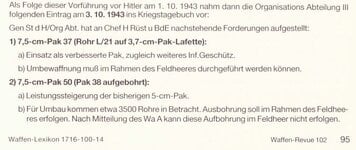
Ref. Waffen Revue No.102, ie. this:

pak50.jpg

"Aufgebohrt" = "drilled out" per Google translate.
Both Pak 37 and Pak 50 were supposed to materialize within the Heer's means/tools/facilities, per both b) bullet points; 3500 of Pak 38 barrels was to be modified (they opted to the out-boring in the 'normal' gun-making factories eventually). The future Pak 50 was supposed to offer 'increased power' vs. the Pak 50 per the second a) bullet point.
The circumstantial evidence is also against the narrative that Pak 50 was a shortened Pak 40, since the Pak 40 was a much better gun.

2. A lot of bigger gun barrels were constructed in pieces. A series of tubes places inside of each other and often the inter tube with the rifling was made replaceable so the gun could be relined when the rifling wore out. Cheaper and easier than building new barrels. I don't know if the soviet 76mm AA gun needed to bored out to take a bigger liner or if an 88mm liner could be slid into the existing outer tube/s. The 85mm gun might have just accepted an 88mm liner. This is also what the Germans did with the 10.5cm to 12.7cm change over.

Reasonable points. That the Germans accepted the thinning of the totality of the barrel wall was still a thing, though.

3. The British never bored out an existing 57mm gun to make a 75mm gun. They either bored out a gun during manufacture or they designed a 75mm gun barrel to fit the existing 57mm mounts/recoil system and kept just about the same over all length.

Thank you.

And as always, if you are doing this sort of work, what else isn't being done?

In case with the Pak 50, effor to make 3 such guns was probably the same as making of 1 Pak 40?
Similar was the case with the Soviet AA guns turned into 88mm ammo consumers, if not better for the German war economy?
Perhaps conversion of 5 the 105mm guns was the same as it was making just one 127mm whole gun?
Converting the F-22 into the Pak 36(r) was perhaps 10:1 vs. making a Pak 40?

If the work of converting 5 captured gun cost as much as making one new gun, it makes all the sense for the Germans.
 
Diesels get much better mileage running under light load...but tanks are rarely run under light load (tracks don't just roll down the road) - you rail/transport them to the front, fight your battle, then rail them to the next location. So, 100s of km, not 1,000s. As a result, the difference for tanks isn't as significant as say trucks. Mixing petrol for you trucks with diesel for your tanks will result in some logistics issues.
Not true. Tanks are not constantly on the move. In fact they spend a lot of time idling waiting for the enemy to show up. There is also a big difference in fuel consumption when running cross country vs on roads.
Data for an M-1 tank which is a notorious gas hog.
"A tank will need approximately 300 gallons every eight hours; this will vary depending on mission, terrain, and weather. A single tank takes 10 minutes to refuel. Refueling and rearming of a tank platoon--four tanks--is approximately 30 minutes under ideal conditions.
  • 0.6 miles per gallon.
  • 60 gallons per hour when traveling cross-country
  • 30+ gallons per hour while operating at a tactical ideal
  • 10 gallons basic idle
  • A mine plow will increase the fuel consummation rate of a tank by 25 percent"
The M-1s have been retrofitted with auxiliary power units to minimize running the main engine at idle.

When Rolls Royce was developing the Meteor they found:
"When the engine was stripped at the completion of the mileage , they were surprised to find little or no wear of the of the basic Merlin components.
The reason for this was that contrary to to what they had been told, a 600 bhp engine cannot work very hard all the time in a heavy tank driven across country, no matter how ruthless a the driver might be. The instrument they had fitted to estimate the amount of work the engine was doing showed that the average power output was substantially less than the 600 available"
 
Not true. Tanks are not constantly on the move. In fact they spend a lot of time idling waiting for the enemy to show up.

I'm sure anyone who has done some form of military service can recognize that in military life there's a lot of "hurry up to wait", and then wait some more. To some extent an inevitable consequence of coordinating actions on a large scale.

I can very well imagine WWII tank operations being the same. So not only idling waiting for the enemy to show up, but waiting for the rest to form up in preparation for something, waiting for some obstacle ahead being cleared etc etc.
 

Users who are viewing this thread

Back