I'm back - had to teach a class today, doesn't my boss know I have more important things to do like discuss the Lancaster!

OK - Some more points...
I found a great site that has information about a Lancaster crew station reproduction...
http://website.lineone.net/~norman.groom/index.htm
I'm going to use some of their photos....
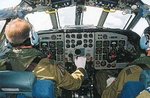
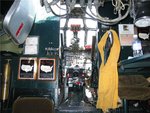
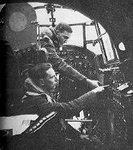
Although the FE and pilot were in a close proximity, for the FE to manage power settings he had to be up front with the pilot, at his station were water and oil temperature gages, oil pressures plus fuel contents gages, oil dilution buttons, fuel booster pump switches and various other items. There are three fuel tanks in each wing, two main and one reserve, hence the six gages to the right of the main fuel cocks.
It seems fuel shut off was accomplished at his station
The on the pilot's panel there were Tachometers, prop feather buttons and fire extinguishers.
During flight any change in power setting will result in a climb or descent so to maintain a constant altitude the pilot is continually trimming the aircraft, this sounds a lot easier than done especially in a 4 engine bomber, and although the Lanc was easy to fly, there is still a lot going on, especially if the pilot only has a few hundred hours.
Now in an emergency situation you may have the FE assisting the pilot in managing power settings; where things may get real sticky is when an engine (or two) is lost and the aircraft has to be trimmed and configured to maintain a given altitude. Now combine that with any other adverse condition that "loads up" the pilot (damaged flight controls etc.) you only have one set of controls, although the FE is there and will help, the second pilot may be the difference between disaster and surviving if the situation worsens and more muscle is needed, especially if that light docile aircraft now becomes a beast in the air to maneuver.
Now a third perspective to this - blind flying. The Lancaster had a blind flying instrument panel.
For the most part the only thing you're going to get out of that panel is the ability is stay straight and level, maintain altitude and fly a general heading. The only real "homing" nav feature available to the pilot at the flight station was a DF receiver indicator. I believe the indicator is second from the right, second row. The main unit was at the wireless operator's panel.
Now let's put all this together...
Pilot flies, FE assists in power settings, fuel management, etc.- Pilot has to fly a crippled aircraft further increasing his workload, compound that with being in the "soup." Without visual aid the navigator is virtually useless unless he has radar, which will only guide him to a vicinity.
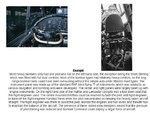
Here's a gee radar
So now worse case scenario - you have a shot up Lanc, flying blind using radar to and a DF beacon to find its way base to base, the base has 1/2 visibility and a 500 foot ceiling. the radar isn't going to be able to paint a precision picture for you to make the landing so you have to use the DF. Here's where it gets fun....
As far as I know there were only 2 ways to make an instrument approach during WW2 one was to follow an audible signal that guided you left or right of a target (the airport). While following that tone you monitored your altitude and airspeed and began to let down at a certain point. If you're airspeed is correct, you interpreted the tone properly you would wind up at the runway's threshold, hopefully seeing the runway at least 1/2 before landing. The second method was the use of the DF what was similar to the homing tone. With the needle aligned at a given which was a given distance from the end of the runway at a specified heading. The pilot would follow that heading until over the station. Once over the station the needle would swing backwards and the pilot would begin a timed descent at a given altitude. If done properly and the descent was on speed the pilot should reach the runway threshold at a given time and be at an altitude where the runway could be visually sighted. If the approach is accomplished and the runways isn't sighted, the pilot goes back to the station, over flies it, turns around and does the same thing all over again.
Today this is known as an NDB approach and is actually being fazed out in favor of GPS.
Approach plates were made to assist the pilot in accomplishing this...
NOW - you have a Shot up Lanc, an engine out (or two), in the soup, the FE managing engine controls and the pilot making this approach that requires you to be within 1/8 mile of course so you could see the runway(easier said than done since you're relying on an "AM radio") to guide you to the runway and the pilot only had say 200 hours and received no formal instrument approach training (very common at the beginning at WW2) - putting this much work load on a single pilot is crazy! A tribute to those RAF pilots who had to do this and also a reason why the 3 man flight crew eventually became the norm after WW2, and I believe after WW2 the Lincoln and Shackleton had a co-pilot