Best Twin-engined fighter

Best Twin Engined Fighter


  • Total voters
    154

Ad: This forum contains affiliate links to products on Amazon and eBay. More information in Terms and rules

Thats fine. Explain why then.

Ofcourse "Allison Sucks..." is going to get people wound up because in all actuallity it does not suck.

No one here said that it was the best engine of the war. Anyone that would say that does not know anything about them. However just saying they suck is rather stupid, you should explain why and then people might understand where you are coming from.

Really the allison don't sucks, it is a very good "ground attack engine" but his performance to hight altitude leaves very much to be desired, and i think that he was quickly outdated because this reason.
 
lool realy ? what you think you are ?? you think that for be moderator of this forum you can insult me ??people here have to express ideas like they want. if you don't like the idea at least sow some respect for the others.

by the way, your theories are extremely americans,you defend allways the americans aircrafts why?? you need read more about the others cultures it is going to do well :).
How about this @sshole - you don't like it here LEAVE or better yet I could expedite your departure...

Read some of my post and you'll find I'm far from being American biased with regards to aircraft (if that's what you're implying) - can I help it if you're a freaking nitwit and 80 percent of your recent posts don't make any f#*king sense!?!?

My only warning - stop being an idiot or you're out of here - compreenda o @sshole!!!!!
 
Yeah, look up some history on the V-1710, even with just the standard supercharger configuration it could be configured for up to 23,000 ft crit. altitude. The main problem was the design lacked the capibillity for a 2-stage or 2-speed supercharger so it was a problem for aircraft that could not use turbochargers. This was due to the USAAC deciding that the engine should be used for low altitude, and if additional high-alt performance was needed a turbocharger would be added.

And we might have seen some turbocharged single-engine V-1710 fighters (like the original P-39 design) if it wasn't another USAAC decision that the US was involnerable to high altitude attack due to the Atlantic and Pacific oceans and so fighters were to focus primarily on low altitude strike capibillities. They were prooven wrong at Pearl...

The Merlins had the same poor altitude performance (or almost so) untill the Merlin-61 with 2-stage supercharger. When some P-40s had their allisons replaced with merlins (standard single supercharger) performance did not improve much. Eventually Allison saw the need to incorporate a 2-stage supercharger in their design and added a auxiliary supercharger (as a rudementary 2-stage, though it lacked the 2-speed gearbox and coolers of the Merlins) to the engine. Water injection was also later added. This was used in the P-63 which had markedly improved altitude performance and ceiling over the P-39. (that model was the Allison V-1710-117 rated at 1600 hp and 1800 hp with water injection)

Even earlier versions had power uprated so even with the inadequate supercharger smaller fighters (like the P-39) would have enough power at altitude even with the drop-off past the critical zone. ( 1325 hp Allison V-1710-47 uprated from the original 1150 hp) Such was seen in the XP-76 (a redesign of the P-39 originaly the P-39E using the Contenetal V-1430 "Hyper" engine). Though Bell added a 2-stage supercharger. It seemed to work and performance was almost up to the turbocharged version of the XP-39, a series was ordered in 1942 but later canceled so Bell could manufacture B-29s. So we'll never know how the P-76 would have done...
see: Bell XP-76 and Bell XP-39E Airacobra

Even though Wikipedia isn't the best resourse, its still more accurate than you've been. There's a good overview on the history of the V-1710 here: Allison V-1710 - Wikipedia, the free encyclopedia
 
Yeah, look up some history on the V-1017, even with just the standard supercharger configuration it could be configured for up to 23,000 ft crit. altitude. The main problem was the design lacked the capibillity for a 2-stage or 2-speed supercharger so it was a problem for aircraft that could not use turbochargers. This was due to the USAAC deciding that the engine should be used for low altitude, and if additional high-alt performance was needed a turbocharger would be added.

The Merlins had the same poor altitude performance (or almost so) untill the Merlin-61 with 2-stage supercharger. When some P-40s had their allisons replaced with merlins (standard single supercharger) performance did not improve much. Eventually Allison saw the need to incorporate a 2-stage supercharger in their design and added a suplemental supercharger (as a rudementary 2-stage) to the engine. Water injection was also later added. This was used in the P-63 which had markedly improved altitude performance and ceiling over the P-39. (that model was rated at 1600 hp and 1800 hp with water injection)
OUTSTANDING! :thumbright:
 
How about this @sshole - you don't like it here LEAVE or better yet I could expedite your departure...

Read some of my post and you'll find I'm far from being American biased with regards to aircraft (if that's what you're implying) - can I help it if you're a freaking nitwit and 80 percent of your recent posts don't make any f#*king sense!?!?

My only warning - stop being an idiot or you're out of here - compreenda o @sshole!!!!!
I AM GAY!
 
I believe in general layout only Holibar, otherwise a completely new Petter design for a new specification, F.4/40, with emphasis on "high altitude capabilities". Tenders prepared were the General Aircraft G.A.L.46, the Hawker P.1004, and the Westland Welkin. But the requirement was revised later as F.7/41, calling for a;

"single-seat fighter able to operate at great heights and in all parts of the world. Armament was to consist of 6 20mm. Hispano cannon with normal ammunition 120rpg and 150rpg per gun. A pressure cabin was mandatory, the machine was to provide a steady gun platform, the view all round for the pilot was to be good-particularly to the rear, and, although designed as a single seater, provision was to be made for an observer or for A.I. radar for the pilot's use only. Minimum top speed required was 415mph at 33,000ft and service ceiling demanded was to be over 42,000ft with a pair of Merlin 61s for power".

Two prototypes eventually emerged to conform to F.7/41. The Vickers Type 432 and the Westland P.14 Welkin Mk.1.

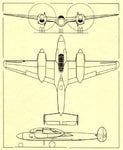
This was the G.A.L.46 design for the original specification.

The original design looks nice though, maby of the callibur of the Hornet, only available before the war's end... Looks cool too! Would have been more use than the final version of the Welkin.

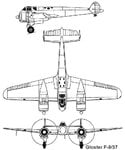
Looks more like the Gloster F.9/37 than the Whirlwind though.
 

Attachments

  • gloster_f9_3v.jpg
    gloster_f9_3v.jpg
    95.7 KB · Views: 135
  • 1smallwv2.jpg
    1smallwv2.jpg
    27.4 KB · Views: 134
Its amazing how you can tell when someone is headed to "Banned Heaven"!

That looks amazing, Kool, any idea what the armament would've been ?
 
The Gloster F.9/37 was mentioned earlier (FBJ had it on the comparisons chart on pg 5) It was to be armmed with 4x 20mm cannons. Performance was similar to the Whirlwind.

The one below is the initial version of what became the Welkin, before it was redesigned for the altered specifications for high-altitude use. I think it had 6x 20mm cannons. I think it looks verru cool Had it been persued in the original form, it might have been like the Hornet... Graeme should know more about this.
 
Yes it certainly can.
And Gramme, is there any more you know about the Westland F.4/40 design, proposed dementions maby? It looks like it would have been much better than the F.7/41 version turned out (Welkin).
 
Tough call, the Beau was the harder hitting (and often had a rear gunner) but the Mossie could outmaneuver it. So I'd probably go for the latter, at least if it came to it you could have outrun your opponent.

I just reread the begining of the thread and noticed that it was claimed that the Beaufighter had a heavier armament than the Mossie. Not true, both had 4x 20mm cannons and the Mossie had 4x .30 cals while the Beau 4x plus 2x, so only a slight increase in firepower and these were in the wings so not as effective as the mossie's nose guns. I also think the Mossie could carry more ammo, so the mossie would be a better all-around fighter.
 
A good example of what Flyboy(I think) was talking about when he said that putting a bigger engine in an AC not resulting in more performance was the F2G-1D. It had a R 4360-4 engine rated at 3000 hp for takeoff but had very little better performance than the F4U4 with the R 2800 and inferior performance compared to the F4U5 with the R 2800.
 

Users who are viewing this thread

Back