

FulmenTheFinn
Airman 1st Class
It was not in my plans to learn Finnish, so I would be grateful for the translation.
Your browser should have a feature that allows you to translate the page. I've read that page in both Finnish and English and the translation at least on Google Chrome is OK. It's mainly about the kill claims of Finnish pilots.
If we are talking about the Porsö island, it is located 20+ kilometers from Hanko Peninsula (or the boundaries of the area leased by the Soviets), if not, please provide the coordinates. For me all these mentions of shelling are absolutely equivalent to Soviet claims of shelling from the Finnish side in the area of Mainila in November, 1939 ("Shelling of Mainila"). It seems that Finnish officials simply needed something to counter the Soviet side's uncomfortable questions about neutrality.
You're looking at the wrong Porsö. This one is at 59°53'49.2"N 22°53'55.3"E, just northwest of Hanko. To make matters more confusing, there's at least two Storholmens very close to each other as well, but I assume the larger one at 59°54'39.8"N 22°57'52.9"E is the one in question.
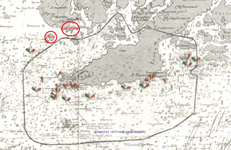
Click to enlarge.
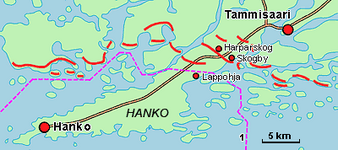
An image with nearby Finnish defensive fortifications on the mainland (the so-called Harparskog Line) and on the nearby islands outlined.
I've now been investigating this matter with a Russian contact of mine. Apparently there are more of those in Russia who think this bombing never happened (including this very vulgar, Solovyov-from-Rossiya 1-type poster here). My contact also uncovered an article by Geust in Russian, according to which the SB unit in question was 57 BAP of the VVS KBF (Saint-Petersburg and Northern European countries: Materials of the thirteenth annual scientific conference (5–7 of April 2011), p. 259). Perhaps you can dig more with this information? It has very much piqued my interest.
But at this point I suggest we move this conversation into DMs as it is OT, so please respond there.
Okay guys. I want to know the truth of this story. I've heard three Finnish service personnel were to be awarded Iron Crosses by their Aryan co-belligerents. Those 3 Finns were Jewish and refused them. Was this a deliberate act of "trolling" and/or did it actually happen?
It's true, and no, it was not trolling. Incidentally, when the German 163rd Infantry Division was on the Svir Front they had a field synagogue next to their sector, built by some of the Finnish Jewish soldiers serving in the units there, which to my knowledge was just fine by the 163rd. If this area of history interests you, I can recommend this video:
View: https://www.youtube.com/watch?v=emgOzd0ng1A&ab_channel=NationalMuseumofAmericanJewishMilitaryHistory
But to try to get back on-topic, I've recently been looking at Finnish aerial victory claims. Officially for the Brewster in Finnish service there's 480 of them, but I have a list with some 494-495 entries (once I've finished sorting out my lists I'll have an exact number). Most or all of this inflation up from 480 comes from aircraft that originally weren't marked as confirmed kills, but which have since been confirmed destroyed with information obtained from the Russian archives. At any rate, the archives look to back up only 155, or about 1/3, of these, including one German He 111 shot down by accident at night in May 1943. Even if this isn't the final tally, it's pretty clear there's air in the Finnish kill claims. Far less than those of Soviet pilots, to be sure, but air nonetheless*. If we assume that 155 would be the final tally, then with 16 Brewsters shot down by the VVS and another 5 destroyed on the ground for a total of 21 by enemy aerial action, then the KLR for the Brewster Model 239 would be 7:1 or 10:1, depending on if you count the 5 destroyed on the ground in air raids or not. Incidentally, 2 were shot down by Soviet AA, 4 by German AA, 12 were lost in accidents and the remaining 5 were scrapped. One or two ended up as playthings for children in public parks before they too were scrapped likely some time in the '50s or '60s.
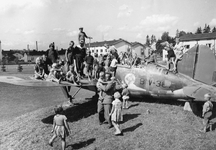
BW-387 in Saukonpuisto Park, Tampere, 1952.
*According to varying sources perhaps 1/2-1/3 of Finnish aerial victory claims are true, while I've read that for the Soviets it's more like 1/16. I know for a fact that in the Winter War it was 1/12 for the VVS (438 claimed vs. 38 actual), and that's not even including the aircraft the VVS claimed to have destroyed in air raids, which is likely in the dozens, or more (in reality they destroyed one, more specifically a de Havilland D.H.60 X Moth on Immola airfield on 1 December 1939).
Speaking of kill claims, and more specifically about the Buffalo kill claims against the Japanese that came up: How verifiable ultimately are these? From what I understand the records of the IJA and IJN air forces were pretty badly destroyed in WW2, or is this not so?
EDIT, 5 October 2025: Regarding the VVS bombings of Finnish ships on 22 June 1941 (for those who haven't followed page 10 of the thread: not to be confused with the large-scale summer bombing campaign the VVS began against Finland on 25 June 1941):
I didn't want to detract the thread further, so I'm editing this post I wrote over three weeks ago. I investigated the matter further with the great help of a Russian contact of mine. He discovered that the Russian author specialising in the history of the VVS KBF that bf109xxl mentioned previously, Miroslav Morozov, has confirmed that the VVS did indeed bomb Finnish ships c. 6:05 am GMT+2 (Finnish time, no DST (GMT+3) yet back then). Seven SBs, evidently from the VVS KBF's 73 SBAP based at Pärnu airfield, Estonia (annexed by the USSR in the summer of 1940), took off over three hours after a pair of MBR-2 flying boats belonging to the VVS KBF's 44 OMRAE spotted a German minelayer flotilla laying the minefield Apolda at the mouth of the Gulf of Finland in the early hours of 22 June 1941. Incidentally the MBR-2s engaged the Germans and the Germans fired back. This was c. 2:30 am and Barbarossa would not begin until 3:00 am (all times in GMT+2), meaning the first shots of the Eastern Front of WW2 were fired, at least in the Baltic Sea, there and then.
At any rate, the KBF ordered an airstrike on this flotilla, but by the time the SBs reached the spot the Germans were long gone. Instead the SBs spotted the Finnish ships to the north carrying out the remilitarisation of the Åland Islands, apparently took them for the German flotilla and engaged them. They flew right at them at a high altitude and the Finns opened defensive fire against them, after which they dropped their bombs at the ships but missed. The bombs fell into the sea and onto a tiny empty island or islet next to Husö Island, where the impact of the bombs caused some small fires to break out.
Interestingly, because of time delays and other factors, this attack erroneously went down in Finnish historiography as a series of Soviet air attacks in the area occurring at different times and slightly different locations between 6-7 am, when in fact there had only been one Soviet air attack (see also: https://www.aromaat.net/Navygallery/Background/Wartime/Kilpapurjehdus.htm), though that's not what was at issue here. The issue here was whether the Soviet Air Force had attacked the Finns at all in the morning of 22 June 1941, and they definitely did. However it was interesting investigating this and getting clarity on the course of events that morning, so I thank bf109xxl for piquing my interest into investigating this further. That is all.
Last edited:


