Brewster Buffalo - what is the verdict?

Ad: This forum contains affiliate links to products on Amazon and eBay. More information in Terms and rules

FulmenTheFinn FulmenTheFinn
Thanks for that excellent post. It hits on the significant differences between Finnish and Allied use of the Brewster F2A/B339.
The B-239 was the Finns best aircraft at the start of the Continuation War, followed by the mix of Curtiss H-75s they bought from Germany just before the war.
 
10 of the first 11 F2A-1 produced for the USN were delivered to VF-3 on Saratoga in Dec 1939.
So this artwork is not totally inaccurate.

RevellF2ABuffalo-1.jpg
 
FulmenTheFinn FulmenTheFinn
Thanks for that excellent post. It hits on the significant differences between Finnish and Allied use of the Brewster F2A/B339.
The B-239 was the Finns best aircraft at the start of the Continuation War, followed by the mix of Curtiss H-75s they bought from Germany just before the war.

Interestingly, both American fighters shone in terms of their operational reliability vis-à-vis other fighters in the Finnish arsenal. Here's a comparison of the average operational percentages of the most common FAF fighters in 1941-43, meaning how much of the year on average the aircraft were in working order. It doesn't include the Bf 109 because the Germans wouldn't sell them to the Finns until the tide of war visibly turned against them at the end of 1942. The purchase order was agreed to in December 1942, signed 1 February 1943 and the first FAF 109s started arriving to the country the following month. If it was included, it'd probably rank highly as well.

194119421943
Brewster Model 239 (American)818490
Curtiss Hawk 75 (American)859293
Fiat G.50 (Italian)505559
Morane-Saulnier 406 (French)786572

Says something about American quality, I think.

EDIT: Granted, these figures wouldn't have been possible without the ingenuity and efforts of the Finnish mechanics. Parts of Soviet license-produced copies of Cyclone 9 engines (Shvetsov M-62 & M-63) acquired both as war booty directly from the Soviets and indirectly via purchase from German depots, were used extensively by the Finns in keeping the existing fleet of Cyclone engines operational. Several Buffaloes were even fitted with these Soviet engines outright. Nominally the M-63 was more powerful (1,100 hp) than the R-1820-G5 Cyclone 9 (1,000 hp), although of inferior production quality (as a rule the American parts were of superior quality to their Soviet license-produced counterparts), but for a long time the Finns flew the engine with the wrong settings resulting in inferior performance to that of the original, nominally inferior American Cyclone engine. Only later in the Continuation War, perhaps in 1944 or late 1943 (I'm writing from memory), did the Finns acquire a captured manual for the M-63 from German depots, which revealed the problem. By then even the M-63-equipped Buffaloes were noticeably obsolete vs. the new Soviet and American fighters the Soviet Air Force was flying.

Source for the table: Jukka Raunio (2018): Brewster: Taivaan helmi vai maailman huonoin?, p. 37.
 
Last edited:
Fiat = Fix It Again Tony.

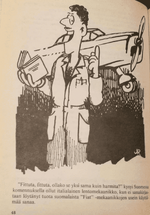
There's a funny caricature, I think from the war, where an Italian Fiat G.50 mechanic serving in Finland is holding a dictionary looking for a translation to a Finnish word that roughly translates to "Fuck I'm pissed off" (vituttaa), and asking in broken Finnish if the word means "to be disappointed". It was apparently one uttered often by Finnish mechanics working on the aircraft.

1757167280838.png
 
My guess is that the higher servicebility rates for the H-75 are due to the P&W R-1830s as compared to the Wright R-1820s.
A handful of Cyclone powered H-75-A4 were sent to Finland but these were soon re-engined with R-1830s. I assume the Wrights went to the Brewsters to ease logistics.
 
Two bits of info I have seen on the Internet - and therefore distrust:

1. The R-1820 engine used on the F2A-1 aircraft sent to Finland were used, overhauled engines, not new builds. I suppose this is possible, since in that time frame the R-1820 was used on the Curtiss F11C, the Grumman F3F, early models of the Super Electra/Hudson, and some models of the DC-3. Most DC-3's had R-1830 but the airlines had the option of specifying which engines they wanted. So I suppose that there were enough used R-1820 around to make use of overhauled engines a real possibility. Of course, the R-1820 in the F2A's sent to Finland could have been overhauled before they were shipped out.

2. The Finns solved overheating problems with the R-1820 on their F2A by pulling the cylinders and turning one of the piston rings around. So perhaps the overhauls had not been done properly?
 
Most anything is possible.

However the US F2A-1s had engines that had direct drive (no reduction gear) and while the US navy used around 375 such engines on a number of different planes and a further 216 on Grumman J2F-5 Ducks from March 1941 on just about everybody else used reduction gears (16:11) and larger propellers. The F2A-2s used engines with reduction gears and larger props. The Photos of the recovered Finish 239 seem to show and engine without a reduction gear.
Curtiss records may have errors and perhaps there some commercial planes built with R-1820G series engines without reduction gears. The F2A-1 and 239 aircraft are listed as using 9ft diameter props and the all of the later planes with reduction gears (and R-1820G100 and R-1820G200 engines) used props that were 10ft 1in or 10ft 3 in depending on model and propeller manufacturer. Using small diameter propellers on transport aircraft seems like a poor fit. A 9ft prop has 63.6 sq ft and a 10ft 3 in prop has 82.5 sq ft. A transport aircraft doesn't have the ground clearance issues of most fighter planes but a 2200rpm prop as some issues if it is too large. The reduction gears allow for even larger props. Most DC-3s used 11ft 6 props but perhaps the earlier ones with lower powered engines used small ones?
Rebuilding commercial engines that had reduction gears and taking the reduction off to sell to Finland seems like a lot of work? You also need new front covers for the engines and perhaps new crankshafts?
For the Brewster 339s that were exported using overhauled airliner engines is a lot more plausible as they were planed for the later G-100 engines.
Many of the early Lockheed 14s used the R-1820F engines with reduction gearing. Trying to turn an F series engine into a G series might be possible during overhaul but you need a lots and lots of new parts and would certainly not be cost effective (or legal).

I think the internet is confusing the stories about the engines in the British/Dutch 339s with the engines in the 239s.

It seems the only source for the direct drive R-1820 engines 2nd hand was the US Navy as they were the only original customer. Not saying the US Navy didn't dispose some of them but it seems highly unlikely. US navy would either overhaul at a navy depot or if contracting out would want their engines back. The paper trail for the engines would be a nightmare if they were sold even if the US navy got equivalent engines in trade.
 
Two bits of info I have seen on the Internet - and therefore distrust:

1. The R-1820 engine used on the F2A-1 aircraft sent to Finland were used, overhauled engines, not new builds. I suppose this is possible, since in that time frame the R-1820 was used on the Curtiss F11C, the Grumman F3F, early models of the Super Electra/Hudson, and some models of the DC-3. Most DC-3's had R-1830 but the airlines had the option of specifying which engines they wanted. So I suppose that there were enough used R-1820 around to make use of overhauled engines a real possibility. Of course, the R-1820 in the F2A's sent to Finland could have been overhauled before they were shipped out.

2. The Finns solved overheating problems with the R-1820 on their F2A by pulling the cylinders and turning one of the piston rings around. So perhaps the overhauls had not been done properly?
1 - It's been my understanding for a long time now that the engines fitted to the B-239's that went to Finland were R-1820-G205's. Whether they were remanned engines or not, I don't know.
2 - I don't think you can do that. As a former mechanic, I've never heard of an engine where any of the piston rings could be flipped over and found to make the engine operate any better. In fact, all of the rings I've ever seen (with exception to oil rings), have a little divot on them to show which side should go up.
 
The Timing seems to be a little off. It is possible but not quite probable.
The R-1820Gs started production in April 1935 and the last ones were produced in Sept 1945 (very low production as replacement engines)
The R-1820G100s were produced from Jan 1937 until June 1943.
The R-1820G200s were produced from March 1939 to May of 1945.
Production in the early months of each model was going to be small. Each model required a lot of new tooling. Gs used an aluminum crankcase. G100s used a steel crankcase and the G200s used a totally new steel crankcase and that is just for starters.
Finland getting pushed to the front of G200 deliveries in Jan/Feb of 1940 seems unlikely.
Brewster did complete the XF2A-2 prototype in July 1939 with a G200 engine (?). But changing the production line over to fit G-200 engines might mean a delay in the Finish planes? The Belgians order 40 339s in Dec 1939, The British order 120 339Es in Jan 1940 while the Finish planes are building. The Belgian and British planes are going to get G100 engines. Why if G200s are available? Of course a lot plans turned to crap in May/June of 1940 and engine and airframe makers scramble to delivery planes as fast as possible and some shortcuts may have happened (overhauled engines)
The US doesn't get any G200 powered planes until Sept 1940.
Brewster cannot produce planes quickly. Their 1940 production looks like.
Jan...............24
Feb..............14
March.........0 (change over)
April............1
May.............8
June............22
July.............9
Aug............0 (change over)
Sept...........6
Oct.............20
Nov............16
Dec.............40

In May Brewster rented a plant/hanger of 217,000sq/ft and in June they acquired an 8 story factory next to the original plant and added 482,000sq/ft. Brewster doesn't build more than 40 planes a month during 1941 (?).

Getting back to the Finish planes in Jan/Feb 1940. A G200 engine is about 200lbs heavier than an ungeared G engine. The larger propellers are about 75lbs heavier. They already knew what it take with the XF2A-2 prototype but it is not a simple drop-in change. Finns did manage to put in some Soviet engines of different weights but for the Finns is modify or not have flyable planes.

It is possible that the Finns got G200 engines, but it would have been a very tight schedule and perhaps slowed down delivery.

The first Hawk 75s with G200 engines were the A-4s (French) and the first one was accepted at the Factory April 8th 1940. Some of these wound up in Finland after passing through German hands.
 
I don't think you can do that. As a former mechanic, I've never heard of an engine where any of the piston rings could be flipped over and found to make the engine operate any better.
Yeah, unless the were using overhauled engines and had been put together wrong during that process. I guess maybe they could be meaning the oil control ring.
 
My guess is that the higher servicebility rates for the H-75 are due to the P&W R-1830s as compared to the Wright R-1820s.
A handful of Cyclone powered H-75-A4 were sent to Finland but these were soon re-engined with R-1830s. I assume the Wrights went to the Brewsters to ease logistics.

Finnish P&W-equipped H-75s (CUw) came with 1,065 hp R-1830-SC-G or R-1830-SC3-G Twin Wasps, while the Wright-equipped ones (CUc) came with 1,200 hp GR-1820-G205A Cyclone 9s.

In October 1941 it was decided that the GR-1820G-205A engines freeing up from the CU [Curtiss Hawk 75] aircraft will be used in the BW [Brewster] fleet. The decision was made amidst great distress and in hopes of a soon-ending war, as there were only a handful of Cyclone-Curtiss aircraft and the GR-1820G-205A had proven less reliable than the G-5. So unreliable in fact that in the CU fleet they were swapped out for Twin Wasps. The engine-swap was ordered to be researched on BW-370 [FAF BW no. 370].

In November 1941 an inquiry investigating the interchangeability of the main connecting rods, crankshafts and cylinders from [Shvetsov] M-62/63 engines into the Cyclone was ordered. Results were obtained in April 1942. Engine no. 29880 was installed with an M-62's crankshaft, main connecting rod, side connecting rod, side connecting rod pins, piston pins, pistons with their rings, front and back main rolling bearing as well as the foremost ring nut of the crankshaft.

The modifications necessitated covering the propeller sleeve and drive gear with white metal., as the crankshaft of the M-62 was about 0.4 millimeters thinner. The crankshaft's extension tooth clutch had to have its hole widened by 0.3 millimeters. The crankshaft fit well in the assembly. The engine was ran for an hour of tuning use and for an hour of endurance testing. It ran well.

The test was conducted with a Russian propeller as the original was not deemed fit for the M-62's axle. In the disassembly check no damages were found. As a result of the test it was deemed that the aforementioned M-62 parts were interchangeable with the Cyclone when used in conjunction, so that the weights of the parts didn't impact the engine's balance. However later parts were also installed independently.

After this mixed-engines were taken into use as they came available from general repairs. Even the Hamilton propeller could be installed onto the nose once it was figured out to swap out the adjustment gear's piston and oil pipe for ones with different types of grooves. In photos these types of engines show up with the paint marking CYG-62, and in a post-war depreciation list there's a dozen of them.

Sights were soon directed towards the installing of entire M-63 engines, which the Finns already possessed and more could be obtained from Germany. In February 1942 investigations were began to installing MCY-CG, i.e. GR-1820G-205A, and M-63 engines into the BW fleet with an urgency rating of 1, meaning very urgent. At the same time it was concluded that "there will be a shortage of engines for the BW by late summer". Their repair had to be kept in the foremost urgency classification and "we must proceed the same way regarding the Russky's M-63 engines coming for the BWs".

In December 1941 preliminary investigations into the difficulties of installing the M-63 into the BW had already been made. Now the State Aircraft Factory continued its investigation as per the order's (perpetual) urgency. It was completed in April 1942. The workload caused by the Curtiss Cyclone was quite immense: new securing bolts, a new NACA ring, new piping for the carburetor and oil cooler, new exhaust fume collectors, new carburetor control-levers, a new connected engine observation instrument, a new RPM instrument, a new oil tank, the enlargening of the oil cooler, new piping for fuel and lubricants and a new propeller pitch control-device. Furthermore the aircraft became noticeably nose-heavy.

This amount of work for the limited number of G-205A engines seems absurd, but it was not alone in its series at the time. The State Aircraft Factory's new CEO who'd come from FAF HQ, Reino Rissanen, was not in the habit of questioning orders from above. (His predecessor Erkki Mäkinen did this and was fired). Thus the GR-1820G-205A was heroically installed into BW-361, tested and broken. Then another G-205A was taken, tested and broken. The fault lay in using too much power with the engine on 87 octane fuel. Higher-octane fuel would've been necessary. The engines seized up.


Jukka Raunio (2018): Brewster: Taivaan helmi vai maailman huonoin?, pp. 28-29, my translation.

The project to install the few G205As in the BW fleet was thereafter abandoned.

In light of the aforementioned tests, I do wonder if the reliability issues the G205A suffered in the CU fleet was also because of the 87 octane fuel, or dust or a combination of those and possibly other factors.

I think the internet is confusing the stories about the engines in the British/Dutch 339s with the engines in the 239s.

This is my suspicion as well. Finnish sources make no mention of the R-1820-G5s the Brewster Model 239s came with as being second-hand.

It's been my understanding for a long time now that the engines fitted to the B-239's that went to Finland were R-1820-G205's. Whether they were remanned engines or not, I don't know.

Bar the two tests with the G205As taken from the handful of Cyclone-equipped Finnish Curtiss Hawk 75s, the 239s flew with G5s, M-62s, M-63s, as well as with mixed-engines with parts from two or probably all three different engines, and probably some other parts as well. E.g. some G5s look to have been installed with Russian BNK-6 fuel pumps beginning in the autumn of 1941 when spare parts for their original American Pesco pumps became sparse.
 
Last edited:
2. The Finns solved overheating problems with the R-1820 on their F2A by pulling the cylinders and turning one of the piston rings around. So perhaps the overhauls had not been done properly?

Regarding this, this is what Jukka Raunio wrote about it:

It is said that in the summer of 1941 the mechanics of the squadron or field air depot tried to alleviate the issue with engine overheating and the engine seizures caused by it, by turning the oil rings at the bottom of the cylinders' piston pins upside-down to push oil upwards. No modification report was made of the procedure and it likely also was not presented up in the chain of command, for in February 1942 FAF HQ wondered about the inverted piston rings when they were discovered during general repairs to the aircraft, and made inquiries about the effects the modification had on piston-head temperature, oil consumption, smoking and the general functioning of the engine. Answers to these inquiries have not been discovered.

Ibid.
, p. 30, my translation.
 
Just to say that Finland joined Germany in attacking the USSR after the USSR attacked Finland in June 1941. Moscow had a choice, Helsinki did not.

The process by which Finland ended up in the Continuation War took 15 months and began immediately after the Winter War. Stalin enforced a peace that was somewhat harsher than the already harsh terms the Finns had agreed to in Moscow on 12 March 1940 (the war ended the next day), demanding de facto war reparations and moving the border somewhat further west than what had been indicated on the map of the eastern frontier accompanying the peace treaty. In the spring of 1940 Finland attempted to secure an alliance with Sweden and Norway, but this would not do for Moscow (neither for Berlin for that matter, for different reasons): Molotov claimed it would be a revanchist war alliance for the purpose of attacking the USSR, and would result in the annulment of the peace treaty and thus the continuation of the hostilities that had ended on 13 March 1940. Soon Norway fell but the Finns made another attempt at allying the Swedes in the autumn of the same year. Certain circles even proposed different variations of political union between the two countries. Pressured by Moscow and Berlin, the Swedes again said no.

While this was going on Finnish communist agitators, now free from prison thanks to the peace treaty, and funded and directed from Moscow, organised various protests and acts of sabotage, while shouting declarations that soon the Finnish government will be history and Soviet rule will be in its place, and that they are backed by the USSR. In August 1940 Göring persuaded Hitler to send an arms merchant to Finland to secretly bolster Finnish military capabilities against the prospect of a renewed Soviet attack. As a part of this deal was also a transit treaty in the same vein Berlin had signed with Stockholm that same summer. The Finns accepted, and in effect, to quote the history books, Hitler had extended the German eagle's wings to protect Finland against the Russians. I've subtitled a related dramatisation from an excellent historical series called Sodan ja rauhan miehet [Men of War and Peace] from 1978 here, which may be of interest:


View: https://vimeo.com/870938484
Persuaded by Göring, who had pro-Finnish leanings and connections through his brother-in-law, the Swedish Count Eric von Rosen, Hitler has sent Lt. Col. Joseph Veltjens to Finland to offer the selling of arms to the Finns and the signing of a transit treaty allowing German troops going on leave to Germany and back to their stations in northern Norway through Finnish territory. In effect this will not only bolster Finland's ability to defend herself from a renewed Russian invasion, but also effectively extends Germany's protection to Finland by virtue of German soldiers travelling through the country, even if the amount of Germans is infinitesimal. Veltjens arrived in Finland on 17 August 1940 and met Mannerheim the next day as well as the day after that. It is possible that he also met Ryti, though my personal understanding with the information I have is that unlike in this documentary drama, in reality Mannerheim made the call to accept the transit treaty without consulting Ryti.

In November 1940 when Molotov met with Hitler in Berlin, his no. 1 agenda on a list of demands to Germany was in effect to resolve the Finnish question as per the secret protocol of the Molotov-Ribbentrop Pact from 23 August 1939. In effect this meant asking for free hands to liquidate Finland, a task Stalin had been forced to put on hold in March 1940, likely due to the international situation involving Franco-British plans against the USSR under the guise of aiding the Finns. Hitler rebuffed Molotov, stating Germany could not tolerate another war in the Baltic Sea area. In the coming months a number of Finnish-German meetings of a military nature took place and in May 1941 the Finns were informed of the plan to invade the USSR. However the Germans presented the matter in such a way all the way until 22 June 1941, that they've sent Stalin an ultimatum demanding the restoration of Finnish and Romanian territory, the independence of the Baltic States and the Ukraine, etc. In reality no ultimatum was ever sent, and the story about it was a ruse to cover up the fact that the Germans were certainly going to attack the USSR. The Finns, and to my understanding the Romanians, Hungarians etc. as well, were told that the attack will commence if Stalin rejects the ultimatum. In other words they weren't told that the Germans will certainly attack the USSR, only that it is a likely possibility and that their allies (both de jure and de facto) should prepare for it in conjunction with the Germans, which they did. The Finns enacted a general mobilisation on 18 June 1941 and the field army was in position in a defensive posture near the border about a week later. The Russians began hostilities against the Finns at 6:05 am on 22 June 1941 by shelling and bombing, with the Finns returning fire at certain locations from 8:15 am onwards. The Finnish government also issued a note to the Soviet embassy in Helsinki inquiring the reason for these hostilities, which went unanswered. On 25 June the VVS began a bombing campaign, which on the first day involved some 540 Soviet aircraft, about half of which were fighters, against population centres across Southern Finland. The Finnish Air Force shot down some 27 VVS aircraft in Finnish airspace without loss. The same day PM Rangell issued a government bulletin to Parliament which gathered to discuss it at 7 pm:

The air raids against our country, the bombing of open cities, the killing of civilians, have proven more clearly than any diplomatic estimates, the Soviet Union's stance on Finland. It is war. The USSR has renewed its attack with which it tried to extinguish the Finnish nation's ability to resist in our Winter War of 1939-1940. Like then, we now too rise to defend our country [...] This beginning of hostilities by the USSR against our country forces us to defend ourselves with all available means. Today our new defensive struggle has begun.

The next day President Ryti confirmed that a state of war with the USSR has begun.


View: https://youtu.be/tltS1vH26vs?t=947
Timestamped, see 15:50-17:05.

Now all that being said, make no mistake, the Finns were committed to Barbarossa. By 25 June they'd already mined the coasts of Estonia and inserted deep-reconnaissance men into East Karelia in preparation for the push there. Finnish air units had been ordered to stand by for the possibility of both defensive and offensive operations. Two German formations, IIRC a division and a brigade, were marching or about to march through Finnish Lapland and two German mountaineer divisions had crossed over from Norway to Petsamo on 22 June. German bombers flying from airbases in East Prussia were flying through Finnish airspace to mine the waters near Kronstadt and stopping over in Finland on the return trip to refuel. German forces were however forbidden from carrying out strikes from Finnish soil into the USSR until Finland was at war, or otherwise from firing at the Soviets unless they crossed into Finland with a large force, a restriction that the Germans adhered to.

Soviet intel had wrongly estimated that there were large German and Finnish air concentrations in Southern Finland preparing to bomb Leningrad, which the VVS sought to destroy by striking them first. In reality there were no German aircraft based in Southern Finland at the time, nor was the FAF preparing to bomb Leningrad. Additionally, especially on the first day of the operation on 25 June, the VVS pilots couldn't find Finnish airfields and airbases, so they went for their alternate targets which were usually situated in population centres.

Finland by 25 June was going to enter the war anyway. Without the Soviet attack probably a few days, perhaps a week later. The Soviet attack saved the Finnish government face from having to do so under more vague justifications (valid as they too may have been; after all the country during the Interim Peace of 1940-41 was stuck between a rock and a hard place). The Finns began offensive operations on the ground at the end of June, mostly in July and August, and quickly moved to not only retake almost all of the land lost in the 1940 Treaty of Moscow, but also moved into more defensively favourable terrain in East Karelia and on the Karelian Isthmus, where they halted their offensive and dug in for the next two-and-a-half years (although the period was by no means entirely static, with Soviet counter-offensives in 1942 and battles with Soviet deep-recon formations, many air battles, etc., but I digress).

 
Last edited:
Thanks to all. Excellent insight and info here, goes in The Keep File.

Often I wonder how many internet Experts ever met a Buffalo pilot, let alone interviewed any in depth. I was fortunate to know several USN/USMC and Geoff Fisken, the top NZ ace against Japan. He got his 11 victories in Buffs and Kittyhawks. (His previous ride had been a Vickers Vildebeast.). Nobody I knew or interviewed disliked the Brewster, and even Boyington called it "a sweet flying ship before they loaded it down." At least that's what I remember. Marion Carl said he would have done as well at Midway in an F2A as in his F4F but of course he had far more time in Brewsters.

Aside from company mismanagement and corruption, the factory was slow to produce airplanes and, according to a couple of prewar aviators, some appeared almost hand built with difficulty interchanging parts. (See Short Round's 7:27 a.m. post) But look no farther than John Lundstrom's The First Team Volume One, which describes fleet difficulties mainly being carrier suitability. VF-3 kept some planes grounded so a few would remain available to meet contingencies.
 

Users who are viewing this thread

Back