In 1950 the British were building their nuclear weapons. At that time, the British government probably sent an inquiry about how effective these weapons would be. The document I posted probably is the reply from those people who build it.
Someone who complains about how untrustworthy so much of history is then writes probably about where a study came from and who wrote it?
Key factors like weapon size and detonation altitude are not given, the 1940/41 RAF night bombers were exporting bombs in the general direction of Europe and usually hitting it. The RAF thought it was hitting key targets, the Germans were trying to figure out what the RAF targets really were. The actual atomic attacks were to 1945 accuracy, Arthur Harris, for attacks on German cities, excluding Berlin, target photographs plotted, in early 1942 under 25% within 3 miles, in February 1945 over 85%, so about 4 times more accurate. USAAF radar aimed bombs, particularly early, could do worse than the 1942 night bombers. And guess what, the report says 80 inaccurate or 20 accurately aimed nuclear bombs when it comes to casualties. And who says they would be night nuclear attacks?
1,300,000 - 500,000 = 800,000, divided by 300 gives the average effective bomb yield of under 3 Kt, or a fraction of the yields achieved in 1945, The nuclear strikes did not destroy all, Nagasaki had its local geography limiting damage. To destroy the urban areas of Berlin would take multiple strikes.
As noted the Germans are fanatical enough they keep going through atomic strikes but are said to be busy surrendering as the enemy has lots more tanks and aircraft, like in Egypt in late 1942, Italy in late 1943 and France from mid 1944, yet no such mass surrenders happened for those reasons.
Hitler probably said that Paris should be defended, In that case, the Allies would have had to choose between having infantry fight around every house, or to bomb the city like Manilla. Von Choltitz probably thought that in this case he'd rather surrender, and sell himself as the "savior of Paris". Strategically it would have made total sense to fight for Paris, because urban warfare causes enormous casualties, especially with the tactics of that time,
Another probably. Looks like there were no orders for defending Paris beyond the general ones and nowhere near the number of troops available anyway, the Germans in Paris were pulling out while trying to hold the transit routes open as long as possible. With enough Germans to properly defend the city the FFI uprising would have ended very quickly. Interesting after denying there could possibly be any destroy Paris orders comes a scenario to destroy Paris, with the allies doing much of the destroying.
The British wiretapped the cells in German POW camps.
That is actually what I understand it to be, but not the point of my use of your words.
I highly doubt that Hitler thought it would even be possible that he can order the Germans to genocide themselves. You say "I only have one document" - you don't even have one document. You believe the nonsense from Speer that Hitler told him by phone to order the ethnic suicide of the German people. That doesn't make sense. Hitler's testament doesn't fit into the same reality.
Who said Genocide? Genocide themselves, mass suicide? I have plenty of documents, like strength returns and do not accept the idea it must be in the Hitler testament to be real. Ethnic suicide = ceasing to speak German and dropping all German culture? What I know is the Germans were doing scorched earth and destruction where possible, like all the bridges across the Rhine, whether Hitler gave an additional order for more destruction is another matter but within the character of the man and within the character of Speer to exaggerate any order and definitely his role in stopping it.
Their Panzers ran out of fuel in Poland. Insufficiant logistics were responsible for this, but that also has to do with the poor mechanization, or ability to fully mechanize.
The US Army ran out of fuel in France "that also has to do with the poor mechanization, or ability to fully mechanize." so the US had oil shortages. Try and understand the difference between tactical and strategic shortages. No army supply system, not even the US one, could use trucks except for the "final mile", they needed working rail lines.
Anyhow, I can't convince you, you just double down. So for me the discussion is over.
You said that at the start then wrote 5 more paragraphs.
Bomber Command and the 8th Air Force on the front line, 10 strike days a month, 2 divisions under each bomb carpet, allied troops move forward, round up the survivors, retreat before new German troops arrive with their wonder infantry weapons. 40 divisions a month wiped, the air commanders would not like it but then again they would have been locked out of Germany by those flak firing Me262.
Artillery in France, responsible for the majority of German army casualties. What would have happened if the ammunition supply was better.
Factoring in all the non divisional units the theoretical standard US corps formation had 4 divisions, (1 armored), 1 cavalry, 1 tank destroyer, 2/3 of an armored and 4 artillery groups translating to 2 or 3 tank battalions, 4 tank destroyer battalions, 1 artillery observation battalion, 16 artillery battalions, 1 chemical mortar battalion (assuming no allocation of units to army level) and probably 4 AA auto weapons battalions. The average US infantry division, with 9 line infantry battalions, had 8 artillery battalions behind it counting the divisional and non divisional artillery.
However excessive ammunition stocks had ended up in North Africa. The result was a cut back of US ammunition production, even closing plants in the winter of 1943/44. When it was reversed the problem was 100% employment and lots of better jobs out there.
Almost no heavy artillery ammunition was shipped to Europe between October 1943 and June 1944, despite the theatre being around 20% below authorised levels in May. Light and Medium artillery ammunition shipments had also been effectively stopped between January and May 1944, despite the theatre having 75% or authorised levels in May. In September 1944 First army replies to a request on ammunition consumption by pointing out it has never been supplied at the authorised rate and so the army is not able to determine whether the rate is adequate. On 11th October the ammunition situation is such that 8 day allocations must now do for 33 days, starting from 5th October, some units had already used stocks. No additional ammunition would be issued before 7th November.
In the period 15th to 21st October 3rd Army 105mm ammunition expenditure is 1.1 rounds/gun/day in action, compared with the desired rate of 60, a total of 3,401 rounds fired. First Army was better off, expending 309,469 rounds at 30 rounds/gun/day. The 155mm howitzer ammunition expenditure was similar, 3rd Army called of the Metz attack due to a lack of ammunition.
During November 1944 21st Army group releases 100 25 pounders and 60 days ammunition supply to 12th Army group, they are divided up amongst the three US armies. Then renewed for another 60 days in January.
Lack of 8 inch ammunition sees under half the guns in theatre used in 1945. January to March 1945 ammunition supply from the US potential is 29.6 rounds/gun/day for 105mm howitzer versus the desired 45, 155mm howitzer 23.5 versus 33, 155mm gun 13.3 versus 25, 8 inch howitzer 5.5 versus 25. During January the ammunition for the 4.2 inch mortar is added to the artillery ammunition system, mainly because much of it was defective, until this was fixed the mortar was fired only when absolutely necessary and only by use of a lanyard.
Message size rules means from now on abbreviated quotes, pages numbers from Oil and War.
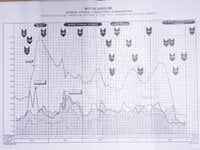
I don't know where this graph is from. But even if it is correct, it is misleading.
The United States Strategic Bombing Survey, to quote "This is military history for members of the military. I assume that the military is analyzing this war soberly and cannot afford to make any mistakes in the evaluation"
quotes from the book "Oil & War" by Robert Goralski and Russel W. Freeburg, Marine Corps University Press, 2021.This is military history for members of the military. I assume that the military is analyzing this war soberly and cannot afford to make any mistakes in the evaluation
The reference is liked. Oil & war : how the deadly struggle for fuel in WWII meant victory or defeat / Robert Goralski and Russell W. Freeburg. New York : Morrow 1987, obviously been reprinted. The authors were not present during WWII which under your rules makes them lesser sources at least.
German concerns about losing Russia as an oil source, albeit temporarily, were very real.
Germans overall fuel production 1940 to 1943 was 4,652,000 tons, 5,542,000 tons, 6,368, 000 tons, 7,508,000 tons, not quite an extra million tons per year.
Romanian Oil Production, Thousand Tons and Exports in tons, columns are year / Crude Oil production / Drilling (km) / Refinery Runs / Domestic Consumption / Exports to Czechoslovakia and Germany / Exports direct to the German Army/ exports to Italy and Albania
1938 / 6610 / 288 / 6228 / 1674 / 999,240 / nil / 560,475
1939 / 6240 / 256 / 5837 / 1785 / 1,285,153 / nil / 629,350
1940 / 5810 / 235 / 5472 / 1862 / 1,429,807 / nil / 342,943
1941 / 5577 / 253 / 5255 / 1811 / 2,885,229 / 34,351 / 761,667
1942 / 5655 / 339 / 5237 / 2098 / 1,822,207 / 369,452 / 862,179
1943 / 5266 / 344 / 4903 / 2007 / 1,795,555 / 715,749 / 391,354
In the above possibility crude exported from Romania is double counted when refined in Germany, in 1940 Germany refined 1,454,000 tons of fuel from crude, in 1943 1,933,000 tons.
UK Official History the Economic Blockade. In 1940 Germany received 3,032,830 metric tons of imports from the USSR, plus 166,242 tons from Japan, 71,902 tons from Iran and 327 tons from Afghanistan, all via the USSR. In 1941 the figures were USSR 1,362,269 metric tons, Japan 212,366 tons, Iran 27,177 tons, Afghanistan 2,103 tons. Around 1/3 of this were food and 1/4 fuel in 1940, and over 1/2 of the 1941 imports were food, 1/5 fuel. So 450,000 tons of fuel in 1940, 270,000 tons in the first 6 months of 1941. In 1941 imports from Africa were 3,811,732 metric tons, in January to August 1942 3,194,766 tons. About 40 to 50% of these were food and a third fertilisers, Germany controlled Europe wanted food.
Also note Oil and War state Germany controlled fuel deliveries to Italy, which is not strictly correct, given Romania, also some of the fuel from Romania was shipped by tanker
It was General Thomas who provided the Nazi leader with the grim facts.
Prediction
The arithmetic of oil at the end of 1940 did not add up to self-sufficiency.
The Nazis were quite content to allow economic declines in western Europe, the French, etc. economies were at economic peace, the countries were not fielding active military forces from home supplies, Vichy France did fight in Syria. The consumption calculations have incorrect assumptions.
... trucks were not available to do so in sufficient quantities ... Tires were in such short supply
So fuel, rubber and trucks are competing to see which is the main limit. We have someone deciding it was fuel from a reference noting it was a combination.
After 1940, the panzers were constantly short of fuel and constituted a small—though feared—part of the Wehrmacht. Blitzkrieg was a fizzle after 1940.
Small being about the same percentage, counting German motorised divisions as well, as the US army. Though of course when and how you count things comes into play, the SS, the Luftwaffe, the occupation forces called divisions, the British had 8 official divisions in Britain in 1944/45 not meant or fit for combat. The after 1940 should be more after 1942, the thrusts to Stalingrad and the early 1943 backhand blow also qualify as mobile warfare.
Germany's supply difficulties were compounded enormously by having to provide 3,000 tons of horse feed daily to its dispersed divisions.
Which is why the Heer had a live off the land arrangement, they were crossing much agricultural land which still used lots of animal power, but the book does not seem to make allowances for this.
Page 70 "As the invasion began, oil was in short supply, and the gamble of reaching the Caucasian oil fields in time to replenish the Wehrmacht and Luftwaffe was risky at best." Except there was no 1941 plan to reach the Caucasus, the dream was the USSR would collapse, with the Germans taking over administration. The Caucasus was the 1942 objective.
Page 77 "General Thomas sounded the first alarm on 29 September when he reported that frontline supplies were running short." Followed by
On 9 October, the quartermaster general of the Wehrmacht outlined the distressing fuel situation. Army vehicles were estimated to be 24,000 barrels short of minimum fill-up levels.
So once again it is the deliveries to units not the amount of fuel available. Nice edit.
The fuel shortages had been predicted, ... On 5 July, the Luftwaffe VIII Corps reported it was curtailing missions ... Panzers on their way to Smolensk ran dry ... Army Groups North and Center halted advances in August to reform when fuel supplies were exhausted ... On 28 October, panzer commander Heinz Guderian found, "We could advance only as fast as our supply situation would allow."
So once again supply problems at the front.
The Luftwaffe,... was losing its dominance over the Russian skies. Soviet air power was rebounding as German planes were increasingly grounded because of fuel shortages.
The Red Air Force was operating from prepared airfields versus Luftwaffe on often temporary ones, plus supply difficulties.
Guderian's panzer corps, which started the campaign with 600 tanks, was reduced to 50 by 13 November. And there was not enough fuel for even that number to go forward.
So lack of combat power and other supplies now competed with lack of local fuel and it was a Panzer Gruppe/Army.
December found Army Group South in retreat because it had run out of fuel and ammunition.
Not surprising given it was at Rostov.
Even Rommel's first offensive almost faltered at the start because of a fuel shortage.
He had the fuel but not at the front line.
The primary reason for the precarious fuel-supply problem was the inability of the Axis to control the eastern Mediterranean because the Italian Navy never had sufficient fuel for its ships
Anybody here recall earlier mention of how the Italian navy could have done with more fuel? Plus the third of the Italian Merchant Marine trapped overseas because Mussolini declared war before recalling them. The port capacity in Libya set up to service a population of "773,000 native and 66,500 white", most of whom were not in the trading system, or the locations of the ports, or the orders to stay in western Libya. Anyone surprised that OKH might supply things on the basis its orders were going to be followed? Add the air escorts, given how the convoys were attacked.
Page 188
"Germany's overall supply situation at the time was described by Field Marshal Franz Halder as "disastrous." As Hitler waited for his offensive to roll, the Wehrmacht counted only 140 tanks fully serviceable on the eastern front among 16 panzer divisions. Only 7,500 motor vehicles were available to replace the 75,000 lost. Try as it did, the supply corps could find only 20,000 horses to make up for the 180,000 that were killed or died in the winter of 1941 – 42. The High Command staff concluded the situation "cannot be made Good" " followed by
Fuel for the Wehrmacht remained critically short. Only one-third of the amount that Germany had stockpiled in 1941 was on hand now a year later.
Note once again only fuel problems are being quoted. So a tenth of the vehicle and a ninth of the horse losses were replaced. The book goes on to page 194 (where the next quote comes from) detailing the changes of orders, how far behind the front line the rail heads were, the lack of rail transport, claims on how the forces at Stalingrad could have made the oil fields instead, the way oil rig production was limited by the amount of steel available.
It soon became apparent that the drive for Grozny and the Dagestan wells was falling apart.
Going well beyond your rail head and increasing your front line length several times does tend to cause you to stop, even more if troops are redepolyed.
Alright? Let's lay this idea to rest that there wasn't a severe fuel shortage prior to 1944.
Let's lay to rest this idea you have any real idea of the situation, or understand the difference between tactical and strategic shortages, or are accurately reporting sources. The book makes it clear supply at the front was the issue, the Germans never ran out of a fuel reserve. Supplies of fuel, rubber and the vehicles competed to see which would run out first.
US Red Ball Express, the original idea was to tow trailers but that stopped as there were not enough tyres, and yes just like the Germans rubber, fuel and the vehicles themselves competed to see which would run out first, or the roads would wear out, in some cases road repairs were abandoned as uneconomic, new routes chosen. The western allies removed all animal transport from their armies in the ETO, they did not totally motorise their infantry.