Yes it is always portrayed as that simple. And that is hindsight.
Eisenhower summarised the position, based on the intelligence he had available, in a report dated around 9 Sept IIRC, to the Combined Chiefs of Staff at the Octagon Conference held in Quebec City 12-16 Sept 1944. In it he expressed the view that one good kick at the door and Germany would collapse. He recognised the logistics problems. He acknowledged it was a risk, but in his opinion, a risk worth taking for the war to be over by Christmas 1944.
The Combined Chiefs discussed that report right at the start of the conference. The logistics issue was raised by the British CIGS Alanbrooke. Churchill & FDR saw that report. Everyone had a chance to overrule Eisenhower. All were satisfied with the course of action being proposed and Eisenhower given the go-ahead for his plans. Market-Garden then became the kick at the door.
Turned out the intelligence was wrong. But when you had the German retreat from Falaise all the way back across Northern France and Belgium in the space of a couple of weeks it is understandable. German morale bounced back much more effectively than thought possible. Or the other way of looking at it, the intelligence was trailing behind what had actually begun to happen on the ground.
And the position at Antwerp was not so clear cut as you present. The push from the Seine across northern France and Belgium by 21 Army Group was by 5 Armoured divisions reinforced with another 2 Armoured brigades. There was insufficient logistics support to move the supporting infantry divisions forward at the same time. When 11th Armoured reached Antwerp it was 40 miles ahead of the divisions on either flank in Brussels (Guards Armoured + 1 Armoured brigade) and Ghent (7th Armoured + 1 Armoured brigade) and there were still substantial German Forces in their rear and on the left flank. They had effectively punched through the retreating German Army and not pushed them ahead of their advance.
11th Armoured paused because it was outrunning its supplies and it needed to reorganise. And the opposition it faced quickly stiffened preventing it crossing the Albert Canal a day or two later.
The German 15th Army was able to withdraw along the coast in organised fashion leaving garrisons in all the major ports which 1st Canadian Army had been ordered to clear. It withdrew into the Breskens Pocket on the south side of the Scheldt taking advantage of a number of major canals in the area. Crossing these then became just like a river crossing. It was the same to the east of Antwerp. Major waterways limiting the actions Armoured divs could undertake.
Eisenhower's lack of a good strategic mind was well understood at the time. Any one could have seen that even had Market Garden worked, which was at best iffy, logistically the entire advance and indeed the NW European front was in a bad situation and needed a functional port. For someone obsessed with wide front advances he very oddly shifted into a very uncharacteristic 'war winning' move that was clearly vastly more likely to fail than succeed.
Alanbrooke's private journal pointed out Churchill was a moron and alcoholic legendary for his bad decisions. FDR was not much better. They were really the ones to overrule Eisenhower and not knowing better wouldn't have known what the actual issues were.
Anyone with half a brain understood that if you're extending your supply lines and having problems and the enemy is falling back on his even if he is weak he has the advantage.
Funny about the Antwerp situation you layout, because instead of waiting to clear the flanks or improve the situation they instead launched an offensive even deeper without a secured supply line. Bad planning yet again, which goes back to my central point: the Wallies weren't as good with logistics as is claimed and in fact screwed up badly by September 1944.
Again why launch Market Garden instead of securing the ports? The thrust wouldn't have ended the war and if successful left them in an even worse position.
Citing total aircraft pool is deceptive. What matters is the number of aircraft within range of the front and able to participate in battles which matters. What's the percentage loss there? I notice you do not cite that.
Not really given that we are talking about a 6 month campaign and within a week the entire functional aircraft pool was either moving or preparing to move to the front. So a minor loss on the first day only disrupts air operations for a the first few days, not the entire friggin' campaign. We're talking about the entire campaign, not just the first day, week, or month. That is where the 25k aircraft reserve matters, especially when the Axis had about 25% of that number in total over the entire campaign.
This describes the air campaign in detail:

en.wikipedia.org
Again you are fixated on total numbers and not the number available at the front and committed to battle at any given time.
You're making an irrelevant point to the discussion at hand.
Your opponent can outnumber you three to one, but if it feeds in that numerical advantage into battle in a piecemeal fashion such that it gets destroyed as it comes in, or the incoming forces are combat ineffective for any number of reasons, then that numerical advantage means little in practice.
But that isn't what happened. Here is what actually happened on day 1 of Barbarossa (from the above link):
The VVS flew 6,000 sorties (in comparison to the Germans' 2,272 sorties) and VVS ZOVO put 1,900 aircraft into the air. They put up bitter resistance in the air, scoring a few successes. Such was the intensity and determination of the Soviet pilots they disregarded their losses and fought with a resolve which surprised German airmen. In several cases Soviet pilots rammed German machines, using the tactic of
taran.
[92]
The Red Air Force despite the surprise generated nearly 3:1 sorties over the Luftwaffe on the first day. Unfortunately the link muddles combat losses by lumping them in with losses on the ground, something you can tell from statements like these:
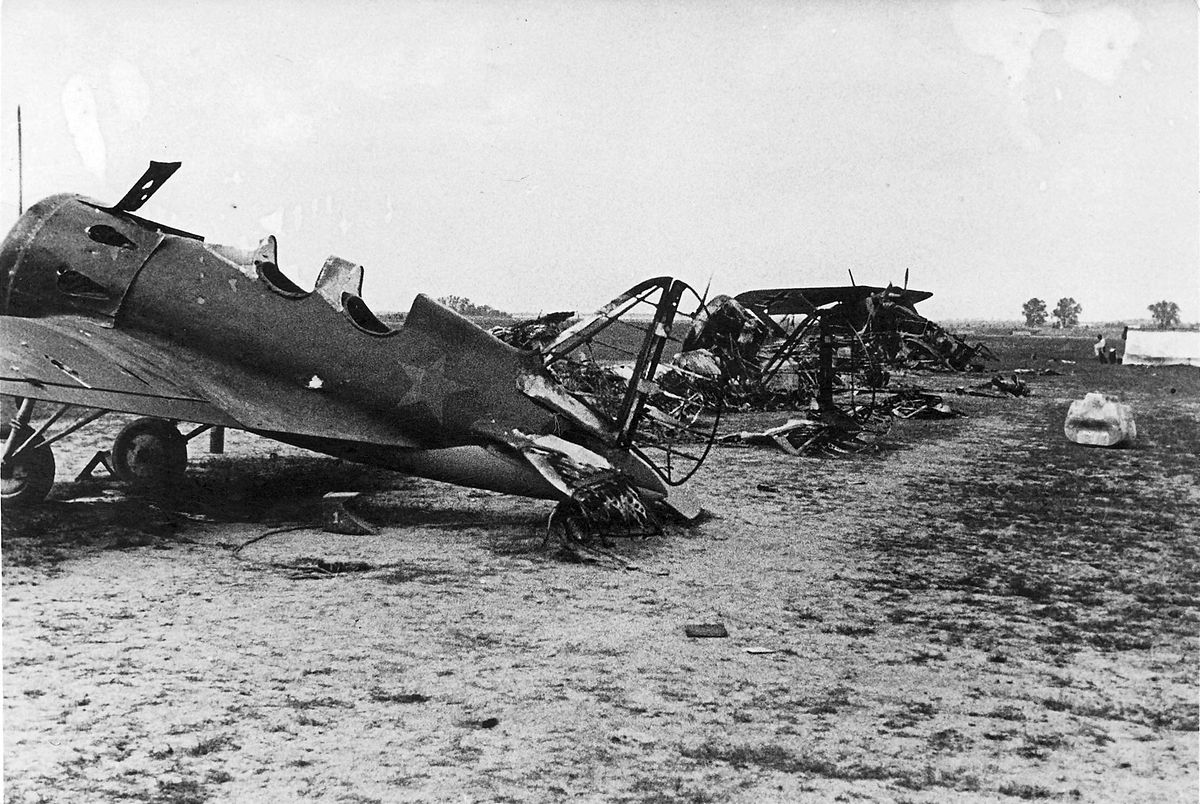
The VVS Kiev District had 23 of its airfields bombed it lost 192 aircraft, 97 on the ground.
Frankly the reality is the Soviets were no match for the Germans and suffered as a result. Not necessarily a function of Soviet problems as much as the Germans were vastly more experienced and had better equipment. Still on day one alone the Germans lost more than on the worst day of the Battle of Britain, so the Soviets weren't slouches, despite being surprised.