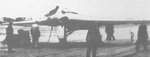
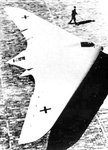
All versions of the Ho 229 resembled each other in overall layout. Reimar swept each half of the wing 32 degrees in an unbroken line from the nose to the start of each wingtip where he turned the leading edge to meet the wing trailing edge in a graceful and gradually tightening curve. There was no fuselage, no vertical or horizontal tail, and with landing gear stowed (the main landing gear was fixed but the nose wheel retracted on the first prototype Ho 229 V1), the upper and lower surface of the wing stretched smooth from wingtip to wingtip, unbroken by any control surface or other protuberance. Horten mounted elevons (control surfaces that combined the actions of elevators and ailerons ) to the trailing edge and spoilers at the wingtips for controlling pitch and roll, and he installed drag rudders next to the spoilers to help control the wing about the yaw axis. He also mounted flaps and a speed brake to help slow the wing and control its rate and angle of descent. When not in use, all control surfaces either lay concealed inside the wing or trailed from its aft edge. Parasite or form drag was virtually nonexistent. The only drag this aircraft produced was the inevitable by-product of the wing's lift. Few aircraft before the Horten 229 or after it have matched the purity and simplicity of its aerodynamic form but whether this achievement would have led to a successful and practical combat aircraft remains an open question.
Building on knowledge gained by flying the Horten V and 'VII, Reimar designed and built a manned glider called the Horten 229 V1 which test pilot Heinz Schiedhauer first flew 28 February 1944. This aircraft suffered several minor accidents but a number of pilots flew the wing during the following months of testing at Oranienburg and most commented favorably on its performance and handling qualities. Reimar used the experience gained with this glider to design and build the jet-propelled Ho 229 V2.
Wood is an unorthodox material from which to construct a jet aircraft and the Horten brothers preferred aluminum but in addition to the lack of metalworking skills among their team of craftspersons, several factors worked against using the metal to build their first jet-propelled wing. Reimar's calculations showed that he would need to convert much of the wing's interior volume into space for fuel if he hoped to come close to meeting Göring's requirement for a penetration depth of 1,000 km. Reimar must have lacked either the expertise or the special sealants to manufacture such a 'wet' wing from metal – whatever the reason, he believed that an aluminum wing was unsuitable for this task. Another factor in Reimar's choice of wood is rather startling: he believed that he needed to keep the wing's radar cross-section as low as possible. "We wished," he said many years later, "to have the [Ho 229] plane … that would not reflect [radar signals]" and Horten believed he could meet this requirement more easily with wood than metal. Many questions about this aspect of the Ho 229 design remain unanswered and no test data is available to document Horten's work in this area. The fragmentary information that is currently available comes entirely from anecdotal accounts that have surfaced well after World War II ended.
As they developed the '229, the Horten brothers measured the wing's performance against the Messerschmitt Me 262 jet fighter. According to Reimar and Walter, the Me 262 had a much higher wing loading than the Ho 229 and the Messerschmitt required such a long runway for take off that only a few airfields in Germany could accommodate it. The Ho 229 wing loading was considerably lower and this would have allowed it to operate from airfields with shorter runways. Reimar also believed, perhaps naively, that his wing could take off and land from a runway surfaced with grass but the Me 262 could not. If these had been true, a Ho 229 pilot would have had many more airfields from which to fly than his counterpart in the Messerschmitt jet.
Successful test flights in the Ho 229 V1 led to construction of the first powered wing, the Ho 229 V2, but poor communication with the engine manufacturers caused lengthy delays in finishing this aircraft. Horten first selected the 003 jet engine manufactured by BMW but then switched to the Junkers 004 power plants. Reimar built much of the wing center section based on the engine specifications sent by Junkers but when two motors finally arrived and Reimar's team tried to install them, they found the power plants were too large in diameter to fit the space built for them. Months passed while Horten redesigned the wing and the jet finally flew in mid-December 1944.
Full of fuel and ready to fly, the Horten Ho 229 V2 weighed about nine tons and thus it resembled a medium-sized, multi-engine bomber such as the Heinkel He 111. The Horten brothers believed that a military pilot with experience flying heavy multi-engine aircraft was required to safely fly the jet wing and Scheidhauer lacked these skills so Walter brought in veteran Luftwaffe pilot Lt. Erwin Ziller. Sources differ between two and four on the number of flights that Ziller logged but during his final test flight an engine failed and the jet wing crashed, killing Ziller.
According to an eyewitness, Ziller made three passes at an altitude of about 2,000 m (6,560 ft) so that a team from the Rechlin test center could measure his speed using a theodolite measuring instrument. Ziller then approached the airfield to land, lowered his landing grear at about 1,500 m (4,920 ft), and began to fly a wide descending spiral before crashing just beyond the airfield boundary. It was clear to those who examined the wreckage that one engine had failed but the eyewitness saw no control movements or attempt to line up with the runway and he suspected that something had incapacitated Ziller, perhaps fumes from the operating engine. Walter was convinced that the engine failure did not result in uncontrollable yaw and argued that Ziller could have shut down the functioning engine and glided to a survivable crash landing, perhaps even reached the runway and landed without damage. Walter also believed that someone might have sabotaged the airplane but whatever the cause, he remembered "it was an awful event. All our work was over at this moment." The crash must have disappointed Reimar as well. Ziller's test flights seemed to indicate the potential for great speed, perhaps a maximum of 977 km/h (606 mph). Although never confirmed, such performance would have helped to answer the Luftwaffe technical experts who criticized the all-wing configuration.
At the time of Ziller's crash, the Reich Air Ministry had scheduled series production of 15-20 machines at the firm Gotha Waggonfabrik Flugzeugbau and the Klemm company had begun preparing to manufacture wing ribs and other parts when the war ended.
Horten had planned to arm the third prototype with cannons but the war ended before this airplane was finished. Unbeknownst to the Horten brothers, Gotha designers substantially altered Horten's original design when they built the V3 airframe. For example, they used a much larger nose wheel compared to the unit fitted to the V2 and Reimar speculated that the planned 1,000 kg (2,200 lb) bomb load may have influenced them but he believed that all of the alterations that they made were unnecessary.
The U.S. VIII Corps of General Patton's Third Army found the Horten 229 prototypes V3 through V6 at Friedrichsroda in April 1945. Horten had designed airframes V4 and V5 as single-seat night fighters and V6 would have become a two-seat night fighter trainer. V3 was 75 percent finished and nearest to completion of the four airframes. Army personnel removed it later and shipped it to the U.S., via the Royal Aircraft Establishment at Farnborough, England. Reports indicate the British displayed the jet during fall 1945 and eventually the incomplete center section arrived at Silver Hill (now the Paul E. Garber Facility in Suitland, Maryland ) about 1950. There is no evidence that the outer wing sections were recovered at Friedrichsroda but members of the 9th Air Force Air Disarmament Division found a pair of wings 121 km (75 miles) from this village and these might be the same pair now included with the Ho 229 V3.
Reimar and Walter Horten demonstrated that a fighter-class all-wing aircraft could successfully fly propelled by jet turbine engines but Ziller's crash and the end of the war prevented them from demonstrating the full potential of the configuration. The wing was clearly a bold and unusual design of considerable merit, particularly if Reimar actually aimed to design a stealthy bomber but as a tailless fighter-bomber armed with massive 30mm cannon placed wide apart in the center section, the wing would probably have been a poor gun platform and found little favor among fighter pilots. Walter argued rather strenuously with his brother to place a vertical stabilizer on this airplane. Like most of the so-called 'Nazi wonder weapons,' the Horten IX was an interesting concept that was poorly executed.
Although the Garber Facility was closed to public tours in 2003, requests to view the extraordinary Horten Ho 229 V3 have continued to pour in to the Museum staff. Curators and restoration specialists hope to begin working on this artifact when the restoration shop complex is finished at the Steven F. Udvar-Hazy Center during the next several years.