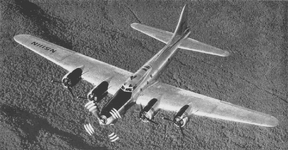
I'm pretty sure those R-2600s were added when the PB4Ys were converted postwar (by civilian companies, not the USN) for water-bombing forest fires in the western US. I am certainly willing to be proven wrong, though.
Yes, that was all private by the eyeball and tape measure hangar engineering(Looks like that will fit!), I should have had wrote 'surplus ex-USN Privateers' to make that more clear.
Was solid enough that the company got the FAA to do a STC on that.
I believe you are correct.
I will also note that the R-2600s were NOT turboed and while the R-2600s gave a lot more power for take-off they didn't give much more power in the high teens or into the 20s than the R-1830s in the B-24s did.
The planes that got the R-2600s seem to be PB4Y-2s that were built without turbos and used R-1830-94 engines that were rated at 1350hp for take-off. They had the taller single tails and a longer fuselage/nose.
As far as some of the engine swap nonsense goes, as a contrarian, this late Twin Wasp went about 1573lbs and was a two speed single stage engine. It was about 400lbs lighter than the Wright R-2600 that was swapped in.
Wright never got a turboed R-2600 into service in anything.
For the B-17 the 9 cylinder R-1820 engines were just over 1300lbs weight. A lot harder to get the just under 2000lb R-2600s to fit (balance) and without turbos the power at altitude doesn't work.
The Firefighting Privateers also had all their combat gear (guns/armor/self sealing tanks)) stripped out and probably new radios and a crew of 3-4 men? A lot of room to juggle weight around. They also were not trying to fly 500-1000 miles each way to drop their load.
Comparing modern (late Viet Nam ) era attack aircraft to WW II is a fools errand.
Different guns, different ammo, different bombs/underwing ordnance and.............
much more importantly much different aiming systems and sensors.
An early AC-47 might have used gum stuck on the side window but they soon escalated to a fighter type reflector gun sight and then night vision, and RF sensors (they could locate trucks by the RF signals given off by the ignition systems) and infrared on the later gun ships and electronic sights. They also operated a lot a night to minimize the effects of the less sophisticated enemy air defenses. At some point the pilot stopped aiming the guns and it done by mission operators in fuselage of the plane at sensor/weapons consoles.
Orbiting in daylight was just offering themselves up as targets.
I would also note that there were ways to improve firepower during WW II that did not involve using time machines,
IF you willing to pay the cost in weight.
A 20mm Vulcan gun weighs about double what a 20mm Hispano does. Granted it fires a lot faster. But they also rarely operate the Vulcan at peak rates of fire for ground attack.
4200rpm or less vs the 1200-1500rpm for two Hispanos. It also becomes a question of weight of the ammo. 500 rounds of Vulcan gun ammo weighs about 225lbs. Adjust rate of fire as you see fit and/or adjust weight of ammo.
They stuck an electric motor underneath a Gatling gun before 1900 with a pair of pullies and a V belt. The Problem was feeding it. How fast can you move the rounds through the feed system leading to the gun.
Gun system for an F-18. There is an awful lot of 'stuff' that the gun needs to run. The ammo in the 'drum' is in a spool/helix and there are motors that move the rounds to and from the gun (WW II might just eject overboard) but the entire spool/helix rotates inside the exterior casing to feed ammo into the system. You need a fair amount of power to get the system up to speed to feed the rounds to the gun quickly. You also need a way to stop the gun and clear it. Throwing 3-5 loaded rounds out the ejection chute as the gun stops may not be a good idea?
Maybe you could get 3 primitive Hispano guns for one Vulcan gun system as far as weight goes?
Doesn't sound as cool.