Dave, I'm certainly not on a par with these guys but from what I've been able to determine this is another German "too little too late" project. The engines were always to underpowered and the two prototypes almost impossible to fly. Improvements and redesign take time. By late 1942 reports were coming in about the ineffectiveness of the MK 103 against newer versions of the Soviet T-34 tanks. One solution would be to use the larger Bordkanone BK 37 gun, recently adapted from ground-based Flak 18. These guns had already been converted into underwing pod-mounted weapons for the Ju 87 and found to be a very effective weapon. When mounted on the Hs 129, the empty area behind the cockpit could be used for ammunition storage, which would address the only problem with the Ju 87's mounting: a limited ammunition supply.
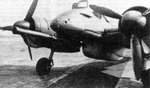
Few Hs 129s were actually installed with the BK 37 however, and the Rheinmetall firm decided to adapt for the aircraft (as had already been done with the heavy-gunned Ju 88P-1) their semi-automatic loading 7.5 cm Pak 40 anti-tank gun into a lighter-weight, fully-automatic aircraft-mountable version, with a completely different and more aerodynamic muzzle brake, to produce the Bordkanone BK 7.5 model. A huge hydraulic system was used to dampen the recoil of the gun, and an autoloader system with 12 rounds in the magazine (easier to design and fit because of the PaK 40's already semi-automated loading) was fitted in the large empty space behind the cockpit, with the gun and its recoil mechanism occupying a gun pod under the fuselage and a hole in the rear end of the pod to allow spent cartridges to be ejected. The resulting system was able to knock out any tank in the world, but its weight slowed the already poor performance of the plane to barely flyable in this new Hs 129 B-3 version.
B-3s finally started arriving in June 1944, and just 25 were delivered by the time the lines were shut down in September. A small number were also converted from older B-2 models. In the field they proved deadly weapons, but with only 25 aircraft available they had no effect on the war effort.
The 1,200 kg (2,645 lb) Bordkanone BK 7.5 cannon installation in the Hs 129B-3 was the heaviest forward-firing "big-gun" installation ever made for a series production military aircraft, until introduction of the 1970s-era General Electric GAU-8 Avenger seven barrel 30mm caliber anti-tank Gatling cannon (as the A-10's main armament) at a total weight with ammunition of up to 1,830 kg (4,030 lb).
[edit] Hs 129 C
In order to address the poor performance of the aircraft, plans had been underway for some time to fit the plane with newer versions of the Italian Isotta-Fraschini Delta engine that delivered 630 kW (850 hp). The engine installation ran into a number of delays however, and was still not ready for production when the plant was overrun by the Allies in 1945.
So with new more powerful engines a deadly "safe-cracker" but still unable to perform without fighter escort




 .
.


