
Navigation
Install the app
How to install the app on iOS
Follow along with the video below to see how to install our site as a web app on your home screen.
Note: This feature may not be available in some browsers.
More options
You are using an out of date browser. It may not display this or other websites correctly.
You should upgrade or use an alternative browser.
You should upgrade or use an alternative browser.
Luftwaffe Aircraft Camouflage and Markings (3 Viewers)
- Thread starter Micdrow
- Start date
More options
Who Replied?Hi all,
RLM 83 was NOT a green but was a Dunkelblau (Dark blue) used only during 1944 in the Mediterranean aera. It was to be used with maritime colors such as RLM 72 or 73.
The green 83 was a convenient reference created by historians who discovered a variation of... RLM 82.
RLM 99 included all colors of varnishes, putties, etc. and ran from dark red to greenish yellow or very light greys. In the above list, yellow green is only for varnishes protecting metal sheets against corrosion.
RLM 83 was NOT a green but was a Dunkelblau (Dark blue) used only during 1944 in the Mediterranean aera. It was to be used with maritime colors such as RLM 72 or 73.
The green 83 was a convenient reference created by historians who discovered a variation of... RLM 82.
RLM 99 included all colors of varnishes, putties, etc. and ran from dark red to greenish yellow or very light greys. In the above list, yellow green is only for varnishes protecting metal sheets against corrosion.

N4521U
Plastic Pirate
All duly noted......
Many notes taken, scratched out and
written again.....
Many notes taken, scratched out and
written again.....

Theater markings - How many disstict theaters did the Luftwaffe account for? Did the Balkans use yellow Russian front markings? Were the regulations enforced? From what I know, Eastern Front identification markings were yellow under wingtips, under cowling and sometimes on tail or tail band. Was there an order?
Attachments
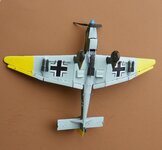
Last edited:
Dr.Chemist
Recruit
- 4
- May 14, 2023
H. I have seen that in this post you have a really deep knowledge. I'm building my first Junkers, Ju88A-4, and I would like to represent the one that was lost in the Sea, near Minorc, in the Mediterranean, which we have been diving.
https://aviation-safety.net/wikibase/175493
I'm trying to find everything that could make it seems realistic. I know it was based in Sicily and it was lost January 1943.
I guess it carried the white band for the Mediterranean theatre and the colour combination could be 79/78 or 79/80/78, but not sure about which one and which pattern for the camo. Also, any help will be really acknowledged about emblems, signs,...
Thank you so much in advanced.
PS: from my "research " I guess the "M" should be painted in white.
https://aviation-safety.net/wikibase/175493
I'm trying to find everything that could make it seems realistic. I know it was based in Sicily and it was lost January 1943.
| Owner/operator: | 5./KG 30 Luftwaffe |
| Registration: | 140474 |
| MSN: | 4D+MN |
I guess it carried the white band for the Mediterranean theatre and the colour combination could be 79/78 or 79/80/78, but not sure about which one and which pattern for the camo. Also, any help will be really acknowledged about emblems, signs,...
Thank you so much in advanced.
PS: from my "research " I guess the "M" should be painted in white.
Last edited:

If the camo for the kite was of the 79/78 or 79/80/78 there wasn't any pattern for it. Just the RLM 79 Sand was on tops and sides and the RLM 78 Light Blue on undersides. If there was the RLM 80 used as well it means that there were applied spots or squigles of irregular shape and randome layout. Of the white was the band on the fuselage and possible the wing tips on the undersides. However the camouflage pattern was used for the North Africa rather while the one the Ju-88s based on the Sicily was the standard one used for the ETO. I mean the RLM70/71/65. So a picture of the prticular Ju-88 would be helpful.
The desert camouflage could looked like that ...

the pic source: the net.
The desert camouflage could looked like that ...
the pic source: the net.
Dr.Chemist
Recruit
- 4
- May 14, 2023
Thank you so much. So... then, you think that it would have the standard pattern? I was guessing the African camo, because we know that the kite was bombing Argel, but for sure it came from Sicily.
Actually it is quite difficult to state of which camouflage the Ju-88s could be. Not all of them wore the one used in the North Africa. Generally it can be stated that if a plane served in the NA it could be of the destert camo. But it is not the rule. Mostly planes came to the Sicily for the Northern Europe still retaining the green pattern.

the source: the net.
the source: the net.
Dr.Chemist
Recruit
- 4
- May 14, 2023
Yes, I understand. Thank you so much. And I guess that even the theatre band could not be present, due to the KG30 was really moving around.
A good example ... Ju-88A-4 of the 7./KG30 , Sicily 1941/42 ...

the source: Junkers Ju 88A4 6.KG30 (4D+FP) Gerhard Straube WNr 140099 shot down over Blackbrook Surry England 14th Mar 1944
Ju 88A4 Stab III..KG30 4D+RD Sicily 1942

the source: Junkers Ju 88A4 6.KG30 (4D+FP) Gerhard Straube WNr 140099 shot down over Blackbrook Surry England 14th Mar 1944
the source: Junkers Ju 88A4 6.KG30 (4D+FP) Gerhard Straube WNr 140099 shot down over Blackbrook Surry England 14th Mar 1944
Ju 88A4 Stab III..KG30 4D+RD Sicily 1942
the source: Junkers Ju 88A4 6.KG30 (4D+FP) Gerhard Straube WNr 140099 shot down over Blackbrook Surry England 14th Mar 1944

Lucky13
Forum Mascot

flypaper2222
Senior Airman
Even after 80 years and many "expert" opinions confusion and difference remain. Luftwaffe color chips whos right? One look at the problem. Un signed.


fubar57
General
So you don't have to squint..... Luftwaffe RLM camouflage colors
Hi Andy and all who contributed to this thread, I would like to apologize profusely for my outrageously belated response. As for "Red B" discussed on pg. 12 of this thread, the full code is usually identified as 9k+BK as you mentioned. The WN.r might be 170064. As for WN.r 500642, coded "9K+CL," I believe the yellow C would most likely not have been outlined, just like one of the examples cited by Wojtek, 9K+KN. It seems to me that the outlining of tactical letters on KG51 aircraft was a feature almost always seen on early production KG51 Me 262s, such as from the 170xxx series. Same also holds true regarding the scribbly/squiggly camouflage patterns seen on many Kg51 Me 262s--these are mostly from the 170xxx series, though exceptions certainly exist (for example, "9k+DK," cited by Wojtek, has a distinctively scribbly camouflage, and it's WN.r is identified as 110613. Also, I am mystified as to why the tactical letter D appears to be black rather than red.) As Andy indicated, David Brown believes that, as a general rule, the early production Me 262s with KG 51 that were overpainted with dark green scribbly/squiggly mottles were painted in the mid-war greys underneath. The Me 262 with WN.r 500642 (9K+CL) was from a much later production batch and so would most likely not have had this type of camouflage. A well-known Me 262 from the same production batch is WNr. 500071, coded "White 3," of JG7. This was the Me 262 the famously defected to Switzerland, flown by Hans-Guido Mute. There are many photos of this particular machine. Perhaps WN.r 500064 was painted similarly. Whether KG51 ground crews would have applied a field-modified paint job is anyone's guess. As for the yellow C, it is also anyone's guess as to the exact shape. I would just go with a rounded C. Just my thoughts!Red B has been id'd as 9K+BK in some places. The would make sense for the red. If it's really 9K+BL then my yellow C theory is out the window.
Reaching my level of competence here so I need to be careful of what I say. Is Jon Olson not a member here any more? He'd be the authority on this.
Users who are viewing this thread
Total: 4 (members: 0, guests: 4)


