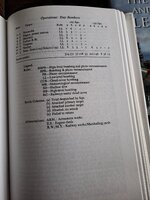
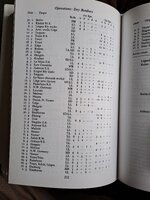
Bomber Command use of 2,000 pound bombs,
Day 2,000 pound AP from 23 July 1941 to 18 August 1944, night from 1 July 1940 to 10 August 1944
Day 2,000 pound HC from 6 September 1944 to 3 April 1945, night from 7 April 1941 to 14 April 1945
Day 2,000 pound M2 from 27 February 1945 to 22 April 1945, night from 16 August 1944 to 16 March 1945
Night 2,000 pound MC on 13 July 1943
Night 2,000 pound GP on 5 March 1943
It would appear the MC version was a trial, as was using the GP version. No details on what the differences were.
Ministry of Aircraft Production figures say 2,000 pound HC bomb production started in August 1941 and do not mention any other type. Bomber Command says Stirling dropped 3,359, Halifax 12,875 and Lancaster 13,044 of them, the bomb would have been mostly meant for the Stirling and Halifax.
Ignoring the ultimately 3.5 Halifax squadrons with 100 group, Bomber Command Halifax strength peaked at 25 Halifax bomber squadrons with 662 aircraft on 11 September 1944, to 24 squadrons with 622 aircraft end November, to 22 squadrons with 538 aircraft end December, to 20 squadrons with 491 aircraft end January 1945, to 19 squadrons with 447 aircraft end February, to 17 squadrons with 400 aircraft end March.
According to the US War Production Board, the US made around 4,000 x 2,000 pound bombs in December 1941 and January 1942, then started a program from August 1942, which was halted in December 1943, then restarted at a lower level in July 1944. Production in thousands by year 1941 to August 1945, 1, 38, 140, 23, 11 total 213 thousand.
The US made over 4,100,000 x 100 pound HE bombs July 1940 to August 1945 to 3,491,000 x 100 pound incendiary, plus another 2,035,000 x 100 pound incendiary clusters, but these weights were nominal as seen by what they contained,
246,000 AN -M12 (14 6-lb M69's),
278,000 AN - M6 (34 4-lb. M50's),
6,000 AN - M8 (34 4-lb. M50's) Navy Pack,
1,041,000 British Box (30 4-lb M50s),
12,000 type 143 (51-2-lb. AN-M52's),
452,000 M2 (34 4-lb AN-M54's)
There were another 8 types of nominal 500 pound incendiary clusters.
According to the USAAF Statistical Digest from 1943 to end of war the USAAF ETO bombers dropped 1,520,209 x 100 pound HE and 821,653 x 100 pound incendiary. And when it comes to incendiary clusters they were 512, 500, 480, 440 and 136 pounds, with the 440 pound version making up 267,023 out of 270,713 clusters dropped, most probably the M17 (1,094,000 made) comprising 110x4 pound M50.
The US made around 2,000,000 x 1,000 pound or heavier HE bombs, and 14,789,000 of 500 pounds or lighter July 1940 to August 1945. The lightest AP or SAP bomb was 500 pounds. With the bombing campaign hitting peaks in 1944 the allies did begin to run out of bombs, which explains Bomber Command night bombers dropping 46,666 US 1,000 pound SAP July to December 1944, along with 7,761 US 500 pound SAP September to December 1944.
Bombs dropped. High explosive. Different Bomber Command Documents will give different results. This is mostly from AIR 22/203 War Room Manual of Bomber Command Operations 1939 - 1945
41 22000 pound MC
854 12000 pound MC/TB
186 12000 pound HC
16 9100 pound SPEC
1,088 8000 pound HC
15 8000 pound M2
16 8000 pound ATX
4 5600 pound CS
2 5330 pound CS
7 4000 pound HC SPEC
67,788 4000 pound HC
537 4000 pound MC
20,778 4000 pound M2
217 4000 pound GP
6 4000 pound RDX
2,290 2000 pound AP
28,633 2000 pound HC
37 2000 pound MC
339 2000 pound M2
11 2000 pound GP
7 1900 pound RDX
2,141 1900 pound GP
4 1500 pound HC (Mine)
14 1500 pound MC (Mine)
94 1100 pound GP
4 1000 pound HC
256,529 1000 pound MC
47 1000 pound M2
82,164 1000 pound GP
1,661 1000 pound USA GP
133,349 1000 pound USA
30 1000 pound SAP
129,574 1000 pound USA SAP
1,475 1000 pound RDX
11,612 500 pound SAP
402,752 500 pound MC
551,424 500 pound GP
3 500 pound LD
159,992 500 pound USA
25,063 500 pound USA SAP
72 400 pound Johnnie Walker
4 250 pound MC
149,656 250 pound GP
4,783 250 pound SAP
342 250 pound Depth Charge
4 250 pound Anti Submarine
42,939 40 pound GP
284 37 pound W
2,324 20 pound GP
500 20 pound AP
2,116 20 pound Frag
528 9 pound AT
664 9 pound GP
Incendiary, the numbers for clusters are the bombs inside, not the cluster containers dropped
100 4000 pound
2,230 1000 pound TI
34 1000 pound smoke
250 500 pound TI
37 500 pound smoke
612 500 pound US
7,244 250 pound
50,582 250 pound TI
2 250 pound Smoke
934 250 pound Spot
32 250 pound float
16 250 pound SCI
27 250 pound photoflash
192 10 pound SIB
10 100 pound smoke
4,597 50 pound
3,018,089 30 pound
413,165 30 pound J (in 500 pound clusters)
20,369 25 pound
61,654,505 4 pound
3,659,099 4 pound X
119 Tins of Deckers (Forest fires)
10,053,130 No. 14 cluster 106 x 4 pound
2,558,786 No. 15 cluster 158 x 4 pound
342,908 No. 16 cluster 236 x 4 pound
627,550 No 17 cluster 110 x 4 pound
128,048 4 lb in 500 pound cluster
581,304 No. 14X cluster 106 x 4 pound
39,974 No. 15X cluster 158 x 4 pound
3,750 4 pound R
14 20 pound fire bomb
11,000 Napalm, gallons
The lessons the British drew from the Luftwaffe bombings in 1940/41 were machine tools and so factories were quite HE bomb resistant, being more vulnerable to fire, particularly precision tools, disruption to the work force caused the bigger loss of production, things like loss of water, power, transport, food outlets to where the work force lived and moved about, plus the factories.
Data from Richard Davis' allied strategic bomber raids, Table is date, 8th Air Force bombs on Germany, tons / % of those bombs on oil targets // Bomber Command bombs on Germany, tons / % of those bombs on oil targets.
May-44 19880 / 12.89 // 9479.8 / none
Jun-44 13120.5 / 34.01 // 5443.5 / 83.82
Jul-44 29838.3 / 22.33 // 14670.1 / 26.14
Aug-44 23597.4 / 26.07 // 16119.3 / 11.49
Sep-44 34818.4 / 21.12 // 22955.3 / 19.56
Oct-44 43552.2 / 11.74 // 57679.1 / 7.09
Nov-44 37798.8 / 42.39 // 58870.2 / 24.20
Dec-44 41092.1 / 7.23 // 51132.1 / 14.54
Jan-45 38551.3 / 7.40 // 33218.9 / 27.55
Feb-45 51187.2 / 11.93 // 50891.2 / 28.69
Mar-45 72951.1 / 13.06 // 74969.8 / 28.28
Apr-45 35646.1 / 4.61 // 38103.1 / 14.80
The figures for November 1944 show the 8th still taking the lead but the Bomber Command assigned targets were assessed as non operational in the third week in November so no further attacks were done on them that month and it was not until early December oil strikes resumed, now against targets previously attacked by the 8th. Harris did not ask for any extra oil targets, Portal did.
Bomber Command War Room: 8,655+42 aircraft missing on operations, 465+1 write offs due to enemy action, 1,604+14 write offs not due to enemy action (the +x are on anti submarine operations under Coastal Command). For Mosquito 254 missing, 32 write offs enemy action, 107 write offs not enemy action of these 169/23/91 on bomb raids, 2/0/0 mining, 83/12/16 other operations, which would include the fighter sorties. From 336,037 bomb, 18,725 mine, 4,086 leaflet, 2,620 reconnaissance, 175 security patrol, 15,638 bomber support, 123 ranger, 3,930 supply, 4,375 diversion, 2 fighter support, 40 dummy parachute dropping, 680 P.O.W. repatriation, 3,140 special duty, 232 anti diver, 8 anti intruder, total 389,809 sorties, plus 2,328 anti submarine patrols under Coastal Command.
When it comes to reallocation of resources. Call the U-boat defeat as of end June 1943. For the US that means 6,339 heavy and 4 very heavy bombers built out of 31,000 heavy and 3,764 very heavy bombers built 1940 to end August 1945. By end June 1943 the USN had received 209 B-24 direct from production, while others were in USAAF anti submarine units.
For the British 4,697 heavy bombers to end June 1943, out of 14,706 built to end September 1945 (UK Statistical Digest). The bomber campaign was very end weighted, meaning relatively few resources are freed early in the war.
The navy figures include under repair, refit etc. The RN started WW2 with 105 modern and 79 older destroyers plus 32 ocean going "escorts" The modern destroyer force bottomed out at 83 in mid 1941 by which time there were still 69 older destroyers. The pre war ordered Hunt class (DE by USN designation) began appearing in March 1940. The escort fleet grew to 88 by end 1940, 224 by end 1941, 238 by end 1942, 401 by end 1943 and 533 by end 1944, including US built ships. There were 214 Flower class commissioned 1940 to 1942. For CVE end June 1943 the RN had 16, wartime peak was 41.
To be clear the RN Escorts are the pre war types and the Captain, Hartland, Colony, Black Swan, Castle, Loch, Bay, River and Flower classes. There were smaller ships that had anti submarine capacity.
In September 1939 the USN had 59 modern and 167 4 stacker destroyers, with an emphasis on building modern destroyers rather than escorts, USN modern destroyer fleet to 85 in December 1940, 102 in December 1941, 167 in December 1942, 284 in December 1943, 356 in December 1944. The first DE appeared in January 1943, 48 by end June, 234 by end December 1943, 373 end December 1944. CVE first one in June 1941, 17 by end June 1943, 35 in December 1943, 65 in December 1944. There were 18 PG March 1942 to August 1943 and 77 PF December 1942 to February 1945. Again there were smaller types with some anti submarine capacity.
No navy was going to build lots of small ships in peace time, the costs were too great, after that came capability, the Flower class had to be stretched to cover the increasing distances from land required. The USN DE program had to use 3 inch guns until the Fletcher class program was largely complete and only received geared turbines in late 1943 as the US warship program as a whole began to be wound down and gear cutting etc. capacity had increased.
Examining the hull numbers of the first few months LST production indicates the US ordered somewhere around 450 to 500 LSTs at least in 1942, but then cancelled 100 of them on 16 September 1942, (LSTs 85-116, 142-156, 182-196, 232-236, 248-260, 296-300, 431-445).
DE cancellations
Sep-43 DE801-904, 905-1005, total 205
Oct-43 DE114-128, 754-962, 775-788, 647-664, 725-738, 478-507, total 100
More during 1944, Total cancellations 432, 430 during the war.
The allies have to mobilise earlier to do better but that means building more late 1930's equipment.
Narvik was the winter iron ore port, once the Baltic ice broke up shipments came direct from Sweden.
Operation Overlord needed to raid the British coaster fleet, a further hindrance to launching earlier than mid 1944.
Initially some 396 coasters totalling 623,000 DWT were considered suitable and each used underwent an on average 3 month refit (extra armament, accommodation, strengthened masts and smoke making equipment) the refit program began in October 1943 just before the rail system began having its usual winter problems. As it turned out the reduction in war damage to the coaster fleet meant the tonnage available in the winter of 1943-4 was about the same as the previous year. Despite agreements to hand back ships after the initial invasion it turned out that between December 1943 and the end of 1944 another 64 coasters of 100,000 DWT were added to the invasion fleet.
In March 1944 the plan called for 250,000 DWT of coasters to be retained after D+42 until at least D+120, this was 150,000 DWT more than the previous plan, and in April SHAEF expected to retain at least 250,000 DWT for most of the campaign. Help was sought from the US and Canada but none was available for the initial assault which would take 420 coasters of 655,000 DWT from the British fleet. This was around 46% of the total fleet or 57% of the operational tonnage in January 1944.
Overall the British coaster trade dropped by around 500,000 tons of cargo a month from June 1944 until after the end of the war in Europe. In the month 15 March to 15 April 1944 some 2,625,100 tons of cargo were moved in the coasters. Relaxation of sailing restrictions thanks to lower hostile activity and the employment of some ocean going ships were the main methods to overcome the problem.
The US logistics history claims that 2/3 of the British coaster fleet was assigned to cross channel work, some 184 coasters 625,000 DWT were allocated, which appears to be an over estimate in terms of percentage of tonnage and an underestimate in the number of ships. (The figures in the previous paragraphs are from the UK transport history). The US history notes one result was 1/4 of British blast furnaces were temporarily shut down. As far as I can see the use of stocks and the fact they were the smaller furnaces meant around a 10% cut in steel production for a time in 1944.
Another result was the British became reluctant to return locomotives loaned to them until wanted for allied operations in France.