What criteria do you use when comparing two very different aircraft? Appearance? A twin row Pratt Whitney 2800 radial engine vs. liquid cooled Rolls Royce? Hands down the Mustang was the looker. Top speed? Mustang. Climb rate? Hellcat. Durability? Hellcat. Combat proficiency? Hellcat. Why? A 19:1 kill ratio. Hellcats shot down 5163 enemy aircraft of all types with the loss of only 270 cats! The Mustang only achieved a 3.6:1 ratio.
As a first time poster - I greet you. But I would like to take the time to request your sources and direct me specifically to your Macr rollup that leads you to believe any ratio you want people to believe. The 8th AF Mustangs, for example destroyed 3328 LW a/c in the air, 3212 on the ground, lost 326 in air to air combat, lost 570 strafing - and including losses air/ground lost a total of 1280 "all in" meaning
air
strafe
mechanical
weather
pilot/accident
The latter 3 ("other") categories were 1280 - 326-570 = 384
So, the ranking of cause of loss would be Strafing, Other, Air to Air combat
I suspect one reason the Mustang always out votes the competition is that it was the most produced American fighter of WW2, and it got its rep in the ETO (which for some reason was the more glamorous stage).
Who knows what your definition of Glamorous is - but Germany and the Luftwaffe was a threat to the world - Japan was not. Mustangs dribbled out to the PTO because the Strategic air mission over Germany was far more important than the Far East. The Luftwaffe was a far more formidable force than the IJN and IJA in any category you wish to look at except number of aircraft that flew off carriers.
Bottom line though is durability. Me thinks that over water be it the Pacific or Channel, the radial reliability of the Hellcat's Pratt Whitney (or a Jug's its ETO counterpart) would seal the deal for me. There were only about 4 thousand some odd more Mustangs produced than Hellcats during the war, but there were almost 10 times as many P-51's lost than F5F's!
I suspect, without proof that the F6F is more durable because of the radial and would have been a better ship strafing airfields - but I would point out that the Mustang lost fewer aircraft per strafing award than either the P-47 or the P-38.
You are comparing apples to oranges in both the Mission and the Competition.
A simple fact is that the Hellcat couldn't do what the Mustang did over Berlin and Poland and Czechoslovakia and Rumania and Austria - and the Mustang would never be carrier qualified by Navy brass.
I might also draw your attention to Henning's plots on the P-51D versus the F6F-5, which I have checked based on the flight test data. While we don't compeltely agree on some details (SL and altitude greater than Critical Performance altitudes are good) the trends and comparitive performance differences are pretty good.
I might also point out that the P-51B-5 with a Merlin 1650-3 or a P-51B-7 and -15 with the Merlin 1650-7 are all significantly better in climb and better in turn than the P-51D due to a.) better engine performance at high altitude for the -3 and about 500 pounds less take off weight than the P-51D.
My sources for the above statistics are;
USAF 85 (and Frank Olynyk's Stars and Bars) for cross reference of air Awards,
the 8th AF Victory Credits Board for Ground scores,
the Missing Aircrew Reports for 8th AF and,
the Accident Reports for the 8th AF
So, your sources would be?
So, in conclusion, present your Hellcat breakouts with sources so that we may learn from your academics.
Perhaps you and Doughboy can share data?
Regards,
Bill


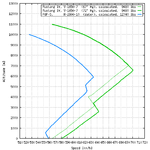
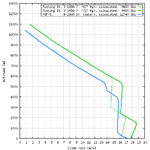
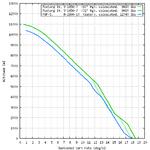


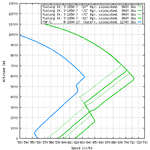
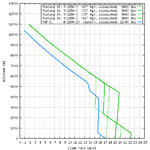
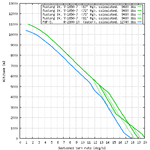
 Your charts looks as good as I've seen. Good work.


