The Guns We Own

Ad: This forum contains affiliate links to products on Amazon and eBay. More information in Terms and rules

Why did you want a locking bar sight on a M1A?
That seems like a bit of an anachronism.
I find it easier to adjust and operate.The aperture on the M1a site seems to be about .010" smaller so I may change ? ;)
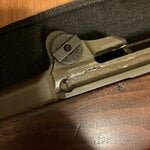
 
I find it easier to adjust and operate.The aperture on the M1a site seems to be about .010" smaller so I may change ? ;)

I have not found the locking bar sights to be any easier to use than the regular sight but this is what came on one rifle, so I figured I would lieave it the way it was because it was more representative of what was found during the war. On this particular rifle, I replaced the gas cylinder lock because it happened to be the post-war configuration and the rest of the rifle except for the barrel date is correct for war time production.

LockingBar.jpg
 
For me Ivan it's just the fact no screwdriver required to work the sight just unscrew the lockbar and retighten easy peasy. ;)

You don't need a screwdriver to make sight adjustments on the typical M1 or M14 sight. The screwdriver is just needed if you want to adjust the tension on the sight or disassemble it.
The locking bar was added when it was found on early models of the sight that the inertia under recoil would sometimes shift the setting.
The locking bar would prevent the sight from accidentally shifting. Eventually they figured out that it was a faulty design for the spring applying tension on the windage knob and when that was fixed, the locking bar sights were replaced.
 
You don't need a screwdriver to make sight adjustments on the typical M1 or M14 sight. The screwdriver is just needed if you want to adjust the tension on the sight or disassemble it.
The locking bar was added when it was found on early models of the sight that the inertia under recoil would sometimes shift the setting.
The locking bar would prevent the sight from accidentally shifting. Eventually they figured out that it was a faulty design for the spring applying tension on the windage knob and when that was fixed, the locking bar sights were replaced.
My M1a sight would always lose elevation unless I locked it from the get go when I bought it back in the 90's.It's highly possible I may of been doing tension all wrong but somewhere along the way I started locking it the bar sight works just fine for me. ;)
 
My M1a sight would always lose elevation unless I locked it from the get go when I bought it back in the 90's.It's highly possible I may of been doing tension all wrong but somewhere along the way I started locking it the bar sight works just fine for me. ;)
I have guns with the standard sights and obviously one with a locking bar sight. I also have one with the NM/2A sight which is basically the same thing but with finer threads in the base and in the windage knob so that the windage clicks move the sight only 1/2 MOA. My first M1A had the Springfield Armory Inc. version of the NM sight with 1/2 MOA adjustments. The NM/2A parts are somewhat expensive and a bit hard to find, so Springfield Inc. took a standard windage knob and machined off the bumps and then put notches into the now flat back side of the knob. There is a small recess in the receiver which holds a ball bearing and that is what the notches index against. It isn't really a USGI solution but works well enough. The gun will of course take the NM/2A parts if you happen to have them but even back in the 1990s they were about $75 and are probably more expensive now.

These sights rely on a screw to adjust tension against a spring washer for the clicks. The most common failure is for the spring washer to lose tension and then your sight will not hold elevation or if you tighten the screw down enough to hold elevation, you can't make adjustments.
I believe the solution was typically to replace the windage knob which contains the spring washer. I haven't had to do this and it has been decades since I last looked hard at these sights, so do your research before just buying a windage knob.
 
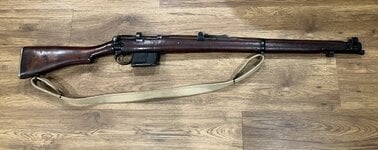
After the mention of the Ishapore .308 Lee Enfield here, I decided to look at my own Ishapore 2A1 rifle.
It appears to be in pretty good shape, but I never spent any time tuning or inspecting for accuracy bugs in the gun.
I also watched a bunch of videos of people who have bought Royal Tiger Imports B and C grade guns in the hopes of rebuilding them to be good shooters.
When I found my 2A1, next to it was the $20 donor rifle that supplied so many parts for my Frankenstein SMLE.
Here is the background of that rifle and how I acquired it for parts:
Many years ago, when I was at a rifle range, there was a fellow next to me who had a SMLE that he was shooting at a 50 yard target.
The target was big but he was missing most of his shots and the shots that were hitting were making pretty distinct keyholes in the paper.
After listening to him complain about the rifle, and hearing him say, "I would sell this rifle to any fool willing to buy it." I asked to look at the rifle.
Externally it wasn't too bad. It was obviously old and a bit worn, but much of the finish was still there. I asked him what he wanted for the gun. He said $25. I offered him $20 and came home with a 1912 British SMLE Mk.III (no *).
What I had noticed when looking over the gun was that the magazine looked brand new and the finish on most of the parts was quite good and there was no rust. The bore was a sewer pipe though.
For my Frankenstein rifle, I wanted a better barrel than was on it. I also ordered several bolt bodies so that I could have a chance of properly headspacing Frankenstein. The replacement barrel turned out (after a bit with the dealer) to be much better than I expected and I believe Frankenstein will easily shoot .308 bullets.
With a bunch of left over parts and the veteran from the Great War, I figured I would replace the sewer pipe with the take-off barrel from Frankenstein. The barrel wasn't the greatest, but at least it never keyholed any rounds. The original bolt body was so worn that it wobbled in its track and the bolt head would easily come off the track. I replaced the bolt body as well.
I had never thought about rebuilding it completely to be a shooter but in comparison to the SMLEs from RTI, this Great War veteran seems to be a much better starting point. Who would have thought SMLEs would become so expensive today?

Incidentally, the sewer pipe barrel was obviously non serviceable, so I did what many people just talk about. I stuck it into a pot of dirt we were using to grow Tomatoes at the time where it continued to rust in peace. My Wife left it there for a couple years but eventually just threw it out without me knowing.
 
Picked up a very nice 1937 vintage Winchester Model 52 target rifle in .22LR. Can hardly tell it is 88 years in age looking at it. Metal is in 99% condition, stock has a couple minor scratched, bore looks like it has barely been shot. Came with a very nice Marbles GOSS rear aperture sight, front sight has no markings but appears to be a Lyman 17a.
Put 60 rounds through it at a 25 yard target and she shoots. I did learn that I need to shoot with that style sight more.
 
A friend inherited a model 52 from his Dad. When we shot it with .22 long, not long rifle, ammo it is so quiet with that long barrel, we taught wives to shoot it with no flinch.
 
L2A1_Rifle.JPG

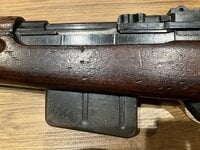
This is my 2A1 rifle. It is in much nicer looking condition than I remembered it.
Note the Ishapore squared front sight protectors. I really don't like those.

L2A1_ReceiverMarkings.JPG

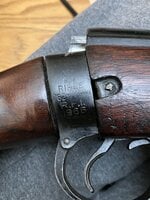
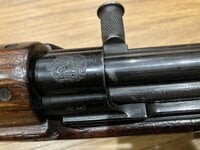
These are the markings under the bolt handle. I can't quite figure out what is on top.
It sort of resembles a crown but not quite. For this type of rifle, 1966 is not particularly late production.
They were manufactured well into the 1970s.

L2A1_Sights.JPG

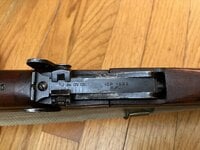
This is the distinguishing feature of the 2A1 as versus the 2A rifle. The 2A has sights out to 2000 Meters / Yards.
There may be other differences, but this is the most obvious.

My intention is to inspect this rifle to the best of my ability and tune it for accuracy in the same manner as a SMLE No.1 Mk.III.
I have seen a lot of videos of people shooting this type of rifle and so far, none has seemed particularly impressive for accuracy, but I don't think they are taking the time to take the boogers out of the gun.
 
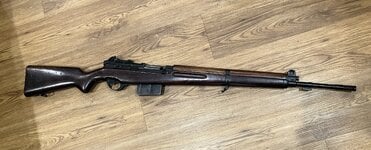
The FN-49 or SAFN was a very widely distributed rifle. In the United States, we typically see just the 7.92 x 57 that was manufactured for Egypt, but there were many many others. The Belgians themselves used a 7.65 mm version as did one of the South American countries (Argentina?).
The Venezuelans used one in 7 mm Mauser. The Colombians used a version in .30-06 on a slightly longer action. My understanding is that most of these countries never put these guns on the surplus market.
For a short time I owned a custom conversion of one to 7.62 NATO. I believe the fellow who made it (a friend of mine) took a M1903A3 Springfield barrel and machined it down. The problem was that he didn't really figure out the sizing of the gas port correctly from what I could tell, so even with the gas vent completely closed, it would short cycle most of the time. I sold it back to him. It would have been a cool rifle if it had been made with a 4 groove barrel instead of a 2 groove and been somewhat reliable in functioning.

- Ivan.
My Dad and I owned a Venzuelan FN-49 in 7mm Mauser. Kind of clunky. One day I was firing offhand from the magazine and it blew up. It thought the tilting bolt didn't engage. The stock cracked and the box magazine ballooned out. More recently I googled this and found it was quite common with FN-49s. I don't miss it.
 
I still have these nice Italian-made replicas. .44 1860 Army and .31Baby Dragoon. Civil War reenacting as Company Grade foot officer, I carried the Baby Dragoon in a holster through many battle reenactments.

102_1233.JPG
 
My Dad and I owned a Venzuelan FN-49 in 7mm Mauser. Kind of clunky. One day I was firing offhand from the magazine and it blew up. It thought the tilting bolt didn't engage. The stock cracked and the box magazine ballooned out. More recently I googled this and found it was quite common with FN-49s. I don't miss it.

Hope there were no significant injuries.
I suspect I know what might have actually happened.
My first guess is that you were using reloaded ammunition.
If so, one of the things to know is that the FN-49 like a few other semi automatic rifles has a free floating firing pin. Like the M1 Garand, the firing pin will give the primer a light tap during the loading cycle. There are some commercial primers (Federal Standard Large Rifle) that are very sensitive and that very slight tap will sometimes set one off. When that happens, usually the bolt or bolt carrier is not entirely in battery and when the round goes off, there is not the dwell time necessary between the bullet going past the gas port and the bolt unlocking.
It is a pity about the FN-49. Venezuelan guns are pretty rare in this country. The FN 49 is pretty typical of the wood and steel battle rifles of the 1930s. They were a bit big and clunky.

I have had something pretty similar happen with the M1 Garand. No damage done, but these slam fires basically made the gun fire a three round burst.
 
Hope there were no significant injuries.
I suspect I know what might have actually happened.
My first guess is that you were using reloaded ammunition.
If so, one of the things to know is that the FN-49 like a few other semi automatic rifles has a free floating firing pin. Like the M1 Garand, the firing pin will give the primer a light tap during the loading cycle. There are some commercial primers (Federal Standard Large Rifle) that are very sensitive and that very slight tap will sometimes set one off. When that happens, usually the bolt or bolt carrier is not entirely in battery and when the round goes off, there is not the dwell time necessary between the bullet going past the gas port and the bolt unlocking.
It is a pity about the FN-49. Venezuelan guns are pretty rare in this country. The FN 49 is pretty typical of the wood and steel battle rifles of the 1930s. They were a bit big and clunky.

I have had something pretty similar happen with the M1 Garand. No damage done, but these slam fires basically made the gun fire a three round burst.
No injuries. I was wearing a ball cap and shooting glasses. It was surplus Ball Chilean surplus ammo, though my dad and I did reload for competition. I now know about the slam-fire possibilities with FN-49s.
 

Users who are viewing this thread

Back