My understanding is that the Hellcat's split flaps' degree of deflection is automatically controlled by the compression spring. It should work like this:
As speed increases, lift pressure increases, progressively compressing the spring. As the spring compresses, the slotted flap gradually moves from 50 degrees to 0 degrees. The degree of incidence and design would provide a lot of lift (although higher drag in the stowed/retracted position).
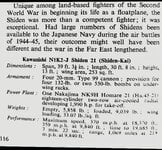
The Shiden's automatic flap system appears to both progressively extend and change angle of incidence based on airspeed. It should be more effective and incur less drag at low speed compared to the slotted-flaps on the Hellcat. On paper the flap moves to 30-degrees of incidence, but then it has a neat trick where it can pop a split flap (which causes a lot of drag, too). Shiden pilots mentioned that they used it for interception missions where they'd activate it at the top of an immelmann to reduce turn radius and stall speed.
Kawanishi used a wing-fuselage fillet of four degrees in order to improve wing root stall characteristics while the flaps were deployed. Because the flaps are located at the wing root and when flying at low speeds, and the airfoil was experimental, this led to stall issues with the N1K1-J. It was known to autorotate easily during flight, probably because with flaps lowered, stalls began at the wingtip rather than at the wing root. This seems to explain why the Shiden-Kai has a larger fillet than the Shiden. I think this is because the automatic flap system had enormous lift and it probably made it a significantly better dogfighter than the Hellcat. But the tradeoff was additional drag.
Hellcats' flap works in two systems. The loaded-spring compresses with increasing IAS which push the flap back from 48deg at 100K to 15 deg at 160K, and at 180K ias, a switch which connected to the airspeed system fully retract the slotted flap, if the flap was lowered by the electrical switch.
The flaps on the F6F was called "NACA slotted", but the Grumman called it "low drag type flap", in the file of Vought, it was categorized as " extensible slotted flap". It more likes an intermediate between slotted flap and the fowler flap, with only 0.15c length, but extends further than conventional slotted flap seen on F4U. It takes up about 64% wing span, making one of the largest flap affected area among ww2 single engine fighters and boosted F6F's already outstanding maximum lift coefficient to 2.1power off and 3.0 power on.
However, the blow-up type automatic flap of the Hellcat was not consider specialized to be used in combat, even though some good amount accounts of using them in combat have been seen, its flap was criticized "when lowered there was too much flap to gain anything in maneuvering" during the Joint Fighters Conference. Since it's flap angle was set by airspeed instead of maneuvering, it can drop too much in a relatively loose turn and bring unnecessary drag.
My theory is that Grumman's "automatic" flap's major goal is to increase the lateral stability of the aircraft during deck landing, instead of maneuvering. The flaps on the Hellcat were not interconnected and were allowed for asymmetrical deflection. During a wave-off, the prop stream would blow up the flap to increase dihedral of the wing, so the pilot can control the plane safer, since the slipstream was asymmetrical, the flap counter-acts it to make the plane fly safe and steady. ( The counter example would be the Corsair and it's notorious torque roll during wave-off)
The Shiden's automatic combat flaps seem to work by G-load, in which a mercury accelerometer controls the angle of flap deployment dynamically. If the plane is in level flight, the flap retracts, but if put it in tight turns, the flap drops in the right moment to help maneuvering, which gives best lift/drag in time-varing actions.
However the flaps on Shiden is very small when compared with the one on the Hellcat, and considering laminar airfoil was used on it, thus it generates much less overall lift coefficient. A good guess is 1.8-1.9 with flaps fully dropped( power off). The Japanese essay gives N1K's power on CLmax in turning 1.7 clean and 2.5 when automatic flap operated in 19deg.