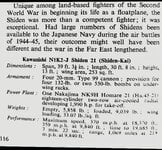
The N1K2-J Shiden Kai vs Its US Counterpart

When piloted by an experienced pilot, the Shiden Kai seems to have been about an equal to the F6F-5. It's true that it was not superior to it, but the Shiden Kai also was not inferior to the Hellcat. As long as an experienced pilot was behind the controls, both planes good square off pretty evenly.

In factory-fresh, theoretical combat performance, that might be true. I have the controversial take that the Hellcat's survival rate and ultra-low cost made it the "best" fighter of the war, from all sides:


Many Japanese aircraft have low cost and high man hours due to Imperial Japan's labor-substitution economic model. But within this mode of production, the Shiden-Kai's cost must have been far below that of the Shiden as it had significantly fewer parts. It would probably have been the Japanese equivalent of the Hellcat, if not for the landing gear issue. The problem was that if the landing gear dropped in combat, it meant almost automatic death for a pilot. 25% of combat losses were due to a malfunction. And the lack of seat pilot armor meant higher pilot attrition.

This might sound too harsh, but any aircraft which has that level of mechanical defect is one of the worst combat aircraft of the war. A technical marvel in many respects, but not fully developed.

Side note: regarding the landing gear dropping at 420MPH, I think this might be some kind of prop pitch governor overspeed problem. This is just me speculating, but my guess is that on a hydraulically actuated system, if the prop overspeeds, it might increase pressure on connected systems, like the hydraulically activated landing gear. Does anyone have any thoughts?
 
Genda said that the landing gear was not falling apart, it was deploying and causing aerodynamic drag. "apt to fall apart in the air" may be a mistranslation.
It may be both, or not.

Depending on speed and altitude it might be possible for the landing gear to unlock at high speed and the gear to partially descend?
Once the gear door/s are even a few centimeters lower than the wing bottom
Kawanishi-N1K2-J-3.jpg

The Airflow could force the landing gear even further out and landing gear is not supposed to handle 400mph IAS at anything except full retraction.
Even F4Us were not supposed to do that. Max speed for the F4U landing gear was 350kts but that was already down and locked. At speeds over 260kts the landing gear will not fully extend and/or lock according to the manual and they were planning to use the landing gear as a dive brake.
A landing gear leg coming out at 420mph could very well come off the plane.
Trying to condense the exact sequence of action/s into one or two words may not give a good picture.
Perhaps on some planes the landing just dropped a bit causing drag and on others the drag from the dropped gear caused the leg/s to come off?
Having one landing gear leg lower by even a small amount at high speed could cause asymmetric drag that might be difficult to trim out?

Just theory.
 
It may be both, or not.

Depending on speed and altitude it might be possible for the landing gear to unlock at high speed and the gear to partially descend?
Once the gear door/s are even a few centimeters lower than the wing bottom
View attachment 874009
The Airflow could force the landing gear even further out and landing gear is not supposed to handle 400mph IAS at anything except full retraction.
Even F4Us were not supposed to do that. Max speed for the F4U landing gear was 350kts but that was already down and locked. At speeds over 260kts the landing gear will not fully extend and/or lock according to the manual and they were planning to use the landing gear as a dive brake.
A landing gear leg coming out at 420mph could very well come off the plane.
Trying to condense the exact sequence of action/s into one or two words may not give a good picture.
Perhaps on some planes the landing just dropped a bit causing drag and on others the drag from the dropped gear caused the leg/s to come off?
Having one landing gear leg lower by even a small amount at high speed could cause asymmetric drag that might be difficult to trim out?

Just theory.
That pic was worth the techno-babble.
Apologies in advance. Okay, it does rate an "informative" as well.
 
These VPB-109 PB4Y-2 fought 12 of them and nailed two. The copilot of 'Blind Bomber" told my friend Bob Berry, a radio operator on "Hogan's Goat," that when he looked up and saw what the enemy fighters were his heart just about stopped. Hogan's Goat had to shut down one engine when the throttle was shot away and had some minor wounds and one major wound to some crewmen but made it home to Okinawa, along with Blind Bomber and a Martin PBM that showed up right after the George II fighters turned for home.

Think about that. The PBM came to the aid of the two PB4Y-2, even though it had to be even more vulnerable than they were. THAT'S GUTS!

By the way, the George II in the museum photo above was one of those that attacked the VPB-109 Privateers that day.

SixToOneSM1.jpg
 
Last edited:
Many Japanese aircraft have low cost and high man hours due to Imperial Japan's labor-substitution economic model. But within this mode of production, the Shiden-Kai's cost must have been far below that of the Shiden as it had significantly fewer parts. It would probably have been the Japanese equivalent of the Hellcat, if not for the landing gear issue. The problem was that if the landing gear dropped in combat, it meant almost automatic death for a pilot. 25% of combat losses were due to a malfunction. And the lack of seat pilot armor meant higher pilot attrition.
Wasn't this landing gear issue fixed with the Shiden Kai?
 
Wasn't this landing gear issue fixed with the Shiden Kai?
According to Genda, it was introduced in the Shiden Kai. In the quote above he said that it got better later on but it seems it was never fully resolved.

The N1K1-J Shiden was the one with a landing gear that collapsed on a rough landing.
 
When piloted by an experienced pilot, the Shiden Kai seems to have been about an equal to the F6F-5. It's true that it was not superior to it, but the Shiden Kai also was not inferior to the Hellcat. As long as an experienced pilot was behind the controls, both planes good square off pretty evenly.
Famous Fighters of the Second World War. William Green.
 

Attachments

  • Screenshot_20260403_111252_Google Play services.jpg
    Screenshot_20260403_111252_Google Play services.jpg
    1.1 MB · Views: 36
  • Screenshot_20260403_110950_Gallery.jpg
    Screenshot_20260403_110950_Gallery.jpg
    193.2 KB · Views: 43
According to Genda, it was introduced in the Shiden Kai. In the quote above he said that it got better later on but it seems it was never fully resolved.

The N1K1-J Shiden was the one with a landing gear that collapsed on a rough landing.
Oh! I was not aware the Shiden-Kai introduced a different problem in spite of the prior one being fixed.

Also, that info about the F6F having automatic flaps is news to me! That definitely should be featured in more publications for sure.
 
Famous Fighters of the Second World War. William Green.
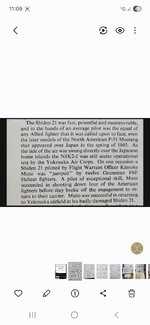
Something else that's interesting about the attachments here. In the second photograph, the story of Muto single-handedly shooting down four Hellcats is an exaggeration.

The combat involved a group of Hellcats getting jumped by Shiden-Kai led by Muto. Saburo Sakai would later claim that this event really did happen and that it involved Muto piloting a Zero, not a Shiden-Kai. But Sakai did not mention any specific dates and it could be rumor, although he is an excellent and reliable source of information. To my knowledge all of his wartime anecdotes were corroborated by independent sources.

By the way, for some reason most Japanese military aircraft recorded top military speeds rather than WEP speeds, which is the continuous maximum speed. WEP values are higher. Japanese wikipedia has two sources which corroborate each other: Tomokazu Kasai and the Japanese field manual for the Shiden-Kai put the WEP top speed at around 388 MPH or 624 KPH (if you synthetically calculate WEP speeds as one forum member did).
Also, that info about the F6F having automatic flaps is news to me! That definitely should be featured in more publications for sure.
I could not locate any information on the flaps, in any book on the Hellcat, but I believe it's probably true. It's weird that no pilot spoke about the automatic flaps in interviews and no author mentioned it.
 
Last edited:
There are manuals for the F6F on this website.


There was an automatic function.
If the flap control was in the DOWN position the flaps would automatically retract at over 170kts and would lower the flaps at under 170kts.
No mention of intermediate positions in the sections I have read so far. Not saying it wasn't possible. Just that I haven't read it.
There was an airspeed switch in the wing center section would control the flaps it the control was in the down position. If the control was in the UP position, it didn't.
 
I recall reading where a Hellcat pilot encountered a George II for the first time and felt he had to be wary about it, a big fast fighter that looked like a P-47.

And then he just went and shot it down, no biggie.
 
There are manuals for the F6F on this website.


There was an automatic function.
If the flap control was in the DOWN position the flaps would automatically retract at over 170kts and would lower the flaps at under 170kts.
No mention of intermediate positions in the sections I have read so far. Not saying it wasn't possible. Just that I haven't read it.
There was an airspeed switch in the wing center section would control the flaps it the control was in the down position. If the control was in the UP position, it didn't.
The F6F provides an extra spring-loaded lever for manual flap operation and intermediate flap position. When the flap is in manual mode, it can be lowered exceeds 180kts ias. There were accounts where Hellcat used flaps at 200K ias and turned with A6M.

 
Except that veteran IJN A6M pilots still shot them down.
Normally Veteran A6Ms still needs to trade 2-3 of themselves per Hellcat shot down, in an even/ favorable encounter situation, which is extremely unprofitable.

A perfect example was air battle over Iwo Jima taken place in July 1944, where the Yokosuka Koukutai, top guns of the IJNAF, met the rookie F6F-5s. Famous Japanese pilots including Sakai Saburo, Muto Kaneyoshi, Matsuba Akio, Iwashita Kunie and Yamaguchi Sadao all taken place in action. Loss ratio of three encounters were 6:1, 3:1 and 2:1, with Yamaguchi himself KIA. Which showed the struggling of A6M5 facing the Hellcat, even piloted by a group of aces, with radar commands and favorable altitudes/ numbers.
 
Last edited:
See Bill's comment (post #2) in this thread:
Question re F6F Hellcat's Wing-Flap Operation

it provides a good explanation about the "automatic" function of the flaps.
My understanding is that the Hellcat's split flaps' degree of deflection is automatically controlled by the compression spring. It should work like this:

As speed increases, lift pressure increases, progressively compressing the spring. As the spring compresses, the slotted flap gradually moves from 50 degrees to 0 degrees. The degree of incidence and design would provide a lot of lift (although higher drag in the stowed/retracted position).

The Shiden's automatic flap system appears to both progressively extend and change angle of incidence based on airspeed. It should be more effective and incur less drag at low speed compared to the slotted-flaps on the Hellcat. On paper the flap moves to 30-degrees of incidence, but then it has a neat trick where it can pop a split flap (which causes a lot of drag, too). Shiden pilots mentioned that they used it for interception missions where they'd activate it at the top of an immelmann to reduce turn radius and stall speed.

Japanese Wikipedia, from an experimental AI translation technique that I'm trying to use on the Shiden prototype handbook:

The main wing, inherited from the earlier Kawanishi N1K Shiden, [41] has an unusually large wing root incidence of 4 degrees [42] for a fighter aircraft. The N1K Shiden had 0 degrees [43], and the Fw 190 had 3 degrees [44], while most fighter aircraft fall within this range. Generally, floatplanes have lower wing loading than land-based aircraft, but the high-speed requirements of the strong winds led to a higher-than-usual wing root incidence. This was likely done to ensure good stall characteristics. As a result, the first N1K Shiden, when flaps were deployed, experienced wing root stall turbulence that caused the horizontal stabilizer to vibrate [45], despite being a mid-wing design. To compensate, it incorporated large fillets [46]. The low-wing N1K Shiden required even larger fillets [47], which negatively impacted both aerodynamics and weight. In contrast, the J6K1 "Hamp" (another Kawanishi aircraft), originally designed as a land-based fighter, has a wing root incidence of 2 degrees [48]. Furthermore, the main wing incidence of the A-1 "Sky Raider" is the same as that of this aircraft, at 4 degrees, but it uses the older NACA 2417 airfoil for the wing root, and the fuselage lower surface is streamlined without fillets. The internal dimensions between the left and right flaps are the same as the fuselage width, providing a stark contrast to the strong winds and N1K Shiden (modified), where the fillet presence reduced the width and area of the flaps.

Kawanishi used a wing-fuselage fillet of four degrees in order to improve wing root stall characteristics while the flaps were deployed. Because the flaps are located at the wing root and when flying at low speeds, and the airfoil was experimental, this led to stall issues with the N1K1-J. It was known to autorotate easily during flight, probably because with flaps lowered, stalls began at the wingtip rather than at the wing root. This seems to explain why the Shiden-Kai has a larger fillet than the Shiden. I think this is because the automatic flap system had enormous lift and it probably made it a significantly better dogfighter than the Hellcat. But the tradeoff was additional drag.
 
My understanding is that the Hellcat's split flaps' degree of deflection is automatically controlled by the compression spring. It should work like this:

As speed increases, lift pressure increases, progressively compressing the spring. As the spring compresses, the slotted flap gradually moves from 50 degrees to 0 degrees. The degree of incidence and design would provide a lot of lift (although higher drag in the stowed/retracted position).

The Shiden's automatic flap system appears to both progressively extend and change angle of incidence based on airspeed. It should be more effective and incur less drag at low speed compared to the slotted-flaps on the Hellcat. On paper the flap moves to 30-degrees of incidence, but then it has a neat trick where it can pop a split flap (which causes a lot of drag, too). Shiden pilots mentioned that they used it for interception missions where they'd activate it at the top of an immelmann to reduce turn radius and stall speed.


Kawanishi used a wing-fuselage fillet of four degrees in order to improve wing root stall characteristics while the flaps were deployed. Because the flaps are located at the wing root and when flying at low speeds, and the airfoil was experimental, this led to stall issues with the N1K1-J. It was known to autorotate easily during flight, probably because with flaps lowered, stalls began at the wingtip rather than at the wing root. This seems to explain why the Shiden-Kai has a larger fillet than the Shiden. I think this is because the automatic flap system had enormous lift and it probably made it a significantly better dogfighter than the Hellcat. But the tradeoff was additional drag.
Hellcats' flap works in two systems. The loaded-spring compresses with increasing IAS which push the flap back from 48deg at 100K to 15 deg at 160K, and at 180K ias, a switch which connected to the airspeed system fully retract the slotted flap, if the flap was lowered by the electrical switch.

The flaps on the F6F was called "NACA slotted", but the Grumman called it "low drag type flap", in the file of Vought, it was categorized as " extensible slotted flap". It more likes an intermediate between slotted flap and the fowler flap, with only 0.15c length, but extends further than conventional slotted flap seen on F4U. It takes up about 64% wing span, making one of the largest flap affected area among ww2 single engine fighters and boosted F6F's already outstanding maximum lift coefficient to 2.1power off and 3.0 power on.

However, the blow-up type automatic flap of the Hellcat was not consider specialized to be used in combat, even though some good amount accounts of using them in combat have been seen, its flap was criticized "when lowered there was too much flap to gain anything in maneuvering" during the Joint Fighters Conference. Since it's flap angle was set by airspeed instead of maneuvering, it can drop too much in a relatively loose turn and bring unnecessary drag.

My theory is that Grumman's "automatic" flap's major goal is to increase the lateral stability of the aircraft during deck landing, instead of maneuvering. The flaps on the Hellcat were not interconnected and were allowed for asymmetrical deflection. During a wave-off, the prop stream would blow up the flap to increase dihedral of the wing, so the pilot can control the plane safer, since the slipstream was asymmetrical, the flap counter-acts it to make the plane fly safe and steady. ( The counter example would be the Corsair and it's notorious torque roll during wave-off)

The Shiden's automatic combat flaps seem to work by G-load, in which a mercury accelerometer controls the angle of flap deployment dynamically. If the plane is in level flight, the flap retracts, but if put it in tight turns, the flap drops in the right moment to help maneuvering, which gives best lift/drag in time-varing actions.

However the flaps on Shiden is very small when compared with the one on the Hellcat, and considering laminar airfoil was used on it, thus it generates much less overall lift coefficient. A good guess is 1.8-1.9 with flaps fully dropped( power off). The Japanese essay gives N1K's power on CLmax in turning 1.7 clean and 2.5 when automatic flap operated in 19deg.

 
Here is some artwork that depicts that action. Pretty clear that the Hellcats got in each other's way and Saki did what those Privateers did and got down low over the water, his wingtips actually hitting the waves three times.

View attachment 874172
Was the pilot's name Saki or Sakai? I'm not that familiar with IJN pilots. Just checking if that's the right name or a typo.
I read Saburo Sakai's book so I'm curious.
 

Users who are viewing this thread

Back