Irregualr23
Airman
- 65
- May 13, 2025
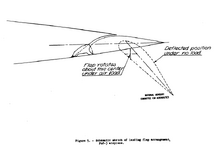
My understanding is that the Hellcat's split flaps' degree of deflection is automatically controlled by the compression spring. It should work like this:
As speed increases, lift pressure increases, progressively compressing the spring. As the spring compresses, the slotted flap gradually moves from 50 degrees to 0 degrees. The degree of incidence and design would provide a lot of lift (although higher drag in the stowed/retracted position).
The Shiden's automatic flap system appears to both progressively extend and change angle of incidence based on airspeed. It should be more effective and incur less drag at low speed compared to the slotted-flaps on the Hellcat. On paper the flap moves to 30-degrees of incidence, but then it has a neat trick where it can pop a split flap (which causes a lot of drag, too). Shiden pilots mentioned that they used it for interception missions where they'd activate it at the top of an immelmann to reduce turn radius and stall speed.
Kawanishi used a wing-fuselage fillet of four degrees in order to improve wing root stall characteristics while the flaps were deployed. Because the flaps are located at the wing root and when flying at low speeds, and the airfoil was experimental, this led to stall issues with the N1K1-J. It was known to autorotate easily during flight, probably because with flaps lowered, stalls began at the wingtip rather than at the wing root. This seems to explain why the Shiden-Kai has a larger fillet than the Shiden. I think this is because the automatic flap system had enormous lift and it probably made it a significantly better dogfighter than the Hellcat. But the tradeoff was additional drag.
My understanding is that the Hellcat's split flaps' degree of deflection is automatically controlled by the compression spring. It should work like this:
As speed increases, lift pressure increases, progressively compressing the spring. As the spring compresses, the slotted flap gradually moves from 50 degrees to 0 degrees. The degree of incidence and design would provide a lot of lift (although higher drag in the stowed/retracted position).
The Shiden's automatic flap system appears to both progressively extend and change angle of incidence based on airspeed. It should be more effective and incur less drag at low speed compared to the slotted-flaps on the Hellcat. On paper the flap moves to 30-degrees of incidence, but then it has a neat trick where it can pop a split flap (which causes a lot of drag, too). Shiden pilots mentioned that they used it for interception missions where they'd activate it at the top of an immelmann to reduce turn radius and stall speed.
Kawanishi used a wing-fuselage fillet of four degrees in order to improve wing root stall characteristics while the flaps were deployed. Because the flaps are located at the wing root and when flying at low speeds, and the airfoil was experimental, this led to stall issues with the N1K1-J. It was known to autorotate easily during flight, probably because with flaps lowered, stalls began at the wingtip rather than at the wing root. This seems to explain why the Shiden-Kai has a larger fillet than the Shiden. I think this is because the automatic flap system had enormous lift and it probably made it a significantly better dogfighter than the Hellcat. But the tradeoff was additional drag.
Actual gun cam footage on N1K2's combat flap:
This actual scene above the Bungo strait in July 1945. The shooter was Lt. Malcom Cagle, the leader of VF-88 piloting an F6F-5. He just wounded the famous Muto Kaneyoshi's N1K2 in the head-on pass, and came in to help this F4U. Who was caught in a turn by this N1K2 using flaps, and Cagle came in to shoot it down reporting "No difficulty in following despite enemy used flaps while F6F didn't plus a belly tank".
In the same battle, Oshibuchi's N1K2 was outmaneuvered and shot down by an F6F using flaps, a fight between N1K's flap and F6F's flap.