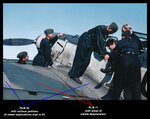
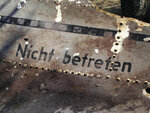
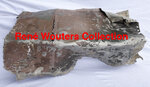
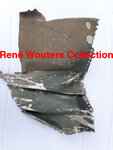
The possibility of the Berge's misidentification of colours due to desaturation
- It's unlikely the simplified pattern had been on the aircraft long enough for the colours to undergo any significant desaturation before it ditched into the sea on 2 June 1940. As Werk Nr 2450's unit was a night fighter unit its fighters would have been originally finished in the night-fighter scheme of 70/71/65 before being sent to Norway at the beginning of May 1940. With nearly twenty hours of daylight in Trondheim in May, a daytime fighter scheme was required and obviously applied, either shortly before or after the unit left Germany. In other words, the simplified pattern colours had most-likely been on the aircraft less than six weeks, not six months.
- Berge identified 70/71 underneath the 74/75 scheme, which is consistent with the aircraft's background as a night fighter. If the underlying colour scheme was 70/71, why hadn't the underlying 71 also morphed into 74? How was it that Berge was still able to identify it as 71? And don't forget, the 70/71 scheme had been on the aircraft since it was built in 1938; plenty of time for desaturation of the 70/71 colours to occur.
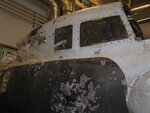
- I know of one Heinkel III P-1 (Werk Nr 1526) and two Ju 88s (Werk Nr 0880119 and Werk Nr 0886146) that have been raised from the depths in Norway in recent years. Presumably they were finished in the standard bomber top-surfaces scheme of 70/71 when they were lost. Had the RLM 71 on those aircraft morphed into 74 by the time they were raised? If not, why would the RLM 71 on Berge's 109C have been any different? Can you cite any confirmed examples of 71 or 02 on recovered Luftwaffe aircraft that morphed into 74 or 75 over time?
- JU88.net
- Preserved Axis Aircraft
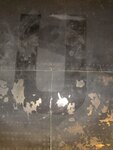
- Berge was able to identify the cockpit colour as RLM 02. Why hadn't that RLM 02 morphed into 75? And if you want to know what RLM 02 looks like after being submerged in seawater for 63 years, here's a photo of part of Gelbe 16's radio equipment. It still looks like RLM 02 to me.

- What are the chances of 71/02 morphing into such a close match to 74/75 that Berge was fooled into misidentifying them as 74/75? Although the scope of Berge's article does not include his methodology, there were several reference sources for RLM colours at the time he may have had access too. The L.Dv. 521/1 colour charts of 1938 and 1941, Karl Ries' L.Dv. 521 colour chart first published in 1963 and the L.Dv. 521/1 colour chart at the back of Hitchcock's "Messerschmitt O-Nine gallery" of 1973.
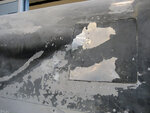
- Thanks for posting the photograph. I'm afraid I must disagree with your interpretation of the colours in that photograph. Desaturation or not, the wing looks like it's painted in 74/75 to me.
74/75 scheme
02/71 scheme
Berge's findings were initially dismissed here as a "field test" scheme and therefore not representative of fighter camouflage schemes of the time. Then Berge's qualifications were questioned. Then the question of paint surviving in sea water was raised. And now we have the claim that Berge misidentified the colours on Werk Nr 2450 because 71/02 had morphed into 74/75. Well here's a thought: rather than trying to manipulate the evidence so the 02/71 hypothesis can remain credible, how about simply letting the evidence speak for itself?
Because Berge's 109C is not the only piece of hard evidence for the 74/75 splinter pattern existing in 1940. How do you explain, for instance, the Duxford 109 E-3? And how come no-one seems to be able to come up with a single piece of original wing skin with an RLM 02/71 pattern on it? A single piece of hard evidence like that would end this debate immediately. Aviation archaeologists have been digging up crashed planes for years now, so surely they would have found something with an 02/71 splinter scheme on it by now if it ever existed. I've yet to see any such evidence cited anywhere.
Faber's Fw 190 A-3
Regarding Faber's Fw 190 A-3, I'm not sure what your point is as I don't see what difference it makes. One person's "light olive green" could be another's "light olive". As there was no common standard they were matching the colours to, who knows what greens they actually were? Even if the report had stated RLM 02 and RLM 71, if it didn't refer to what parts of the aircraft those colours were on, those colours may well have been mottling colours, we just don't know.
The other point I made about Faber's aircraft is that there were in fact two eye-witness reports. Here's the quote I was referring to in full:
"Two wartime descriptions exist on the camouflage colours of this aircraft. One mentions a "normal" German fighter camouflage, which is hardly helpful as this had been changed comparatively recently from an 02/71/65 scheme to 74/75/76. However, this report does go on to describe a mottled blue-grey finish with pale blue undersides, while the other, an RAF Intelligence Report, mentions dark green, light olive green and pale blue". Page 38 "Luftwaffe Colours Vol 4, Sect 1, Jagdwaffe, Holding the West 1941-1943", D Wadman & M Pegg.
Again, note how a belief in the existence of an 02/71/65 scheme leads the authors to dismiss as "hardly helpful" the description of the scheme as "normal". However, if 02/71/65 is a modern-day myth and 74/75/76 was what those at the time considered a "normal" German fighter camouflage, then it's actually a very helpful and accurate description!
Now, if you accept the RAF Intelligence Report was referring to fuselage mottling colours, the two reports do not necessarily contradict each other. But if you want to argue that the RAF Intelligence Report was referring to the camouflage pattern colours on the wing, tailplane and fuselage spine, then you have to ask which report is the more likely, given we're dealing with an Fw 190 A-3 captured on 23 June 1942.
Even if you don't believe RLM 74 and 75 were used on fighters in 1940, "An RLM order, dated June 24, 1941, is believed to have ratified the changeover to an official RLM camouflage scheme incorporating the new colors 74, 75 and 76 in conjunction with 65. By August 15, 1941, Messerschmitt had set forth its new painting chart for the Bf 109 F calling for camouflage colors 74/75/76 with a fuselage mottle of 02/70/74". (See page 24, The official Monogram Painting Guide to German Aircraft 1933-1945)
So, from 24 June 1941, we have documented proof of the existence and use of the 74/75/76 scheme. And when was the Fw 190A-3 first introduced? Well, the Fw 190 A-2 model was introduced in August 1941, with a total of 124 A-2s delivered by the end of 1941. (W. Green, "Warplanes of the Third Reich", 1979, p. 199) Green dates the introduction of the A-3 to the spring of 1942 (p. 200), while "Aero Detail 6" dates it to "late 1941". (Nohara & Shiwaku, "Aero Detail 6: Focke-Wulf Fw 190A/F", 1993, p. 73)
So an aircraft first introduced sometime between late 1941 and the spring of 1942, when the official camouflage scheme was 74/75/76, was somehow painted 02/71/65? Even Wadman & Pegg's Jagdwaffe book features a fine colour photograph of an Fw 190 A-2 in 74/75/76 and dates it February 1942 (see page 16), so what would an 02/71/65 scheme be doing on a later model A-3 on 23 June 1942?
"Red 14" and descriptions of grey camouflage schemes
Anyway, if we don't know what parts of the aircraft are being referred to and the style or pattern of painting, eye-witness descriptions of aircraft colours, while difficult to dismiss, are open to interpretation. The possible exception I would make here is when eye-witnesses describe the colour of a 109 as "grey". We know 109s were originally in 70/71, and 02 (or was it actually 63?) was later used as a mottling colour, so that can explain the descriptions of greens and light olive greens. But grey? What conclusion can be drawn other than the aircraft was possibly in 74/75/76? Even if the eye-witness was only describing the fuselage, we still can't avoid the strong possibility they were describing a 74/75/76 colour scheme.
And this is why Berge's reporting of the eye-witness account of "red 14" is so important. We have his findings of Werk Nr 2450 and we have a corroborating eye-witness account of another 109 also in grey. That sounds like fairly convincing evidence of a widely-used 74/75/76 scheme to me. I don't have the actual eye-witness account Berge was referring to, so will repeat the account of it related on page 18 of "The Official Monogram Painting Guide":
"Herr Berge's research has also located an eyewitness report from the person who captured the pilot of a Bf 109E, when Red 14, of 5./JG 77 made a forced landing at Mandal (about 20 miles from Kristiansand) on April 11, 1940. Camouflage colors were recorded as grays, and photographs of the machine show clearly the very pale coloring typical of 76 camouflaged side surfaces".
Note that the eye-witness in question actually captured the pilot, so close proximity to the aircraft and the chance to observe its colour scheme appears to have been highly likely.
I would therefore strongly disagree with the above-mentioned quote from page 95 of the Merrick book (2004) that "….as this is anecdotal evidence only, it must remain speculation". "Anecdotal" is defined as "(of an account) not necessarily true or reliable, because based on personal accounts rather than facts or research". "Speculation" is defined as the "forming of a theory or conjecture without firm evidence." (see online Oxford Dictionary).
Considering the claim for RLM 02 as a splinter-pattern colour is based in part by Merrick on eye-witness accounts of "greenish-grey" and "light olive green", I find it curious to find the same author dismissing an eye-witness account of "grays" as anecdotal and speculation! For all their limitations, eye witness accounts are primary or original sources of information. I don't see how they can be dismissed as anecdotal or speculation, especially if they're readily accepted when they appear to support the 02/71 hypothesis.
And if you think Berge's eyewitness account is the only mention of greys so early in 1940, what do you make of the following by a Belgian, Mr Gaston Fally:
"On 10th May 1940 I was acting as a sergeant in the First Light Infantry Regiment and on the 14th, with my squad, I was ordered to assume protection of a Bf 109 that had crashed near Wolverthem, Belgium, until a recovery team arrived. That 109 was the first aircraft I was able to see so close, so I remember her very well. It was painted solid dark grey on the top surfaces and light blue beneath". See page 19 of "The Modeller's Luftwaffe Painting Guide" (1979).