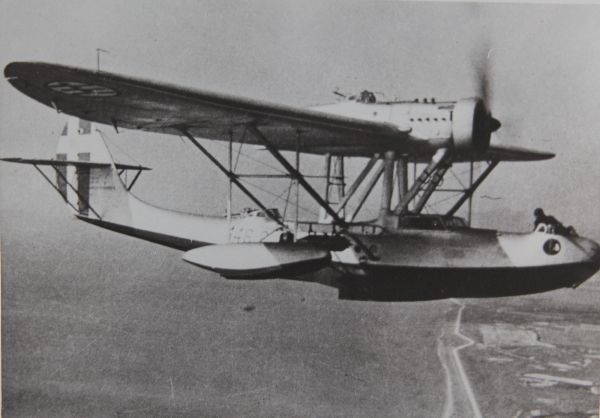
I'm somewhat skeptical about the prospects for Italian carrier aviation in the WWII time frame. To have time to develop the equipment like carriers, aircraft, catapults, doctrine and procedures how to use them etc. etc. they need to start earlier. All the navies that operated significant carrier forces during WWII (RN, USN, IJN) got started in the 1920'ies or even earlier. And then you need several carriers so you can actually afford to use them and to not be without an aviation capability because your carrier is under repair/refit/etc. A carrier as a harbor queen because you don't dare to risk your single precious carrier is an expensive waste of money.
With an extraordinary amount of clairvoyance, and wishing away the navy vs. air force turf wars, sure they might have built a carrier in the 1920s instead of extensively modernizing the Dorias and Cavours, and then when the treaty system breaks down in the mid-1930s rapidly building, say, 4 carriers. Scale down the Vittorio Veneto program to 2 battleships to pay for the carriers?
That being said, by efficiently utilizing land bases in Siciliy, Sardinia, Aegean islands, Rhodes&Greece, they could have covered a fairly large fraction of the Mediterranean, so maybe the added value they would have gotten from carriers is limited in any case? A big question here is the navy vs. air force turf wars, but building a carrier doesn't magically make those disappear either.
I don't think it can be said that it was a lack of effort on the part of the RM inter-war that it didn't have at least one carrier by 1939. Over the last 20 years or so, there has been a series of articles in the annual Warship publication that details the evolution of Italian ambitions with respect to carriers.
Warship 2007 - "Search for a Flattop: The Italian Navy and the Aircraft Carrier 1907-2007" by Enrico Cernuschi & Vincent P O'Hara ("story of internecine battles which bedevilled the development of naval aviation in Italy between the wars.....")
Warship 2015 - "The Bonfiglietti Project: An Aircraft Carrier for the Regia Marina" by Michele Cosentino (then new information about carrier projects 1927 to 1931).
Warship 2020 - "The Quest for an Italian Aircraft Carrier 1922-1939" by Michele Cosentino.
Warship 2021 - "The Italian Aircraft Carrier Aquila" by Michele Cosentino. A detailed account of the rebuilding of the former liner Roma during WW2.
Warship 2026 - "The Italian carrier Falco / Sparviero" by Enrico Cernushi.
By Nov 1918 the Italian naval air branch had grown to 638 aircraft (wheeled, flying boats and floatplanes including both fighters and bombers), 26 airships and 13 blimps. At that point they had one seaplane carrier, but with the main part of their WW1 sea war having been fought in the Adriatic, it is easy to see why.
1919-1921 a number of proposals were made for seaplane and aircraft carriers, but all ran into the problem of money. The navy budget had shrunk to just 80% of its 1913 figure. These included a fast seaplane carrier, a conversion of the salvaged battleship Leonardo da Vinci and a conversion of the uncompleted super-dreadnought Caracciolo. What they did get was seaplane carrier Giuseppe Miraglia, converted from an incomplete hull they were able to pick up cheaply.
1922 Washington Treaty gave Italy 60,000 tons standard displacement for carriers (max 27,000 tons each) led to a revised Caracciolo proposal. Again money was the problem.
Mussolini's rise to power in Oct 1922 brought hope of a revived 9,000 tonne carrier design being ordered in late 1924 but again sacrificed because of budget constraints, as were proposals for it in 1925 and another design in 1926.
Then disaster! On 28th March 1923 legislation was approved merging the Army and Navy air arms into the Regia Aeronautica. It became the Italian Navy's " most vicious and dangerous opponent". After that aircraft procurement was a matter for the RA not the RM (shades of RAF v RN in the 1920s and 1930s).
Another problem to emerge at this time was the lack of building slips in Italian yards of 200m or longer. Only 3 such slips existed and they were occupied through to 1931/32 with building liners and heavy cruisers. So there was no opportunity to build a carrier at a time when the Admirals heading the navy were at best lukewarm to the idea around 1925. But it was still a battleship centric world and would remain so into WW2.
In 1928 a new requirement for a carrier emerged, with the chief designer Bonfiglietti drawing up a design in 1929 for a 15,000 ton ship carrying 42 aircraft on a 210m long between perpendiculars, at up to 29 knots. Double hangar forward for fighters (18 Fiat CR20) and single hangar aft of that (for 12 Fiat BR1 bombers and 12 IMAM Ro 1 recce) design with 3 lifts but no catapult (deemed unnecessary for the types envisaged but was available from the various cruiser designs of the period). Various designs based on this emerged before the project was canned in late 1931. There were three issues around this period - slips, finance and a new naval limitation treaty with France brokered by Britain.
From 1931-34 plans were drawn up for conversion of the liners Conte di Savoia & Rex into "fleet catapult ships" with a capacity of 30 recce flying boats and fighters plus 5 smaller vessels as "escort carrier catapult ships".
Then with the looming Abyssinian Crisis in 1934 the subject of a proper carrier again arose. Conversion proposals of the old dreadnoughts Doria & Dulio were dismissed in a week based on the work of a decade earlier. Two new designs of 22,000 tonne and then 14,000 ton purpose built ships emerged inspired by USS Ranger, with the hope that one could be laid down in 1937 following the launch of the battleship Littorio. With the end of the Abyssinian Crisis in 1936, these plans were dropped along with the aircraft being designed for it (Ca.165 biplane fighter and a version of the Cant Z.1012 as the torpedo bomber).
1935/36 saw a couple of proposals to convert the liners Roma and Augustus with new Fiat 18,000shp diesels for 26 knots during a 12 month refit schedule. Plans dropped as naval staff thought they lacked protection.
In 1935 naval aviation received a small boost when the head of the RA was forced to admit in front of Mussolini, that they couldn't protect the fleet against the RN while it was at sea. This proved short lived however as in 1936 a group of SM 81 level bombers succeeded in turning back a flotilla of Spanish destroyers, allowing the RA to say it could do the job!
In March 1939 the RM tried again to get two 15,000 tonne carriers. But again a financial crisis intervened. At that point it was anticipated that they could possibly be ordered in 1940 for completion in 1943 & 1944.
With the outbreak of WW2 the liner Roma was called home and the 1936 plans for a 12 month conversion dusted down. But the diesels weren't available (in fact they did not become available until 1943) so the project was assigned a lower priority in Oct 1939 and then suspended altogether. At that point the RA ordered a batch of twelve Caproni Vizzola F.5 as carrier fighters. Work was able to begin in late 1940 but ground to a halt again in Feb 1941 when the RA announced it had no aircraft in service or projected that could operate from a carrier. Another redesign finally got approval in July 1941 with the RM envisaging use off the Re.2000 as the aircraft it would carry.
The RA had little interest in supporting the RM. It was mid-1940 before the first SM 79 torpedo bomber unit was formed. It was only after the July 1940 Action off Calabria that the RM succeeded in getting an increase in maritime recce to reduce the number of missed and delayed ship contacts.

 , and even with Italian aero engines on 87 grade fuel it would have been relatively doable. As was seen with the Japanese Ki-46 and the Mosquito, even a true 350-380 mph recon aircraft had a high degree of immunity to interception for the first years of the war - at sea in the Med maybe upto late'43 or early'44? The UK did not have anything at sea that would have much chance of catching one at altitude until the F4U and F6F? Both the Ki-46 and Mosquito proved the long range capability as well.